

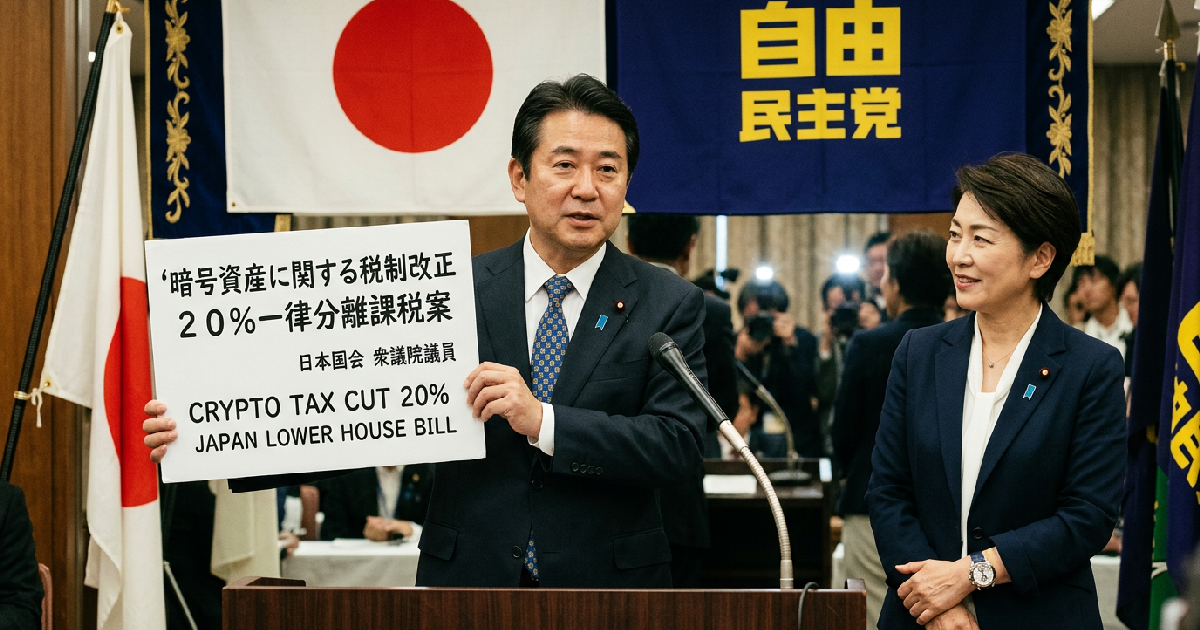
Japan’s Lower House passes bill to slash crypto capital gains tax to 20%
Japan’s Lower House (House of Representatives) passed a bill on Thursday, June 11, 2026, reaching a milestone in national crypocurrency regulation by reclassifying digital assets as financial instruments.
The legislation, supported by the government of Sanae Takaichi, will slash the individual capital gains tax on crypto from a progressive rate that could reach 55% to a flat 20% rate. This structural shift moves crypto oversight from the Payment Services Act to the Financial Instruments and Exchange Act (FIEA).
The reform aims to bring crypto taxation in line with traditional assets like stocks and investment trusts. Finance Minister Satsuki Katayama, whose cabinet approved the measure in April, framed the move as a way to expand the supply of growth capital while ensuring market fairness and investor protection.
Following the lower house vote, the bill now heads to the House of Councillors, where passage is widely expected. The news follows a period of market volatility where Bitcoin price drops led to significant contract liquidations earlier this year.
By treating digital assets as legitimate financial instruments, the Japanese government is looking to modernize its financial sector. Masato Yoshizawa, an official at the Policy and Markets Bureau of the Financial Services Agency (FSA), stated the overhaul aims to foster innovation by creating a sound trading environment.
This regulatory clarity is expected to simplify reporting for retail traders and potentially unlock fresh capital from the broader Japanese population.
Impact of the 20 percent flat tax on crypto market stability
The transition to a 20% tax rate addresses long-standing complaints from the Japan Crypto Asset Business Association (JCBA), which originally submitted reform requests in 2024. Under previous rules, crypto profits were treated as miscellaneous income, often leading to punishing tax bills for high earners.
The new flat rate mirrors the treatment of traditional securities, providing a more predictable framework for both individual investors and institutional players entering the space.
The legislative landscape has been shifting rapidly throughout the year. A law that became effective on March 31, 2026, had already set the groundwork by cutting crypto taxes to a flat 20.315% and allowing investors to carry forward crypto losses for three years.
This earlier provision specifically applies to crypto income over JPY 200,000 for assets listed on Japanese exchanges. The current bill reinforces this direction by officially shifting the regulatory code to the FIEA.
Industry leaders have welcomed the move toward transparency. Koichi Kano, the Japan head at Singapore-based crypto market maker QCP Group, noted that while zero tax would be the ideal for many, providing clear rules is a major step forward. This environment of increased clarity may encourage long-term holding patterns, similar to how
com/crypto-news/ethereum-whales-accumulate-17-41-million-eth-22-03-of-total/\”>Ethereum whales accumulate
Stricter oversight and new insider trading rules for digital assets
Along with the tax cuts, the bill introduces rigorous new standards for market integrity. For the first time, formal insider trading rules will be applied to the cryptocurrency sector in Japan. This change is part of a broader push by the Financial Services Agency (FSA) to ensure market fairness and transparency as digital assets become integrated into the mainstream financial system.
The FSA is also preparing expanded disclosure requirements for the 105 tokens currently approved for domestic trading in Japan. These rules will require issuers and exchanges to provide more detailed information to the public, aiming for healthy market growth. This level of scrutiny aligns with how other financial sectors are evolving; for instance,
com/international-news/ubs-khan-china-business-ai-impact-analysis-2026/\”>UBS Asia President Iqbal Khan
Corporate tax exemptions and the path to implementation
The reform package also includes vital changes for the corporate sector to prevent “brain drain” of blockchain talent. Japan’s Cabinet previously approved a tax reform outline on December 22, 2023, which exempts companies holding crypto assets issued by third parties from mark-to-market valuation taxes.
This means businesses are only taxed when they actually sell assets for profit, rather than being taxed on paper gains at the end of every fiscal year.
Prime Minister Fumio Kishida’s administration has consistently signaled its intent to use Web3 technology as a pillar of Japanese economic growth. By removing the tax on unrealized gains, the government hopes to encourage startups to keep their treasuries and operations within Japan.
Advocates believe these combined reforms will make Tokyo a more competitive hub compared to other Asian financial centers that have already established clear digital asset frameworks.
As the bill moves to the Upper House, the focus shifts to how quickly domestic exchanges can adapt to the expanded disclosure and FIEA compliance standards. Market participants expect the new tax system to simplify the compliance burden significantly, potentially leading to a surge in domestic trading volume.
For individual investors, the ability to carry forward losses from the March 31 law combined with the 20% flat rate represents the most favorable environment for Japanese crypto trading in over a decade.