

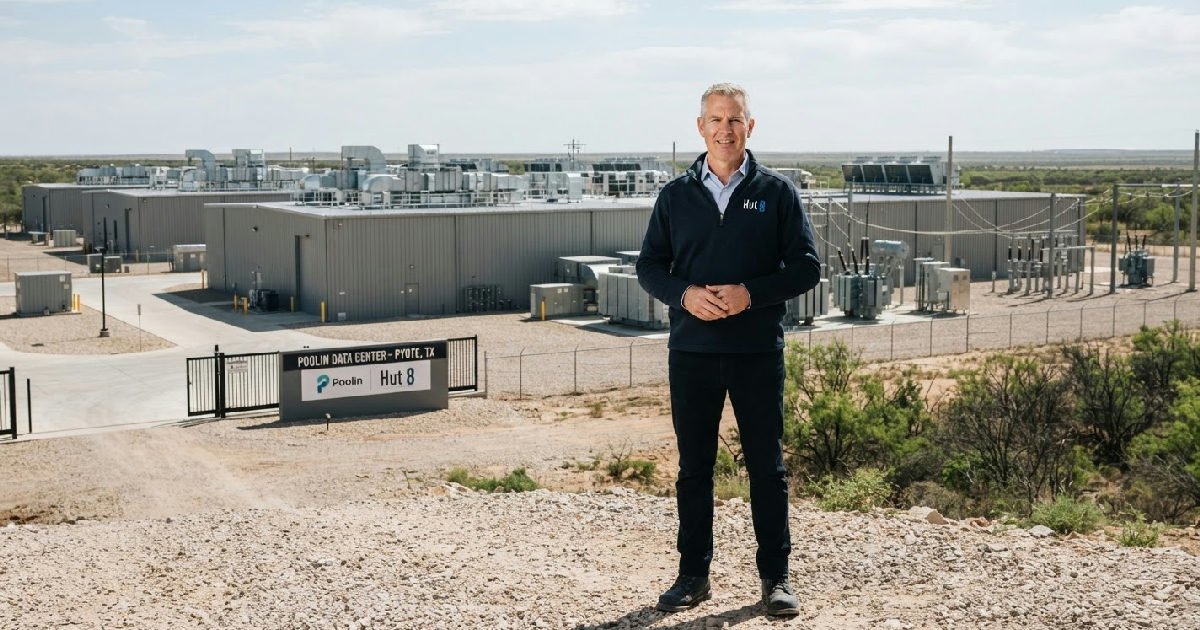
Hut 8 Wins $140M Bid for Poolin’s Texas Data Centers
Hut 8 has emerged as the winning bidder for two of bankrupt crypto mining firm Poolin’s data centers in Texas, submitting a $140 million offer in a fiercely contested auction. The move, disclosed in a court filing on September 20, 2023, signals an aggressive expansion of Hut 8’s footprint beyond Bitcoin mining and deeper into the lucrative artificial intelligence infrastructure market.
The successful bid covers Poolin’s facilities in Pyote and Tarbush, Texas. However, the transaction is not yet final. It remains subject to approval by the U.S. Bankruptcy Court for the District of New Jersey, with a critical sale hearing scheduled for September 29, 2023.
A fiercely competitive auction signals a market shift
The final $140 million price tag dramatically overshadows the initial $52 million stalking-horse bid that set the floor for the auction. That initial offer was placed by Thor CALAP, which had proposed $15 million for the Pyote site and $37 million for the Tarbush location.
The intense competition that followed highlights the soaring value placed on data center assets with secured power access. This dynamic is also reflected in wider cryptocurrency and financial markets, where new digital asset alliances are emerging.
Competition came from both the crypto and AI sectors. Other bidders included DigiPower X and Pecos Industrial Development, the latter acting as a designee for the AI infrastructure company Fluidstack. This diverse interest underscores a significant market trend: the underlying value of these sites is increasingly seen in their potential for high-performance computing (HPC) and AI, not just their capacity for hashing Bitcoin.
The backup bids further illustrate this point. Pecos Industrial Development, representing Fluidstack, submitted a backup offer of $100.5 million for the Tarbush site alone, while DigiPower X placed a $36.5 million backup bid for Pyote. The fact that an AI-focused entity was prepared to bid over $100 million for a single site demonstrates where the market’s momentum is heading.
Hut 8’s strategic pivot from bitcoin mining to AI
For Hut 8, this acquisition is a calculated move in its ongoing strategic pivot. The company has been actively diversifying its operations, moving from a pure-play Bitcoin miner to a broader digital infrastructure provider. In today’s market, access to large-scale power has become one of the most valuable and constrained resources, a critical component for training and running power-hungry AI models.
The acquisition of the Poolin sites provides Hut 8 with immediate access to established power infrastructure, accelerating its expansion plans in a key geographical market. The company already controls approximately 1.5 gigawatts of power capacity in Texas across sites that are either operational or under development. This deal significantly adds to that portfolio.
It solidifies Hut 8’s position as a major player in the state’s booming data center landscape.
The financial logic behind this pivot is compelling. Industry estimates suggest that hosting AI-related workloads can generate around $1.5 million in annual profit per megawatt. This is a substantial increase compared to the estimated $0.5 million per megawatt for Bitcoin mining. Such figures provide a clear incentive for miners to repurpose or develop their sites for AI clients.
Hut 8’s Q2 2023 development pipeline further demonstrates this scale, encompassing approximately 8.7 gigawatts. This marked an increase of about 300 megawatts quarter-over-quarter. Its contracted IT capacity for Q2 2023 reached 949 MW. This capacity was valued at an estimated $26.6 billion in base-term contracts.
While the upfront cost is significant, converting a Bitcoin mining site to AI-grade infrastructure can cost roughly $8 million to $15 million per megawatt. By acquiring existing facilities, Hut 8 gains a considerable head start on development timelines. It also capitalizes on infrastructure already in place.
This strategy leverages the increasing value of grid access and broader compute potential, aligning with wider trends in AI infrastructure development.
The collapse of Poolin and its financial aftermath
The sale of these assets is a pivotal moment in the bankruptcy proceedings of Poolin, once a major force in the crypto mining world. The company and its two U.S. affiliates, Lonestar Dream Inc. and Lonestar Taproot LLC, filed for Chapter 11 bankruptcy protection in July 2023. This followed the cessation of their Texas mining and hosting operations earlier that month.
Court filings reveal the extent of Poolin’s financial troubles, listing approximately $173.1 million in total debts. The vast majority of this, around $163.7 million, consists of unsecured liabilities. These debts are primarily tied to unsecured promissory notes—effectively IOUs—owed to users of the Poolin Wallet, who saw their withdrawals frozen in 2022 amid the wider crypto market downturn.
The unexpectedly high sale price of $140 million is therefore welcome news for Poolin’s creditors. The proceeds from the auction will be crucial in repaying the thousands of users and other parties left with significant losses following the company’s collapse.
Poolin’s management had explicitly stated that their sale strategy aimed to leverage the rising demand from AI and HPC sectors to maximize the value of their assets for creditors.
Texas becomes a hotbed for data center development and scrutiny
The state of Texas has become a global hub for data centers, thanks in large part to its deregulated energy market and what was once a permissive regulatory environment. The demand for power is staggering, with the Electric Reliability Council of Texas (ERCOT) reporting over 438 gigawatts of connection requests in its queue. Nearly 89% of those requests are from data centers.
This explosive growth has not gone unnoticed and is now attracting significant scrutiny. On September 21, 2023, Texas Governor Greg Abbott directed state environmental and grid authorities to temporarily halt the issuance of new data center permits. The pause is intended to allow for a comprehensive audit of the industry’s impact on the state’s power grid, water resources, and local communities.
This regulatory shift creates a more complex operating environment for developers. However, Hut 8 appears to have anticipated such concerns. On August 10, 2023, the company issued a statement welcoming state scrutiny focused on grid reliability, local resources, and community impacts.
What the $140 million price tag really signifies
Ultimately, the $140 million valuation is not just about the physical buildings and land. It’s a clear indicator of the immense value now placed on grid-connected power capacity. In the age of AI, a large-scale power agreement can be a more valuable asset than the computing hardware it supports. This acquisition is a strategic purchase of energy access.
This deal serves as a bellwether for the entire digital asset mining industry. Companies that have successfully navigated the complex process of securing large power purchase agreements and interconnection rights are no longer just crypto miners; they are valuable digital infrastructure providers. They have become prime acquisition targets for the capital-rich AI sector, which is desperately seeking ready-to-use capacity.
The line between Bitcoin mining and general-purpose high-performance computing is blurring rapidly. Hut 8’s successful bid for Poolin’s assets is one of the most definitive examples of this convergence. It demonstrates a clear-eyed strategy to pivot toward a future where the ultimate commodity is not a specific cryptocurrency, but raw, scalable compute power.