

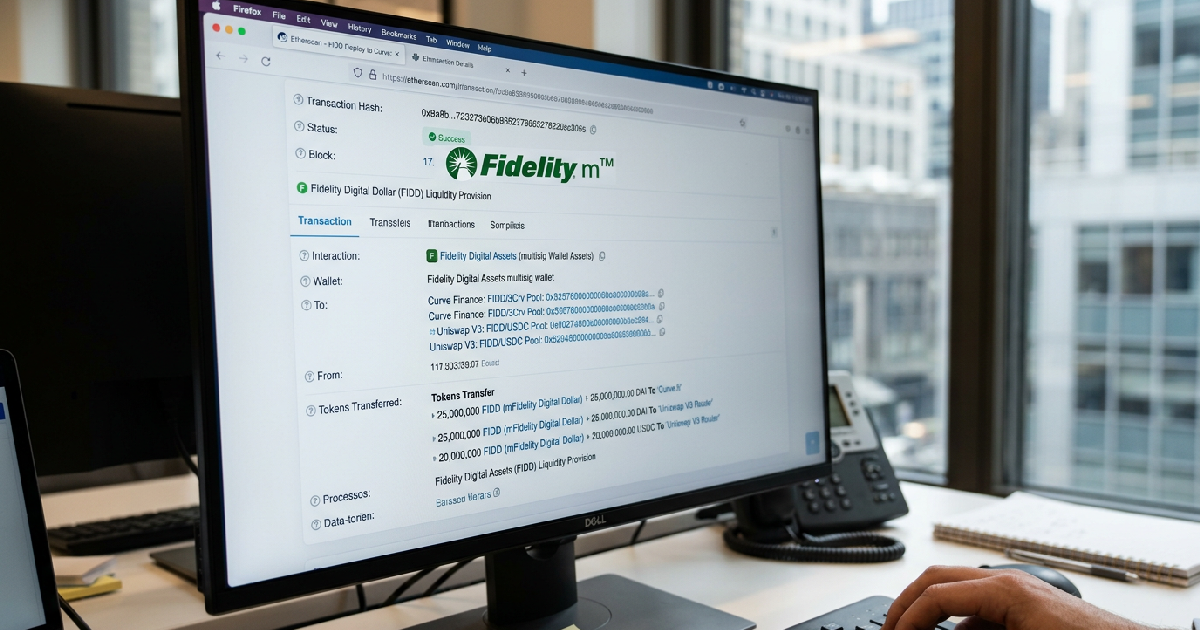
Digital Assets firm launches stablecoin liquidity on Curve and Uniswap
Fidelity Digital Assets, National Association (FDA, NA) established a primary liquidity layer for its Fidelity Digital Dollar (FIDD) stablecoin on Thursday evening, June 11, 2026. The firm deployed Curve Finance Stableswap and Uniswap LP positions simultaneously within a single Ethereum block. This move represents the first time the Fidelity Investments subsidiary has utilised permissionless decentralized finance (DeFi) infrastructure to support its dollar-pegged asset.
The coordinated deployment was first identified by on-chain watcher LytninCrypto. Michael Egorov, the founder of Curve Finance, responded to the discovery within minutes on X, praising the “same block” execution as evidence of Fidelity’s operational expertise in the DeFi sector.
By bundling the liquidity additions into a single block, the firm likely used a scripted multi-call contract to ensure price consistency across both protocols from the moment of launch.
Fidelity Digital Assets has built steady momentum in the blockchain space since it began researching digital assets in 2014. The firm currently operates a spot Bitcoin ETF and a spot Ethereum ETF, while also filing to tokenize an on-chain Treasury fund. The move to active DeFi liquidity indicates that institutional players are increasingly targeting on-chain settlement and retail payments through regulated instruments.
Regulatory clarity provided by the GENIUS Act
The adoption of permissionless rails for FIDD follows the passage of the GENIUS Act last year. This legislation created a federal compliance path for stablecoin issuers, specifically addressing reserve management and regulatory guardrails. Mike O’Reilly, President of Fidelity Digital Assets, noted that the Act was a significant milestone that provided the industry with the clarity needed to bring such products to market.
Following the signing of the GENIUS Act, the broader stablecoin supply grew by $18 billion in just one month. Fidelity’s FIDD is an ERC-20 token backed 1:1 by cash and short-term US Treasuries. The firm publishes monthly reserve reports to maintain transparency for its customers.
These regulated tokens provide a stable alternative for users, particularly during volatile periods where major crypto assets see sharp price drops and liquidations.
Market capitalization and circulating supply metrics
As of June 12, 2026, the Fidelity Digital Dollar is establishing its footprint within a total stablecoin market that exceeded $316 billion earlier this year. On-chain data reported on June 11 showed a circulating supply of roughly 62.6 million tokens. However, market capitalization estimates vary, with some figures placing the valuation at approximately $40 million as of the current week.
Despite being in the early stages of adoption, trading activity is already visible on decentralized protocols. Total 24-hour trading volumes in the Uniswap V3 FIDD pools have reached into the hundreds of thousands of dollars. The token is designed to serve as a versatile tool for 24/7 institutional settlement while remaining accessible to other market participants through various channels.
- Institutional clients can buy or sell FIDD for $1 via the Fidelity Digital Assets platform.
- Retail customers can access the stablecoin through Fidelity Crypto.
- Advisors can manage FIDD for clients via Fidelity Crypto for Wealth Managers.
Infrastructure choice and the role of Curve Finance
The selection of Curve Finance and Uniswap gives FIDD exposure to the two deepest permissionless liquidity layers on the Ethereum blockchain. Curve is a dominant force in stablecoin trading, having processed $34.6 billion in volume during the first quarter of 2026. This infrastructure allows large-scale capital moves with minimal slippage, a critical factor for institutional participants.
Fidelity Digital Assets, NA, which began client services in 2019, is leveraging its status as a federally chartered subsidiary to differentiate itself. The parent company, Fidelity Investments, manages $17.5 trillion in assets under administration as of late 2025. By integrating with DeFi, the firm brings institutional-grade compliance to protocols that were once considered the sole domain of crypto-native users.
Using sophisticated transaction methods to prevent price gaps between platforms suggests a high level of “on-chain hygiene.” While most traditional firms have historically avoided public blockchains due to perceived risks, the current trajectory suggests a shift toward active participation. The successful deployment on Thursday signals that Fidelity is ready to use public infrastructure for its evolving digital asset platform.