

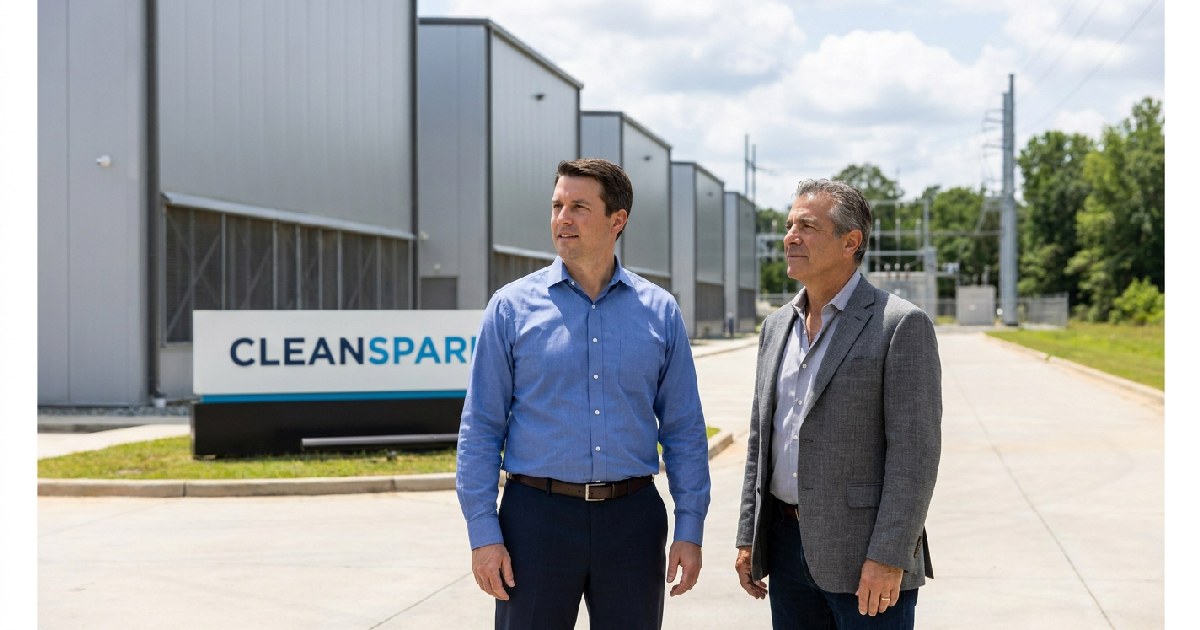
CleanSpark seals $6.6 billion data center lease, pivots to AI compute
CleanSpark, the Nasdaq-listed bitcoin miner, has officially announced a significant 20-year infrastructure lease agreement with an unnamed “high-investment-grade global technology company.” This strategic deal, confirmed on July 14, 2026, sees the firm pivot substantially towards high-performance computing (HPC) and artificial intelligence (AI) data center services, moving beyond its traditional bitcoin mining operations.
The agreement, centered at CleanSpark’s Sandersville, Georgia campus, is projected to generate an initial $6.6 billion in contracted revenue over its two-decade term. CEO and Chairman Matt Schultz called it a “transformational moment,” emphasizing the company’s evolution into a diversified digital infrastructure platform and its new approach to monetizing its extensive power assets.
CleanSpark’s major shift to AI infrastructure
This long-term infrastructure lease specifically covers data center capacity capable of supporting 175 megawatts (MW) of critical IT load. CleanSpark expects an average annual net operating income (NOI) of approximately $330 million from this agreement, with CFO and President Gary Vecchiarelli stating that direct costs will be minimal, pushing NOI margins close to 100%.
The lease is structured as a triple-net agreement, requiring the tenant to cover operating expenses like taxes, insurance, and maintenance. This arrangement bolsters CleanSpark’s financial stability, as it repurposes parts of its existing electricity and mining infrastructure to power advanced AI data centers.
There’s potential for even greater returns, with total contracted revenue possibly reaching $11.6 billion if the tenant exercises both available five-year extension options. First deliveries are slated for the fourth quarter of 2027, with the remaining data halls expected to be completed in the first quarter of 2028.
Expanding compute capacity in Texas
CleanSpark’s ambitions in the high-performance computing space extend beyond Georgia. The company has also secured a letter of intent and an exclusivity arrangement with the same technology giant for its entire Texas portfolio.
This includes the Sealy and Brazoria campuses, which together boast up to 885 MW of secured and planned power capacity across 718 acres. The Sealy campus alone spans 271 acres with nearly 300 MW, while Brazoria, at 447 acres, can support an initial 300 MW demand load and potentially expand to 600 MW.
Converting these Texas discussions into firm contracts would solidify CleanSpark’s role as a major infrastructure landlord for artificial intelligence and cloud workloads. It reflects a growing demand for specialized data center space, particularly for power-intensive AI applications, moving the company away from the sole dependency on bitcoin mining.
Robust bitcoin mining operations persist
Despite this significant pivot, CleanSpark’s core bitcoin mining operations continue to demonstrate strong performance. In early July, the company produced 614 bitcoin and successfully increased its operational hashrate to a company-high of 50 exahashes per second (EH/s).
The firm also maintains a substantial treasury of 13,924 bitcoin, positioning it among the larger corporate stashes held by public miners. Management has opted to hold much of its mined bitcoin, signaling a long-term bullish outlook on the digital asset’s price and the future of decentralized finance.
Wall Street’s reaction and future outlook
Wall Street’s initial reaction to the compute pivot has been notable. CleanSpark’s stock (CLSK) saw a 15% increase in pre-market trading following the news, then jumped 12% to $13.85 in Tuesday morning trading. The company also faces a significant 33% short interest in its stock.
Analysts have generally reacted positively to the strategic shift. Citizens initiated coverage with an “Outperform” rating and a $27 price target, specifically citing the company’s move toward hyperscale compute capacity. Chardan also lifted its price target to $19 from $16, maintaining a “Buy” rating.
Diversification hedging against crypto volatility
The Georgia lease offers CleanSpark a crucial hedge against the inherent volatility of bitcoin prices and network difficulty fluctuations that often impact mining margins. Contracted rent from a creditworthy tenant provides a stable, predictable revenue stream, distinct from the ups and downs of the crypto market.
This financial stability allows CleanSpark to keep its mining fleet operational and its bitcoin treasury intact, pursuing a dual-pronged strategy for growth. The next crucial steps for the company involve the successful execution of the Sandersville project, bringing the 175 MW online before the close of 2027, and converting the Texas letter of intent into definitive signed leases.
The evolving role of bitcoin miners
CleanSpark’s strategic maneuver isn’t an isolated event; it reflects a broader trend among large-scale bitcoin miners to leverage their energy infrastructure for other compute-intensive tasks, especially with the surging demand for AI processing. Miners possess unique advantages, including access to vast power capacities and the expertise to manage significant data center operations.
Zach Bradford, CleanSpark’s CEO and President, previously commented on the company’s hashrate achievements, noting that building and operating their own infrastructure from the ground up provides the control, resilience, and scalability needed for industry leadership. This pivot could serve as a blueprint for other crypto-native firms seeking to diversify and capitalize on emerging technological demands in an increasingly AI-driven global economy.