

Senate Banking Committee advances CLARITY Act as Bitcoin sentiment peaks
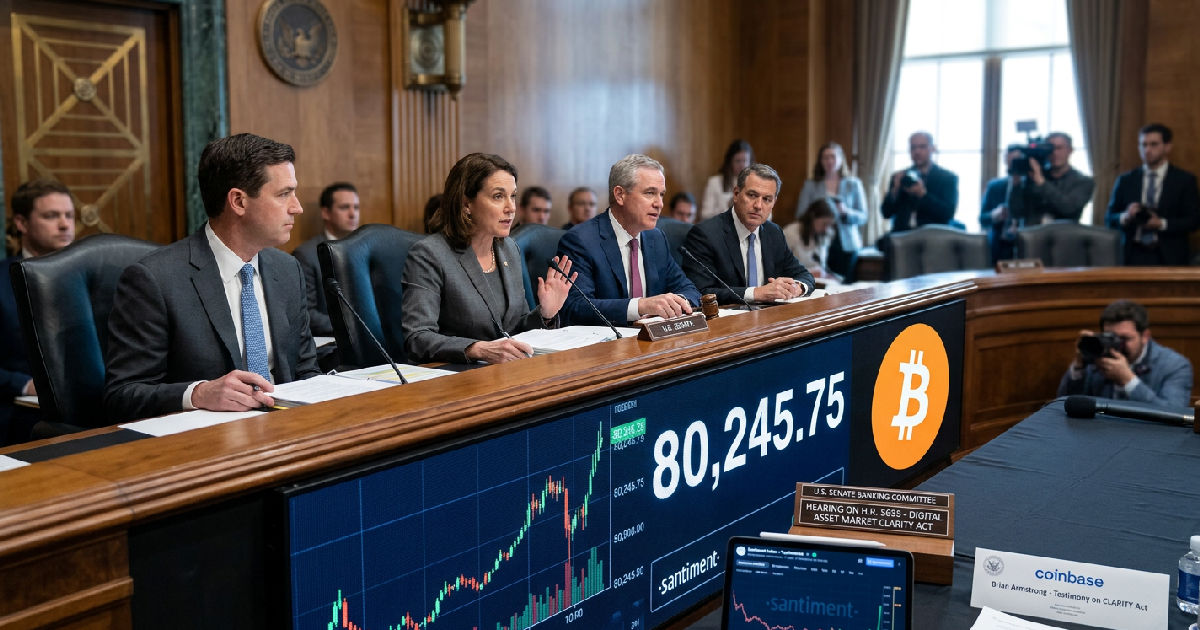
The U.S. Senate Banking Committee advanced the CLARITY Act on May 14, 2026, triggering a surge in social media euphoria that pushed Bitcoin sentiment to one of its “greediest” points of the year. The Digital Asset Market Clarity Act of 2025, formally known as H.R. 3633, cleared the committee with a 15-9 bipartisan vote, marking a significant milestone in the multi-year effort to establish regulatory certainty for the American cryptocurrency industry. Following the vote, Bitcoin rapidly climbed above $82,000 before settling near $81,500, a move that analytics platform Santiment identified as a potential signal for short-term market caution.
The legislative breakthrough saw all 13 Republican members of the committee join forces with two Democrats, Senator Ruben Gallego and Senator Angela Alsobrooks, to push the bill forward. Conversely, nine Democrats voted against the measure. This progress follows the bill’s successful passage through the House of Representatives in July 2025, where it garnered a 294 to 134 vote. The CLARITY Act aims to bridge the gap for approximately 50 million Americans who hold digital assets by providing a clearer framework, moving away from the “regulatory gray zone” that has defined the sector for years.
Market data reflected immediate optimism across the board. On the day of the vote, Coinbase shares jumped roughly 9%, while Strategy and Robinhood saw gains of 8% and 6% respectively. While some analysts worry about a cooling period, current crypto price forecasts suggest that institutional demand continues to underpin the broader rally. Bitcoin’s price of $79,084 on May 16 represents a 3.15% increase since the start of the month, even as altcoins like XRP and Dogecoin joined the fray with 5% surges of their own.
Santiment monitors social sentiment spike and greed levels
According to data released by Santiment on May 15 and 16, the social media landscape reached a boiling point of bullishness. The platform recorded a ratio of 1.55 bullish comments for every one bearish mention across X, Reddit, and Telegram. While this high level of “euphoria” often accompanies price rallies, contrarian analysts view such lopsided sentiment as a warning sign. Historically, when the crowd becomes this overwhelmingly positive, the market frequently undergoes a localized correction or a period of consolidation.
Despite the “greed” flagged by data providers, the underlying cause for the excitement remains grounded in tangible legislative progress. Prediction market Polymarket saw the odds of the CLARITY Act being signed into law in 2026 jump to 68% by May 17, a sharp rise from the 46% chance estimated at the beginning of the month. Other analysts, including those at Thorn, have placed the odds as high as 75%, suggesting that the industry is finally nearing the end of its long-standing battle with regulatory ambiguity.
Brian Armstrong and Cynthia Lummis on the compromise bill
Coinbase CEO Brian Armstrong praised the advancement of the bill, describing the current version as a “true compromise” between the crypto sector and traditional banking interests. Armstrong noted that both sides made concessions to reach this stage, specifically addressing the “asks of the bank lobby.” He highlighted that under the current draft, rewards on stablecoins would only apply when there is “some sort of material activity on the account,” a provision designed to satisfy concerns from legacy financial institutions.
The banking lobby has not been a silent observer in this process, reportedly spending $56 million on financial lobbying throughout 2025. In the six weeks leading up to the markup session, the lobby sent more than 80,000 letters to the Senate. While the industry faces ongoing volatility that can lead to liquidation events for overleveraged traders, the bipartisan support for H.R. 3633 suggests a shift in how Washington views the asset class.
Senator Cynthia Lummis, who leads the Senate Banking Committee’s digital assets panel, called the CLARITY Act “the hardest piece of legislation” she has worked on in her career. Lummis described the bill as a “case of first impression,” acknowledging the difficulty in drafting rules for a brand-new asset class. Senator Tim Scott, Chair of the Senate Banking Committee, supported this view, stating the bill would protect consumers while keeping American innovation within domestic borders rather than driving it overseas.
Future outlook for Bitcoin and the CLARITY Act
Looking ahead, the focus shifts to the full Senate floor. The bill’s supporters believe it will close doors that “hostile regimes” have exploited while providing a safe harbor for legitimate firms. Some investors are drawing parallels to previous cycles where regulatory news preceded massive inflows, often as MicroStrategy accelerates its accumulation of the premier digital asset. If the CLARITY Act reaches the President’s desk, it would represent the most significant piece of digital asset legislation in U.S. history.
For now, the market is navigating the “sell the news” risk that often follows these legal milestones. While the 1.55 sentiment ratio suggests the crowd may be too bullish for a continued straight-line move up, the 15-9 vote in the Senate Banking Committee provides a fundamental floor for long-term confidence. The coming weeks will determine if the euphoria translates into a sustained break past the $82,000 resistance or if a healthy pullback is required to wash out the late-coming speculative interest.