

bitcoin primed for gains across all economic scenarios
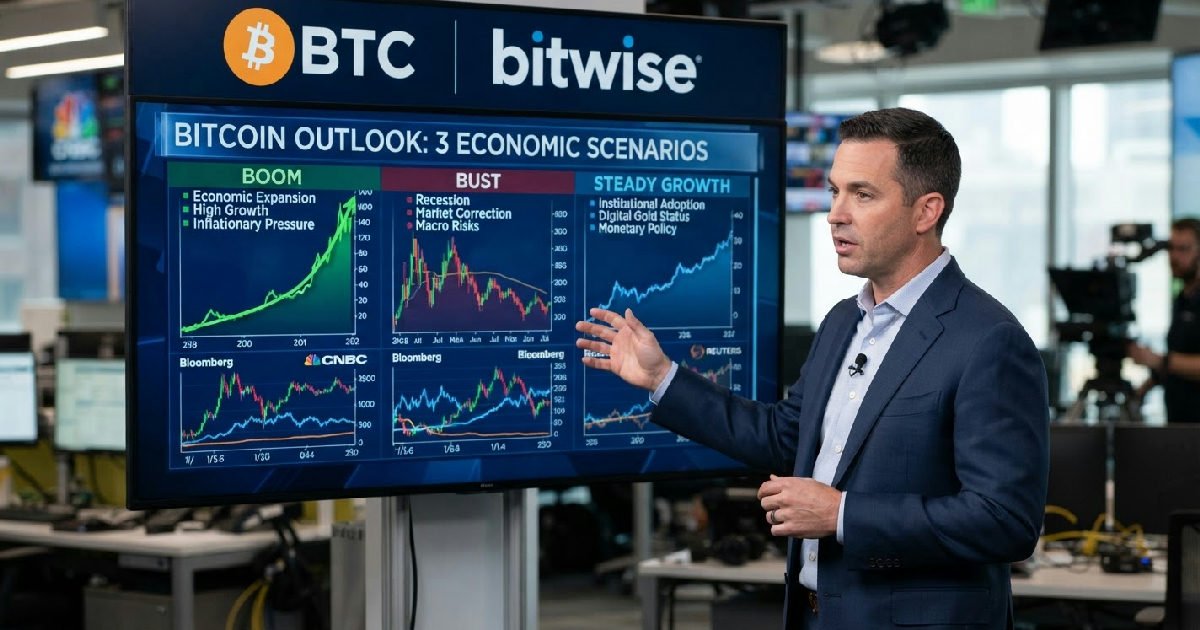
Bitcoin economic scenarios indicate success across all macroeconomic environments, according to Bitwise CIO Matt Hougan on May 9, 2024, regardless of boom, bust, or steady growth. His analysis, widely reported by financial news outlets, suggests the cryptocurrency’s long-term growth prospects remain favorable, especially when considering various Bitcoin economic scenarios.
Hougan’s assertions came amid mounting global macroeconomic uncertainty, including persistent inflation concerns and the unpredictable impact of artificial intelligence. He presented a compelling case for Bitcoin as an asset that can not only withstand but also thrive under three distinct economic paths: a soft landing, a no landing, and a hard landing.
Bitcoin economic scenarios and resilience
Hougan outlined his conviction during a period marked by fluctuating market sentiments and ahead of critical U.S. Consumer Price Index (CPI) data releases. He explicitly stated, “Bitcoin wins in all three scenarios,” emphasizing the asset’s adaptability to varying financial climates.
He further elaborated on this robust outlook, asserting, “If we get a soft landing, Bitcoin wins because institutions are still under-allocated. If we get a no landing, Bitcoin wins because it’s digital gold. If we get a hard landing, Bitcoin wins because the Fed will print money.” This encapsulates his broad confidence in Bitcoin’s future.
Soft landing: institutional adoption propels growth
In a “soft landing” scenario, where inflation gradually cools and the economy avoids a recession, Bitcoin is poised to benefit significantly from increased institutional adoption. Hougan highlighted that institutions are still “under-allocated” to Bitcoin, with only 10% of financial advisors currently recommending the cryptocurrency.
He predicts this percentage will surge to 80% over the next five years. This anticipated influx of traditional investment capital would drive substantial demand, pushing Bitcoin’s price higher as more mainstream financial vehicles integrate digital assets.
No landing: Bitcoin as digital gold amidst inflation
Should the economy experience a “no landing” — characterized by persistent inflation and robust growth — Bitcoin is expected to serve as a crucial hedge. Here, its role mirrors that of gold, leveraging its fixed supply to protect purchasing power against currency devaluation.
This “digital gold” narrative gains traction when traditional fiat currencies lose value due to inflationary pressures. Investors would increasingly turn to scarce assets, enhancing Bitcoin’s appeal and value.
Hard landing: Fed easing sparks a rally
Conversely, a “hard landing” scenario, involving a recession and cooling inflation, also presents a bullish case for Bitcoin. In such an event, central banks, particularly the Federal Reserve, would likely implement aggressive interest rate cuts and quantitative easing measures.
This expansion of the money supply, aimed at stimulating the economy, historically benefits assets with limited supply. Hougan suggested that this environment is precisely “what Bitcoin was built for,” enabling it to rally hard as liquidity increases.
Institutional flows drive long-term adoption
The emergence of US spot Bitcoin exchange-traded funds (ETFs) has been a pivotal development, making institutional participation in the Bitcoin market a central component of Hougan’s positive outlook. These products offer traditional investors simplified access to Bitcoin without the complexities of direct asset management.
Bitwise, a key player in this space, launched its own Bitcoin ETF, BITB, on January 10, 2024. This passively managed fund tracks spot Bitcoin prices and quickly surpassed $1 billion in assets under management (AUM) within five weeks, marking it as one of the fastest-growing ETPs in history. Such rapid growth underscores the appetite for accessible crypto investment vehicles.
Beyond ETFs, corporate treasury strategies continue to evolve, with more companies exploring Bitcoin as a reserve asset. Moreover, the possibility of sovereign adoption of cryptocurrency could further influence Bitcoin’s long-term trajectory, adding another layer of institutional demand.
It’s worth noting that Bitwise Asset Management manages $9 billion in client assets across a diverse suite of over 70 investment products. The firm has committed to donating 10% of BITB’s profits for at least a decade to non-profit organizations supporting Bitcoin open-source development, including Brink and OpenSats.
AI’s dual impact on digital assets
Hougan also considered the transformative impact of artificial intelligence on the economy, proposing that Bitcoin stands to gain whether AI leads to unprecedented productivity or an market downturn. In a scenario of “AI superabundance,” where intelligence becomes widely accessible and inexpensive, he argues investors will increasingly value scarce assets.
This scarcity principle would position Bitcoin alongside traditional safe havens like gold. He likened an AI market crash to the 2008 financial crisis, envisioning government intervention and bailouts due to AI’s geopolitical importance, which would ultimately lead to a surge in money supply and a Bitcoin rally.
Monetary policy and market dynamics
The Federal Reserve’s actions on interest rates remain a critical factor, but Hougan maintains Bitcoin’s potential for appreciation is resilient. He noted that if the Fed aggressively hikes rates, triggering a recession, government support measures would again buoy Bitcoin’s price.
Conversely, if policymakers hesitate to raise rates, and inflation remains high, investors would likely seek out Bitcoin as a haven asset. This perspective was offered in May 2024, ahead of the April 2024 CPI data release, highlighting the ongoing focus on central bank decisions.
More recently, fresh inflation data has amplified concerns about further monetary tightening. September’s CPI rose 3.7% year-over-year, while core inflation gained 0.3% monthly. Both readings exceeded expectations, leading traders to increase the likelihood of a 0.25-percentage-point rate hike on October 28 to 41.5%, up from about 22% the previous day. This dynamic backdrop underscores the complex environment in which Bitcoin operates.
Crypto market shows signs of bullish resurgence
Beyond theoretical economic scenarios, Hougan has more recently pointed to tangible evidence of a bullish recovery in the broader crypto market. He highlighted the third quarter’s substantial market gains and surging network data as indicators of a new growth cycle unfolding, shaking off the “winter chill.”
Bitwise’s large-cap crypto index recorded an impressive 46.4% gain for Q3. Simultaneously, US spot Bitcoin ETFs saw $6 billion in net inflows, effectively reversing prior outflows and restoring positive year-to-date performance for these products. Bitcoin ETF outflows had previously been a concern, but these new inflows suggest renewed investor confidence.
However, opinions among crypto analysts remain divided on whether the bear market has truly ended. While CryptoQuant declared a new Bitcoin bull run in September based on technical and on-chain data, Bitget’s Ryan Lee advises caution, suggesting more proof is needed for a definitive cycle bottom. Still, Hougan finds the booming ETF flows and active networks compelling evidence of recovery.
Historically, Bitcoin was conceived in 2009 amidst the Global Financial Crisis, often seen as a direct response to failures in traditional financial institutions and discretionary monetary policy. This origin story underpins much of the argument for its resilience during economic upheaval. Its design as a decentralized, finite asset continues to appeal to those seeking alternatives to conventional finance during times of instability.
The broader vision for Bitcoin’s future
Ultimately, Matt Hougan’s analysis paints a consistent picture: every potential economic trajectory points toward higher Bitcoin prices in the long term. This isn’t merely based on speculative fervor but on fundamental shifts in investor behavior and monetary policy reactions.
Whether it’s the institutional hunger for crypto assets, the inherent scarcity countering inflation, or the response to economic contractions, Bitcoin appears to have a role. This perspective provides a robust framework for understanding the asset’s enduring appeal as it continues to mature within the global financial landscape.
Hougan’s career, marked by leadership at ETF.com and contributions to crypto literature, gives significant weight to his pronouncements in this evolving sector.
His insights also resonate with the broader trend of increased interest from traditional finance into digital assets, exemplified by the rapid growth of spot Bitcoin ETFs. This integration suggests that Bitcoin is moving beyond a niche investment, solidifying its position as a significant asset class in mainstream portfolios, even amidst discussions around Bitcoin volatility paradox.