

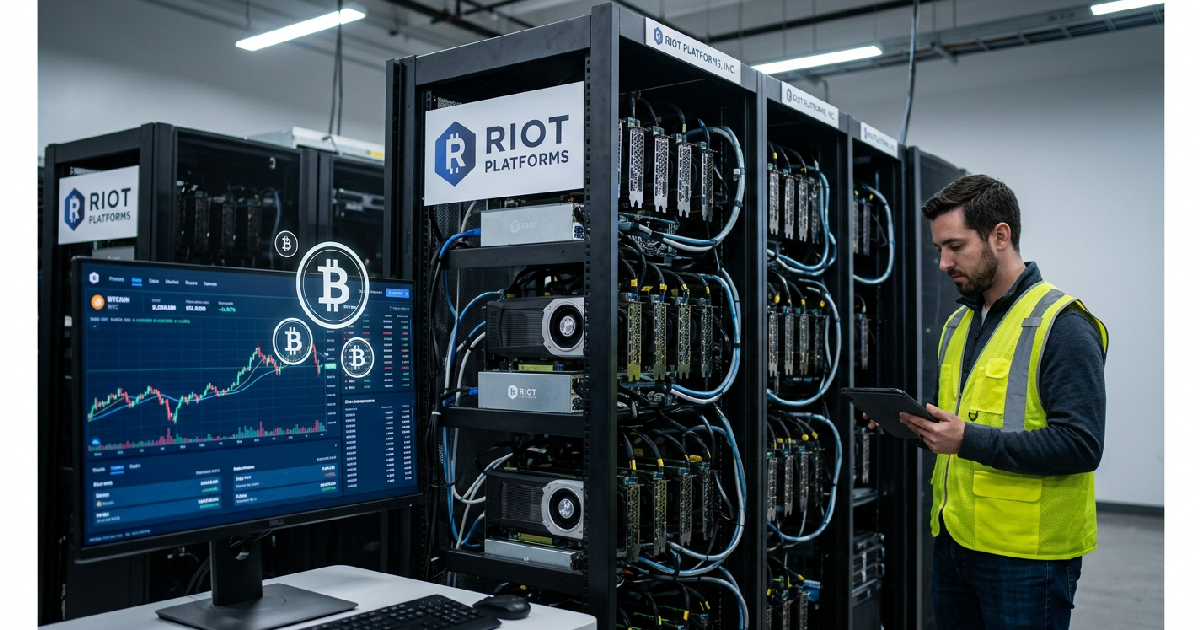
Reported Riot 500 BTC transfer highlights AI funding pressure on Bitcoin miners
Bitcoin Miners’ AI Funding Pressure is at the centre of this story. Reports of a 500 Bitcoin (BTC) custody transfer involving Riot Platforms, Inc. (NASDAQ: RIOT) have surfaced, drawing attention to the mounting financial pressures on Bitcoin miners. These reports, emerging on July 4, 2026, suggest a strategic realignment by the digital infrastructure company, likely driven by the surging capital demands of the artificial intelligence (AI) sector.
This development underscores a broader trend within the crypto mining industry. Firms are increasingly evaluating how to best leverage their existing energy and data center capabilities beyond just Bitcoin operations, seeking to diversify revenue streams into more computationally intensive fields like AI.
Bitcoin Miners’ AI Funding Pressure: Bitcoin miners face evolving capital challenges
Traditionally, the Bitcoin mining industry has focused almost exclusively on validating transactions and securing block rewards. However, that landscape is rapidly changing. Miners now find themselves competing fiercely for capital, not only for essential mining rig upgrades but also to pivot into burgeoning sectors such as AI.
This strategic shift is becoming less of an option and more of a necessity for many. Bitcoin mining profitability can be inherently volatile, heavily influenced by the price of Bitcoin, network difficulty adjustments, and fluctuating energy costs. The promise of more stable and high-growth revenue streams from AI-related services is proving increasingly attractive.
The insatiable demand for AI infrastructure
Artificial intelligence, particularly in areas like large language models and advanced machine learning, demands colossal amounts of computing power and energy. Bitcoin miners already possess extensive data center infrastructure, often strategically located to access affordable power sources.
These facilities, initially designed for cryptographic hashing, hold significant potential for repurposing or expansion to host AI compute clusters. Yet, such a transition is far from inexpensive; it necessitates substantial investment in specialized graphics processing units (GPUs) and sophisticated cooling systems.
Riot Platforms considers strategic repositioning
Riot Platforms, Inc. has long positioned itself as a vertically integrated digital infrastructure firm. While its core business remains Bitcoin mining, reports of a 500 BTC custody transfer signal a potential re-evaluation of its asset allocation and capital deployment strategies.
A move of this nature, if confirmed, could free up significant liquidity. That capital might then be channelled into funding new AI initiatives, acquiring the necessary high-end hardware, or expanding data center capacity specifically for AI workloads. It’s a pragmatic business decision in a swiftly evolving technological environment.
Balancing Bitcoin holdings with AI investments
Any decision to reallocate Bitcoin holdings, even partially, represents a careful balancing act for mining companies. Bitcoin functions as both their primary product and a substantial treasury asset. Selling off a portion provides immediate funds but reduces their direct exposure to the cryptocurrency’s potential future price appreciation.
For Riot Platforms, this could represent a strategic hedge against future Bitcoin price volatility while securing a foothold in the high-growth AI market. It’s a calculated risk, betting that long-term returns from AI ventures will outweigh potential short-term gains from holding onto all Bitcoin reserves.
This trend highlights institutional players navigating complex market dynamics, often influenced by broad capital shifts, such as when AI and quantum tech divert capital.
Market reactions to miner treasury adjustments
Such reported custody transfers or potential sales by major miners can send ripples through the broader cryptocurrency market. Investors frequently monitor miner treasury movements closely. These actions are often seen as indicators of industry sentiment and future Bitcoin supply dynamics.
A perceived increase in sell-side pressure, even from a relatively small amount like 500 BTC compared to total supply, can subtly influence market psychology. It reinforces the narrative of miners becoming net re-allocators of their digital assets.
Broader industry implications for mining operations
Other Bitcoin mining operations are closely watching these evolving strategies. Many are actively exploring similar diversification tactics, though with varying degrees of ambition and success. Some companies are forging partnerships with dedicated AI firms, while others are attempting to build out their own internal AI compute divisions.
The competitive landscape within digital infrastructure is intensifying. Miners are now compelled to innovate beyond simply securing block rewards. While access to cheap, reliable energy remains a critical competitive advantage, the focus is broadening to how efficiently that energy can power both blockchain and AI computations.
The convergence of crypto mining and AI
The reported actions by Riot Platforms underscore a growing convergence between the cryptocurrency mining sector and the artificial intelligence industry. Both fields are profoundly energy-intensive and rely heavily on advanced computing infrastructure. This natural synergy presents both significant opportunities and complex challenges.
On one hand, this convergence offers a viable pathway for Bitcoin miners to future-proof their operations and tap into entirely new revenue streams. On the other, it introduces new layers of operational complexity, demanding different skill sets, specialized hardware, and often entirely new business models. It also means potentially diverting resources away from purely Bitcoin-focused endeavours.
Future outlook for digital infrastructure firms
Digital infrastructure companies that originated in crypto mining are clearly evolving into hybrid entities. Their long-term success will hinge on their ability to efficiently allocate resources between their core crypto operations and their burgeoning AI ventures. Expect to see more such reported transfers and strategic pivots in the coming months as companies adapt to these new market realities.
The market will undoubtedly scrutinize these moves, looking for clear, sustainable growth strategies across both sectors. Those firms that can effectively bridge the gap between decentralized finance and cutting-edge AI computation are well-positioned to emerge as leaders in this new era.
Additionally, firms like Grayscale are navigating the complexities of institutional crypto products, as shown by Grayscale’s third Hyperliquid ETF amendment, indicating broader shifts in how digital assets are managed and leveraged.
This strategic shift isn’t merely about survival for Bitcoin miners; it’s about seizing a significant growth opportunity. The potential reallocation of capital from traditional Bitcoin custody to fund AI initiatives marks a pivotal moment. Companies are betting on the long-term value creation within AI, even if it entails short-term adjustments to their existing crypto holdings.
Key details
The competition for computational resources and energy is set to escalate further, driving innovation across data center design and power management solutions. Observers can anticipate a wave of mergers, acquisitions, and strategic partnerships as companies jockey for position in this newly converged landscape.
Brian Armstrong has warned that finance must move on-chain, a sentiment that resonates with the imperative for traditional and crypto businesses to adapt to digital transformation.
As the AI sector continues its rapid expansion, the pressure on Bitcoin miners to adapt and innovate will only grow. The reported 500 BTC transfer by Riot Platforms could well be just the beginning of a larger wave of similar strategic maneuvers across the industry.
Keeping a close pulse on these developments will be crucial for understanding the future trajectory of both crypto and AI infrastructure.
The intertwining fates of Bitcoin mining and AI also raise pertinent questions about energy consumption and overall sustainability. Both industries face scrutiny regarding their environmental impact. Hybrid operational models that optimize energy use across both blockchain and AI computations could offer a more sustainable path forward.
Ultimately, the reported custody transfer involving Riot Platforms serves as a stark reminder of how swiftly the digital economy is transforming. Operational flexibility, robust access to capital, and a keen eye on emerging technological trends are now paramount for companies that once seemed singularly focused on a single digital asset.