

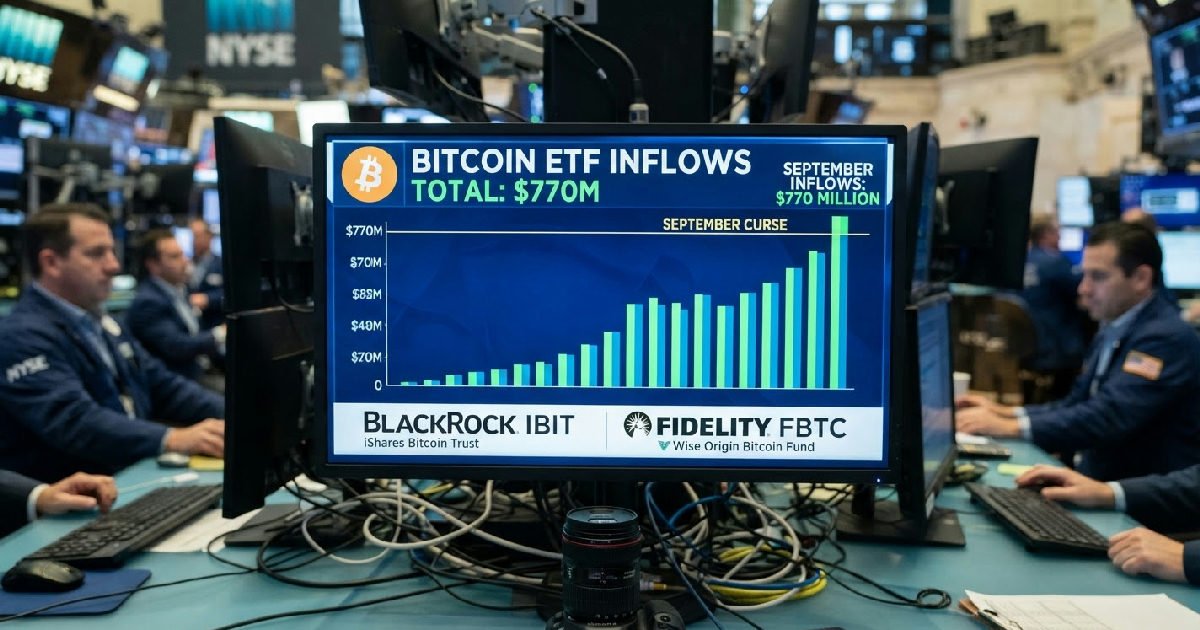
Bitcoin ETF inflows total $770 million, challenging September bearish trend
Bitcoin ETF inflows reached $770 million in the first four trading days of September 2026, a notable increase from Bitcoin’s typical September performance. This surge included a particularly strong single-day inflow of $730.87 million on September 3, the highest recorded since January 14.
The influx of capital suggests a potential reversal of the long-standing “September curse” that has typically plagued the cryptocurrency market. Major players like BlackRock’s IBIT and Fidelity’s FBTC spearheaded these inflows, reflecting robust institutional interest despite Bitcoin’s price struggling to firmly break past the $80,000 threshold.
Bitcoin ETF inflows see major capital
The opening days of September 2026 witnessed a remarkable capital injection into US spot Bitcoin ETFs. After an initial net outflow of $236.46 million on September 1, the tide turned sharply, with $101.15 million flowing in on September 2 and an impressive $730.87 million on September 3. An additional $174.6 million followed on September 4, culminating in the $770 million net inflow for the period.
BlackRock’s IBIT led this charge, drawing in $453.96 million on September 3 alone, complemented by another $117.4 million on September 4. Fidelity’s FBTC secured $74.4 million on September 3 and an additional $57.2 million the following day. ARK 21Shares’ ARKB also saw significant activity, contributing roughly $137.7 million on September 3, indicating broad participation from several major fund managers.
These figures highlight a powerful resurgence of investor confidence in the digital asset class. The cumulative net inflows into US spot Bitcoin ETFs since their January 2024 launch now stand at an impressive $55.6 billion, with BlackRock’s IBIT alone accounting for $64.06 billion.
Fidelity’s FBTC has also accumulated $10.33 billion in net inflows, contributing to a total of $101.3 billion in assets under management across all US spot Bitcoin ETFs.
This strong demand signals continued institutional embrace of Bitcoin as a legitimate asset. While some funds, such as VanEck and WisdomTree, experienced modest outflows, the overwhelming trend was one of aggressive accumulation. For context, Grayscale’s GBTC has seen total net outflows of $27.65 billion since its conversion, underscoring the shift in investor preference towards newer, lower-fee spot ETF products.
Challenging Bitcoin’s Historical “September Curse”
September has historically been a challenging month for Bitcoin, earning it the moniker “September curse.” Data from CoinGlass shows that Bitcoin has posted losses in eight of the past 13 Septembers since 2013, with an average return of -2.97%. This trend has often seen the crypto market endure a difficult period as traditional finance markets also contend with seasonal pressures.
However, 2026 appears to be defying this pattern. The significant Bitcoin price surges and ETF inflows experienced in the first week of the month offer a stark contrast to previous years. This follows a break in the negative streak in 2023 and 2024, when regulatory developments and shifting economic landscapes provided tailwinds.
The “curse” gained prominence during the ICO boom in 2017 when China banned ICOs, leading to a series of six consecutive negative Septembers. While traditional markets like the S&P 500 also exhibit September weaknesses, the reasons cited — such as tax-loss harvesting by mutual funds or institutional traders returning from summer — don’t fully explain Bitcoin’s specific pattern.
The recent positive performance suggests that new market dynamics, particularly the increasing institutional access provided by spot Bitcoin ETFs, could be overriding historical seasonal trends. Investors now have more regulated and accessible avenues to gain exposure to Bitcoin, which may be dampening the previously observed September volatility.
Federal Reserve Comments Fuel Macroeconomic Shift
A key catalyst behind the recent surge in Bitcoin ETF inflows was a shift in the macroeconomic environment, driven by expectations surrounding US monetary policy. On September 3, 2026, Federal Reserve Governor Christopher Waller delivered remarks that markets largely interpreted as dovish.
Waller stated, “I would be inclined to support holding the target for the federal funds rate at its current setting.” This indication of a potential pause in interest rate hikes or even future cuts sent ripples through financial markets, generally benefiting risk assets like cryptocurrencies. Such comments often signal a more accommodative monetary stance, which can encourage investors to allocate capital into higher-growth, higher-risk assets.
The timing of Waller’s comments directly preceded the largest single-day Bitcoin ETF inflow, underscoring the strong link between central bank policy and crypto market sentiment. Lower interest rates can make traditional safe-haven investments less attractive, prompting a rotation into assets perceived to offer greater returns, including digital currencies.
This macroeconomic backdrop is providing a powerful tailwind for Bitcoin, helping to counter any lingering historical negativity associated with September.
Despite the strong inflows, Bitcoin’s price has shown some resistance around the $80,000 level. At one point on September 6, 2026, it was trading at $79,622.23 after a 2.1% daily drop.
Analysis by MSB Intel indicates that Bitcoin has historically spent very little time trading above $70,000, with only 12.7% of its 4,364 recorded daily closing prices exceeding this mark. This suggests that while inflows are strong, breaking new price ceilings still presents a challenge for the leading cryptocurrency.
Altcoin ETF Performance Mirrors Bitcoin Trends
The bullish sentiment seen in Bitcoin ETFs has also extended to other parts of the crypto market, with altcoin ETFs demonstrating similar patterns. Ethereum (ETH) ETFs, for instance, initially saw a modest $8.6 million net inflow on September 1, followed by $48.2 million in net outflows on September 2.
However, buying activity returned aggressively on September 3, when Ethereum ETFs attracted a substantial $141.4 million, marking their strongest day in this period.
Although the inflows for Ethereum ETFs were considerably less on September 4, totaling $25.9 million, the sustained positive streak highlights a broader interest in institutional crypto products. This indicates that investors are not solely focused on Bitcoin but are also looking to gain exposure to other established cryptocurrencies through regulated ETF vehicles.
Solana (SOL) ETFs experienced more mixed sentiment during the same period, reflecting the higher volatility often associated with smaller market-cap altcoins. However, the overall trend suggests a growing acceptance and demand for a variety of crypto-backed ETFs, indicating a broader interest in the Solana ecosystem.
The increasing availability and trading volume of these altcoin ETFs underscore the expanding landscape of institutional crypto investment, suggesting growing confidence in diversified digital asset portfolios. This extends to newer market entrants as well; Hashdex’s NCIQ ETF recently added HYPE, with a 3.4% allocation worth about $14.7 million, creating a fresh avenue for institutional demand in niche crypto assets.
Looking Ahead: Sustaining Momentum and Market Evolution
The impressive start to September 2026 for Bitcoin ETF inflows signals a critical juncture for the cryptocurrency market. Historically, September has been a period of caution, but the current data points to a potential shift in investor behavior and market dynamics. The combined impact of strong institutional demand and perceived dovish signals from central banks creates a favorable environment for digital assets.
Maintaining this momentum will be crucial for Bitcoin to solidify its position above key psychological price levels, such as $80,000. While the recent inflows are robust, the market still faces volatility, as indicated by the widening Bollinger Bands. Investors will be watching closely to see if Bitcoin can convert current resistance levels into new support, demonstrating sustained upward trajectory.
The performance of other crypto ETFs, particularly those tracking Ethereum and Solana, will also offer insights into the broader health and diversification of institutional crypto investment.
Should these altcoin products continue to attract significant capital, it would suggest a maturing market where institutional players are comfortable with a wider range of digital assets beyond just Bitcoin. This evolution could lead to a more resilient and less Bitcoin-dependent crypto ecosystem.
Ultimately, the first week of September 2026 has provided a strong indicator that the “September curse” might be losing its grip, replaced by new forces of institutional adoption and macroeconomic shifts. The recent inclusion of assets like HYPE in broader crypto indexes further highlights this expanding interest.
This expanding institutional interest, further highlighted by Hashdex’s NCIQ ETF adding HYPE with a 3.4% allocation worth $14.7 million, sets the stage for a potentially transformative period for the entire digital asset class.