

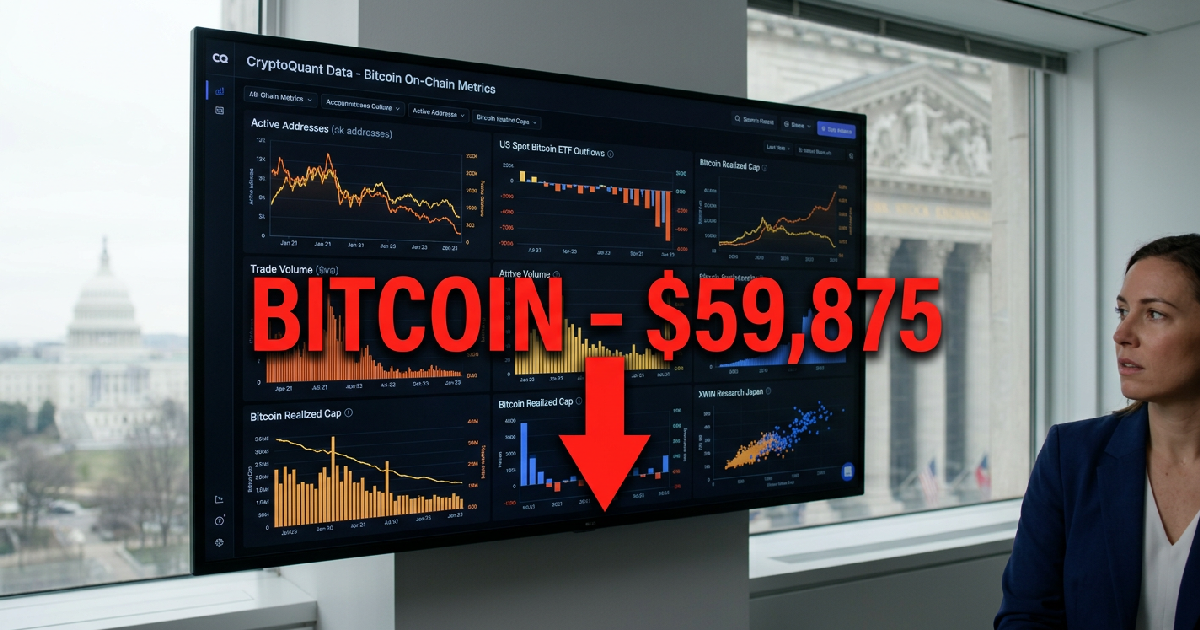
Bitcoin price crashes below $60,000 amid US institutional demand collapse
Bitcoin experienced a significant price crash on June 5, 2026, dropping below the $60,000 threshold for the first time since the reelection of Donald Trump in late 2024. As of June 6, 2026, the digital asset is treading water between $60,690 and $61,100, marking a 16% decline from the previous week’s highs.
New on-chain analysis from XWIN Research Japan and CryptoQuant identifies the “missing ingredient” behind this volatility: a total disappearance of the US institutional demand that previously served as the market’s primary engine.
The market is currently gripped by “extreme fear,” with the Crypto Fear and Greed Index falling to a low of 12. This sentiment shift follows a massive capital rotation where nearly $40 billion has exited the Bitcoin network. On-chain data shows the Realized Cap has declined from $1.12 trillion to $1.
08 trillion, suggesting that investors are not merely reacting to news but are actively withdrawing invested capital. This trend mirrors the capital outflows toward AI and quantum tech seen in other sectors of the digital economy.
The institutional retreat is most visible in the reversal of US spot Bitcoin ETFs, which have shifted from being aggressive buyers to sources of heavy outflows. Since early June, the Coinbase Premium has remained negative for an extended period, confirming that American institutional interest has stalled.
This lack of demand has left the market unable to absorb selling pressure, leading to more than $150 million in leveraged long liquidations between June 3 and June 4.
Capital rotation into AI and US equities triggers selloff
The $40 billion that left the Bitcoin network throughout the first week of June didn’t simply evaporate. XWIN Research Japan’s analysis suggests that institutional capital has rotated into US equities, specifically AI-focused companies within the S&P 500. These firms are currently delivering robust earnings growth and executing aggressive share buyback programs, providing a more immediate value proposition for funds in a high-interest-rate environment.
Bitcoin’s failure to hold the $74,000 level on June 2 accelerated this structural deterioration. The market has since experienced a sequence of lower highs and lower lows, leaving the price pinned below the 50-day, 100-day, and 200-day moving averages. While Grayscale and other ETF issuers were the champions of the 2024–2025 rally, they now find themselves overseeing a market where the spot bid has flatlined.
On-chain metrics confirm loss dominated market phase
Glassnode analysis reveals that the 90-day simple moving average of the Realized Profit and Loss Ratio fell below 1 on February 24, 2026. This technical crossover indicates that the volume of loss-making transactions now exceeds profit-taking, a signal previously seen during the crypto winters of 2018 and 2022.
By June 2, the share of Bitcoin supply held at a loss rose to 40.6%, a level that historically aligns with cyclical bottoms.
Short-term holders are bearing the brunt of the volatility. The 3-day Adjusted Realized Loss (EARL) hit $1.13 billion on June 6, though analyst Murphy noted this is roughly half the loss levels seen in February.
This suggests that while the current price action is painful, the market may be forming a bottoming structure rather than a total collapse, as long-term holders have largely remained intact despite the price being 50% below its October 2025 all-time high of $126,210.50.
Retail participation reaches multi year lows as wallets stagnate
The institutional exodus is compounded by a cooling of retail interest. Data from Santiment shows that daily active addresses have fallen to approximately 624,000, representing a 40% decline from the 2021 peak of 1.12 million. New wallet creation has reached a similar standstill, with only 278,000 new addresses being generated daily compared to the nearly 489,000 seen during previous high-momentum periods.
This stagnation in the “on-chain pulse” leaves the network dependent on a return of institutional buyers to reset the trend. As federal rules for digital assets evolve, the lack of new retail participants suggests the “missing ingredient” for a recovery remains a renewed reason for buyers to step back in.
For now, the market is defined by aggressive sellers dominating the futures order flow, as evidenced by the 30-day Net Taker Volume crossing below zero.
Recovery conditions are now quite narrow. Analysts are looking for three specific signals: the return of positive ETF inflows, a Coinbase Premium recovery above zero, and a stabilization of the Realized Cap. Until institutional capital stops rotating into traditional tech stocks and resumes its accumulation of BTC, the $60,000 floor will remain under heavy scrutiny by both bulls and bears alike.