

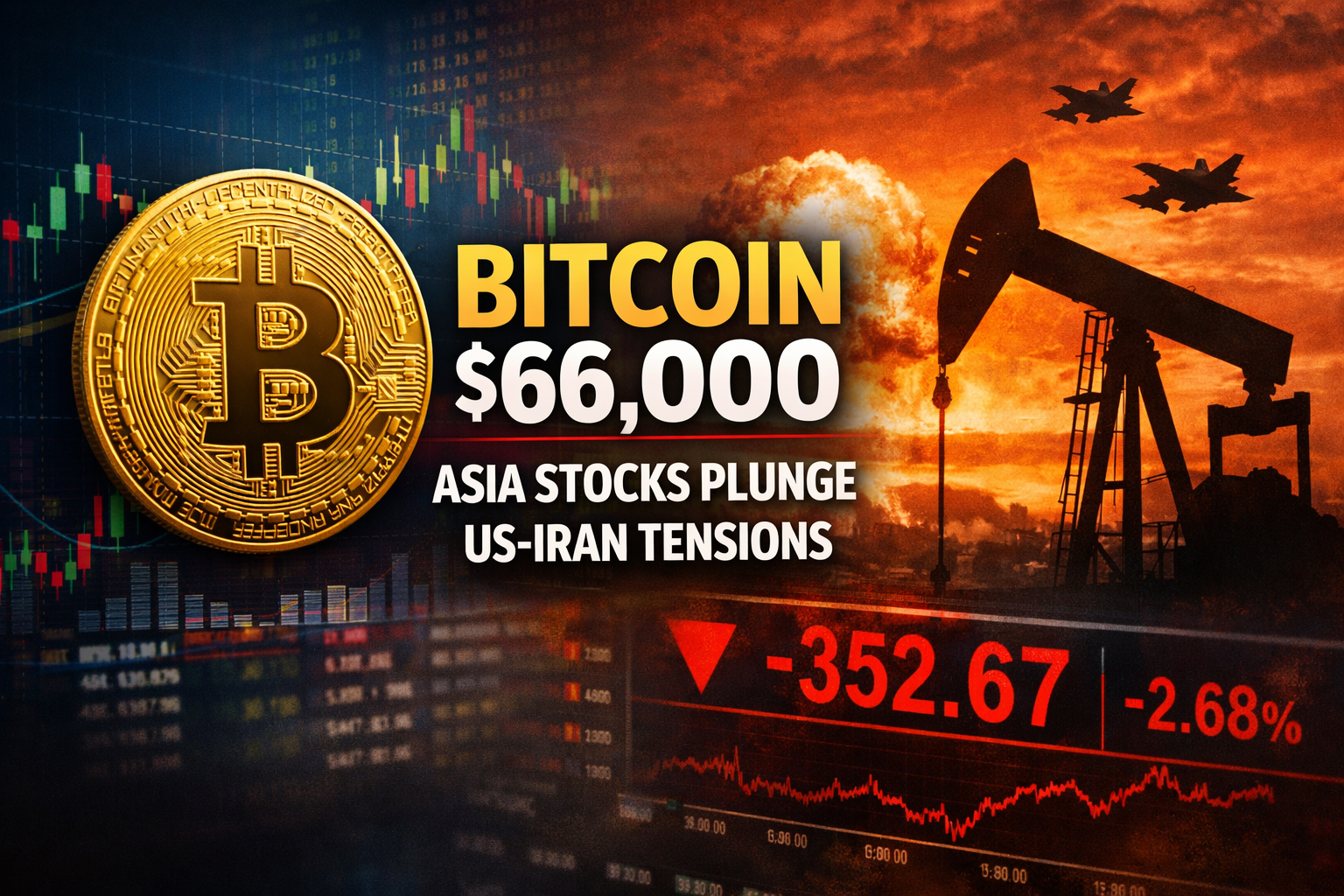
Bitcoin Holds $66K as Asia Stocks Slide on US-Iran Escalation
Bitcoin steadied above $66,000 in Asian trading hours Monday even as regional equities tumbled and oil prices jumped following a sharp escalation in U.S.-Iran hostilities. The muted reaction in digital assets contrasts with heavier selling in traditional markets, reinforcing bitcoin’s evolving role as a high-liquidity macro barometer during geopolitical shocks.
According to data from The Block, bitcoin traded at $66,772 at 12:40 a.m. ET, down roughly 1% over 24 hours. Ether fell 2.2% to $1,971. The moves followed weekend volatility triggered by reports that Iran’s Supreme Leader, Ayatollah Ali Khamenei, was killed in a joint U.S.-Israeli strike — a development that intensified already fragile regional tensions.
Crypto Trades Through the Shock
Unlike equities, crypto markets processed the news in real time. Bitcoin swung between $63,000 and $66,000 over the weekend before stabilizing as traders reassessed risk exposure.
Dominick John, analyst at Kronos Research, said the initial selloff reflected broad de-risking across high-beta assets but lacked signs of systemic strain. “Prices tested short-term support, then rebounded quickly as participants absorbed incoming headlines,” he said. “The 24/7 structure allowed crypto to clear risk while traditional markets were closed.”
Jeff Ko, chief analyst at CoinEx, noted that bitcoin’s ability to hold the $66,000 level — even as Asian equities opened sharply lower — suggests investors view the conflict as a risk premium event rather than the start of sustained financial tightening.
Derivatives markets also signaled contained stress. Rick Maeda, research associate at Presto Research, said there was no evidence of stablecoin dislocations or large-scale liquidation cascades. Funding rates remained orderly across major exchanges.
Asian Equities React Sharply
When regional markets reopened, the reaction was more pronounced. Japan’s Nikkei 225 fell more than 2.5% at one stage, while the broader Topix index dropped nearly 3%. Hong Kong’s Hang Seng and Singapore’s Straits Times Index each lost close to 2%, and Taiwan’s Taiex slipped roughly 0.9%. South Korean markets were closed for a public holiday.
The divergence highlights crypto’s increasingly global liquidity profile. With no opening or closing bell, bitcoin effectively became the first asset class to price the geopolitical shock.
Oil Emerges as the Key Transmission Channel
The sharpest move occurred in energy markets. Brent crude climbed above $78 per barrel, marking a gain of more than 7% over 24 hours. Gold rose nearly 2%, underscoring a broader flight toward defensive assets.
Analysts point to oil as the primary variable linking the Middle East conflict to broader financial conditions. If crude prices sustain a move toward $90 per barrel, inflation expectations could rise, strengthening the U.S. dollar and pushing real yields higher — a combination historically negative for crypto.
Jeff Mei, COO of BTSE, said traders are closely watching the Strait of Hormuz, a critical corridor for roughly one-fifth of global oil supply. Reports of vessel attacks near the passage have already lifted insurance costs and rerouted shipping lanes, amplifying concerns over supply disruption.
A prolonged energy shock could complicate central bank rate-cut trajectories, particularly in the United States, where inflation data remains uneven.
Macro Sensitivity, But No Panic
Despite heightened headlines, on-chain metrics and derivatives positioning show limited contagion within crypto markets. Stablecoin pegs remain intact, and open interest adjustments appear measured rather than disorderly.
Maeda emphasized that the critical question is whether oil stabilizes or establishes a structurally higher range. “If this becomes a sustained tightening of financial conditions rather than a headline-driven spike, crypto will trade as a high-beta macro asset,” he said.
For now, bitcoin’s relative stability suggests investors are differentiating between geopolitical volatility and structural liquidity shifts.
What Comes Next
Market participants are monitoring three primary indicators:
- Crude oil trajectory and shipping security in the Persian Gulf
- U.S. real yields and dollar strength
- Signals of escalation or de-escalation in U.S.-Iran hostilities
Should oil retreat and diplomatic channels reopen, risk assets may regain footing. A deeper military expansion, however, could introduce a more persistent inflation impulse — pressuring equities and digital assets alike.
Key Takeaways
- Bitcoin held near $66,000 despite a sharp selloff in Asian equities.
- Oil surged over 7%, emerging as the main macro risk transmission channel.
- Derivatives and on-chain data show limited systemic stress in crypto.
- Sustained crude prices above $90 could tighten financial conditions.
- Traders are focused on oil stability, inflation expectations, and conflict trajectory.
Source: The Block reporting and market data as of March 2, 2026.