

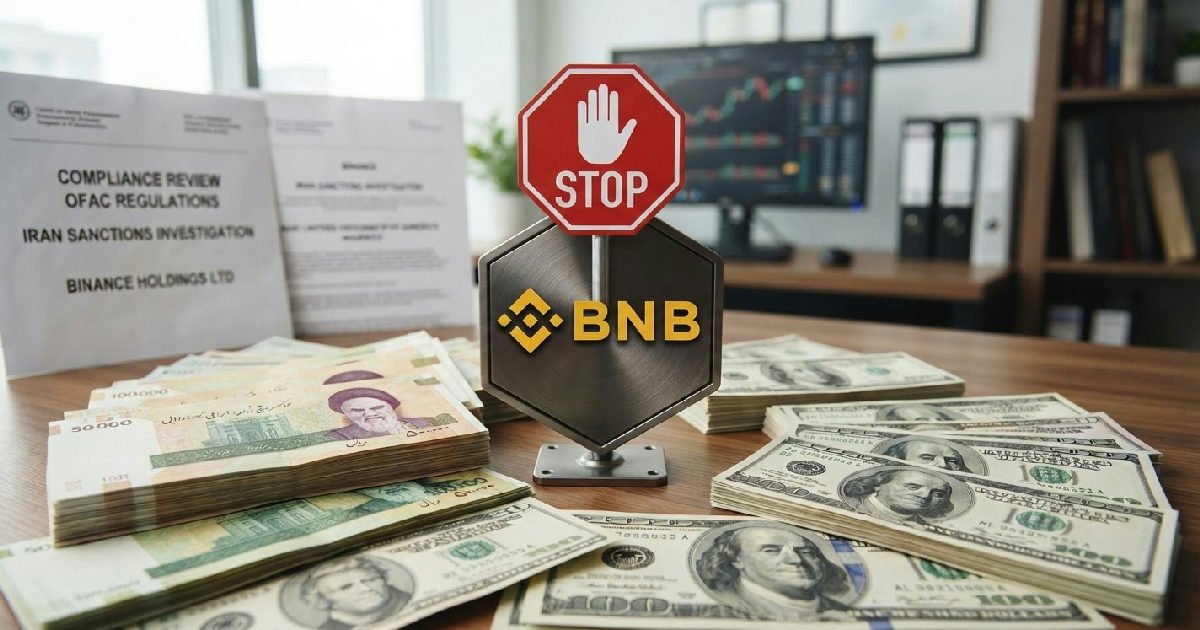
US prosecutors probe Binance Iran sanctions compliance
U.S. federal prosecutors are investigating Binance for potentially violating Binance Iran sanctions, a probe first reported by Bloomberg on September 22, 2026. S. federal prosecutors are once again scrutinizing Binance, the world’s largest cryptocurrency exchange, investigating whether it knowingly allowed trading that violated Binance Iran sanctions.
This renewed probe, first reported by Bloomberg on September 22, 2026, comes nearly three years after Binance’s significant $4.3 billion federal settlement for prior compliance failures. The Manhattan U.S.
Attorney’s Office is spearheading this inquiry, with support from the Justice Department’s Criminal Division.
Fresh scrutiny on Binance Iran sanctions
The latest investigation focuses on Binance’s internal compliance controls and the extent of its knowledge regarding the specific transactions under review. This deep dive into past activities suggests a sustained effort by U.S. authorities to enforce strict financial regulations within the rapidly evolving crypto sector. It also signals that the earlier settlement did not fully resolve all government concerns about the exchange’s operations.
The current investigation zeroes in on allegations that Binance permitted trades that should have been blocked under U.S. sanctions targeting Iran. This isn’t the first time the crypto giant has faced such accusations. An initial inquiry into Binance’s Iran sanctions violations was reported by Reuters on May 9, 2022.
That earlier investigation revealed that Binance processed approximately $8 billion in transactions for Iranian customers. These transfers occurred between 2018 and 2022, spanning both its main exchange and the then-affiliate, Binance.com. A substantial portion of these funds moved through Tron, a cryptocurrency known for its ability to obscure user identities within the broader cryptocurrency market.
Concerns about these illicit flows were reportedly present within Binance’s own ranks. In 2019, Samuel Lim, then the Chief Compliance Officer, was directly informed by a subordinate about Iranian users actively trading on the platform. Lim’s reported response, “we don’t want to make a fuss,” indicates a potential historical disregard for compliance warnings.
Federal oversight bodies are keeping a close watch on these developments. In March, Senators Elizabeth Warren, Chris Van Hollen, and Ruben Gallego announced plans for congressional oversight. They aimed to scrutinize the Justice Department’s ongoing investigation into Iran-linked transactions, emphasizing national security implications.
The Weight of Binance’s $4.3 Billion Settlement
The present probe gains particular gravity given Binance’s November 2023 resolution with U.S. authorities. In that settlement, Binance pleaded guilty to multiple charges. These included violations of the Bank Secrecy Act and operating an unregistered money-transmitting business.
The exchange also admitted to breaching the International Emergency Economic Powers Act. As part of the agreement, Binance committed to paying a staggering criminal financial penalty of $4.316 billion. This sum marked one of the largest corporate penalties in U.S. history.
The Justice Department explicitly stated that Binance had knowingly failed to implement proper controls. These failures allowed U.S. customers to trade with users in sanctioned jurisdictions. Federal prosecutors detailed more than $898 million in trades between U.S. users and those in Iran from January 2018 through May 2022.
The settlement demanded significant reforms, including the appointment of an independent compliance monitor for three years. This monitor’s role was to oversee improvements in Binance’s anti-money laundering (AML) and sanctions systems. Coordinated resolutions also involved FinCEN, OFAC, and the Commodity Futures Trading Commission.
OFAC, specifically, cited Binance’s failure to block transactions involving users in sanctioned regions like Iran. The U.S. Treasury Department underlined how Binance’s “willful failures” enabled illicit actors. These included individuals tied to terrorism, ransomware, and child sexual abuse, to conduct transactions freely on its platform.
Leadership Changes Amidst Legal Ramifications
The fallout from the 2023 settlement also saw a major leadership shift at Binance. Founder and CEO Changpeng Zhao (CZ) stepped down from his role as part of the plea deal. Richard Teng was subsequently appointed as the new CEO, tasked with steering the exchange towards a more compliant future.
CZ himself pleaded guilty to one count of failing to maintain an effective AML program. He faced a potential prison sentence of up to 18 months under federal sentencing guidelines. On April 30, 2024, U.S. District Judge Richard Jones in Seattle sentenced CZ to four months in prison.
Prosecutors had pushed for a three-year sentence, while CZ’s legal team advocated for probation. Judge Jones noted that no evidence suggested CZ was directly notified of specific illicit transactions. He also recognized CZ’s willingness to take responsibility for his actions, a factor in the reduced sentence.
Separate $61 Million Forfeiture Case Unfolds
Compounding Binance’s regulatory challenges is a distinct civil forfeiture complaint filed on September 14. The Southern District of New York initiated this action, seeking to seize approximately $61 million in Tether (USDT). These funds are held across 10 specific cryptocurrency addresses.
Prosecutors allege these digital assets represent proceeds from black-market Iranian crude oil and petroleum sales. They further claim the money was earmarked to finance Iranian government and military bodies. This specifically includes the Islamic Revolutionary Guard Corps.
The complaint names two Chinese companies, Blessed Trust and Hexa Whale, in connection with the funds. It states these entities allegedly used Binance trading accounts while managing proceeds from Iranian oil sales. A broader network of cryptocurrency actors is accused of laundering over $1.5 billion in illicit oil proceeds, highlighting the intricate and often opaque nature of many crypto market activities.
Despite these connections, the forfeiture complaint does not accuse Binance itself of direct wrongdoing in this specific proceeding. The Justice Department has clarified that civil forfeiture complaints contain allegations that remain unproven. A court judgment is required for the government to retain the assets. The case specifically targets the cryptocurrency in identified wallets, not Binance criminally.
Court records indicate the assets are USDT operating on the TRON network. The complaint outlines a process where Tether would “burn” the seized tokens. It would then issue replacement tokens of equal value for transfer into U.S. government custody.
Binance’s Proactive Steps and Compliance Defenses
Binance, for its part, has offered a detailed timeline of its actions regarding Hexa Whale and Blessed Trust. The exchange stated that law enforcement first contacted it in April 2025. This concerned transactions with potential terrorism-financing links.
Binance provided know-your-customer (KYC) and transaction records related to Hexa Whale in June 2025. The company claims it subsequently removed Hexa Whale from Binance.com on August 13, 2025. Following additional requests, Blessed Trust was offboarded in January 2026.
Binance maintains that, to its knowledge, no direct transactions occurred between its accounts and Iran-based entities. An internal review, however, indicated $126.1 million eventually reached wallets linked to Iran. Up to $24.1 million of this sum reportedly found its way to IRGC-related wallets after “multiple blockchain hops.”
The exchange has also defended its compliance team against claims of dismissing employees for escalating concerns. Binance acknowledged one employee’s dismissal after an internal investigation for an unauthorized disclosure. Other compliance workers reportedly left voluntarily.
To demonstrate robust controls, Binance points to its significant compliance workforce. Over 1,500 individuals, representing roughly 25% of its global staff, work in compliance-related functions. This massive undertaking reflects the increasing demands for regulatory adherence in an industry where Bitcoin’s recent surges continually draw new participants.
Binance also asserts a dramatic reduction in its exposure to Iranian crypto exchanges. This fell 97.3%, from $4.19 million to $110,000, over a two-year period. These figures are from Binance’s internal review and have not been presented as court findings.
Broader Implications for Cryptocurrency Regulation
The continuous U.S. pressure on Binance highlights a broader trend in cryptocurrency regulation. Global authorities are intensifying efforts to curb illicit financial flows through digital assets. This ongoing scrutiny serves as a stark reminder to all crypto exchanges.
Compliance with international sanctions and anti-money laundering laws is no longer optional. It is now a critical operational imperative. The industry, once seen as an unregulated frontier, is rapidly maturing under the weight of strict government oversight.
This renewed probe against the world’s largest exchange signals a zero-tolerance approach from regulators. Even after a massive settlement, past compliance failures continue to cast a long shadow. Exchanges must therefore continuously prove their systems are effective and foolproof.
Lawmakers like Senator Elizabeth Warren remain vocal critics of the crypto industry’s potential for illicit finance. Their sustained calls for stronger regulation directly influence the enforcement landscape. Digital asset platforms must meet the same rigorous standards as traditional financial institutions.
For other cryptocurrency platforms, Binance’s ongoing challenges offer a crucial lesson. Investing heavily in robust KYC and AML infrastructure is paramount for survival. A reactive approach to compliance can result in severe penalties and lasting reputational damage.
Binance finds itself navigating a complex legal and regulatory landscape, with U.S. authorities maintaining intense scrutiny. The new probe into Iran sanctions compliance, coupled with the separate $61 million forfeiture case, underscores the ongoing challenges. Despite significant past penalties, the path to full regulatory peace remains elusive for the exchange.
Richard Teng’s leadership will be tested as Binance strives to demonstrate comprehensive adherence to global standards. The outcome of these investigations will not only shape Binance’s future. It will also send a clear message to the broader cryptocurrency industry about the undeniable cost of non-compliance.