

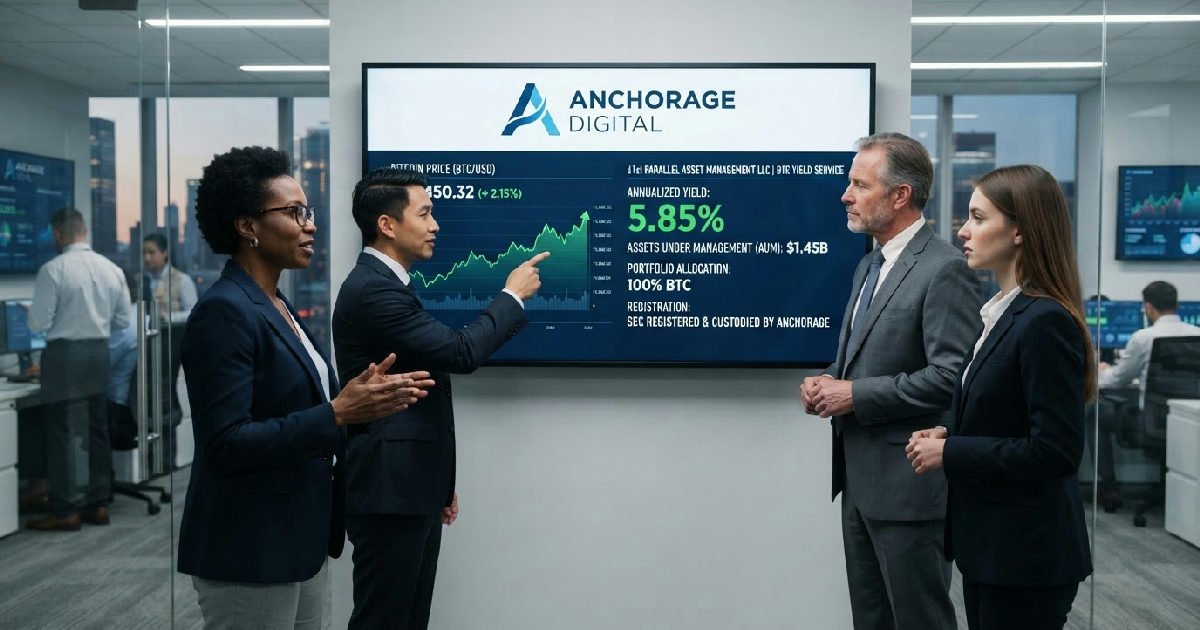
Anchorage Digital launches 61st Parallel for Bitcoin yield
Anchorage Digital, the pioneering federally chartered crypto bank, announced on November 24, 2026, the launch of its new subsidiary, 61st Parallel Asset Management LLC. This new entity aims to provide sophisticated investment advisory services, specifically designed to generate yield from Bitcoin holdings for institutional clients.
The move signifies a strategic expansion for Anchorage Digital beyond its established custody business into the rapidly evolving digital asset investment landscape.
Anchorage Digital expands with dedicated Bitcoin yield service
The creation of 61st Parallel Asset Management LLC addresses a growing demand from institutional investors seeking to maximize returns on their significant Bitcoin holdings. By focusing on yield generation through regulated avenues, Anchorage Digital is positioning itself at the forefront of compliant institutional crypto finance.
This development reflects a maturing market where traditional financial players are increasingly looking for structured and secure ways to engage with digital assets.
The newly formed 61st Parallel Asset Management LLC was officially established in Delaware on May 26, 2026, and received authorization to operate in New York between July 8-9, 2026, well ahead of its public launch. The subsidiary’s primary objective is to offer SEC-registered investment advisory services that generate yield from Bitcoin. This focus directly targets institutional investors, eschewing the retail market.
This strategic pivot allows Anchorage Digital to tap into the substantial pool of institutional Bitcoin that often sits idle. Estimates suggest more than $10 billion in institutional Bitcoin is currently not actively generating returns. Asset managers, fintech companies, and even Bitcoin mining pools are increasingly seeking avenues for productive yield, a gap 61st Parallel intends to fill.
Seeking regulatory clarity through SEC registration
A crucial aspect of 61st Parallel Asset Management LLC’s operational model is its active pursuit of advisory registrations with the U.S. Securities and Exchange Commission (SEC). This commitment to regulatory compliance ensures the firm will operate under stringent fiduciary obligations and disclosure rules.
This approach contrasts sharply with some unregistered yield platforms, which have faced scrutiny in the past. By aligning with SEC requirements, 61st Parallel aims to provide institutional clients with a higher degree of trust and transparency, a critical factor in the often-volatile world of digital assets. Institutions are increasingly preferring regulated crypto access, with 62% favoring registered vehicles over spot holdings, according to recent surveys.
The evolution of Anchorage Digital’s offerings
Anchorage Digital has a history of breaking new ground in the digital asset space. Founded in 2017 by security engineers Diogo Mónica and Nathan McCauley, the company achieved a landmark in January 2021 by becoming the first federally chartered digital asset bank in the U.S.
This critical approval from the Office of the Comptroller of the Currency (OCC) solidified its position as a regulated institution capable of operating as a national trust bank.
Initially, Anchorage Digital built its reputation on providing robust custody solutions for institutional crypto assets. Over time, its service portfolio expanded to include staking, settlement, trading, governance, and token-lifecycle services. The launch of 61st Parallel represents a natural progression, allowing the company to offer more comprehensive financial services tailored to institutional needs.
Key milestones and financial backing
Anchorage Digital has attracted significant investment, raising a total of $587 million across six funding rounds. Prominent investors include Andreessen Horowitz, Blockchain Capital, KKR, Goldman Sachs, GIC, and Visa. A Series D round in December 2021, led by KKR, valued the company at over $3 billion, underscoring investor confidence in its vision.
More recently, Tether invested $100 million in February 2026, further boosting Anchorage Digital’s valuation to $4.2 billion. This substantial financial backing has enabled the company to continuously innovate and expand its offerings, reinforcing its leadership in the institutional crypto sector. Such investments highlight the growing mainstream acceptance and strategic importance of regulated digital asset infrastructure.
Addressing regulatory challenges
Operating in a nascent regulatory environment has its challenges. In April 2022, Anchorage faced an OCC consent order related to gaps in its anti-money laundering program. However, the company demonstrated its commitment to compliance, and the order was officially terminated in August 2025 after significant improvements were implemented.
This track record of navigating and resolving regulatory hurdles provides a strong foundation for 61st Parallel Asset Management as it seeks SEC registrations. It demonstrates Anchorage Digital’s capability to adapt to evolving compliance standards and maintain its position as a trusted and regulated entity in the digital asset ecosystem. This commitment to robust regulatory frameworks is key for institutions.
Strategies for generating yield on institutional Bitcoin
Institutional investors typically employ several structured financial strategies to generate yield on their Bitcoin holdings. These methods often involve lending Bitcoin to market makers or trading firms, utilizing derivatives like options, or engaging in market-neutral strategies that capitalize on pricing discrepancies, such as those between futures and spot prices.
Other approaches include collateralized Bitcoin-backed loans and participation in decentralized finance (DeFi) protocols. However, the emphasis for a regulated entity like 61st Parallel Asset Management LLC will likely be on transparent, well-understood strategies that can be fully compliant with SEC regulations.
Covered calls and other derivative approaches
One particularly explored strategy by Anchorage Digital is the use of Bitcoin covered calls. A research paper published by the firm around May 28-29, 2026, analyzed these strategies, suggesting they could generate synthetic yield for BTC holders when managed with strict discipline.
For instance, a simple 20-delta, 30-day covered-call strategy delivered a net yield of 5.5% on the underlying BTC position between April 30, 2025, and April 30, 2026, even as spot BTC declined by 19.4% during that period.
With specific regime and implied-volatility filters, the covered-call contribution surged to 23.7% over a longer period, from October 2021 to April 2026, representing an annualized yield of 5.2% while the strategy was active only 44% of the time.
The increasing sophistication of the Bitcoin derivatives market, including the growth of notional BTC options open interest, which briefly exceeded $100 billion at the end of 2025, highlights the viability of such strategies.
By May 2026, this figure stood around $60 billion, surpassing the open interest of the entire BTC futures market, indicating a mature and liquid environment for these complex instruments.
Growing institutional demand and market context
The institutional appetite for digital assets continues to surge, with a vast majority of institutional investors either having exposure or planning allocations in 2025. A significant 83% of these investors intend to increase their digital asset allocations. Furthermore, 76% of institutional firms expect to invest in tokenized assets by 2026, signaling a broader acceptance and integration of blockchain technology into traditional finance.
This growing interest is underpinned by Bitcoin