

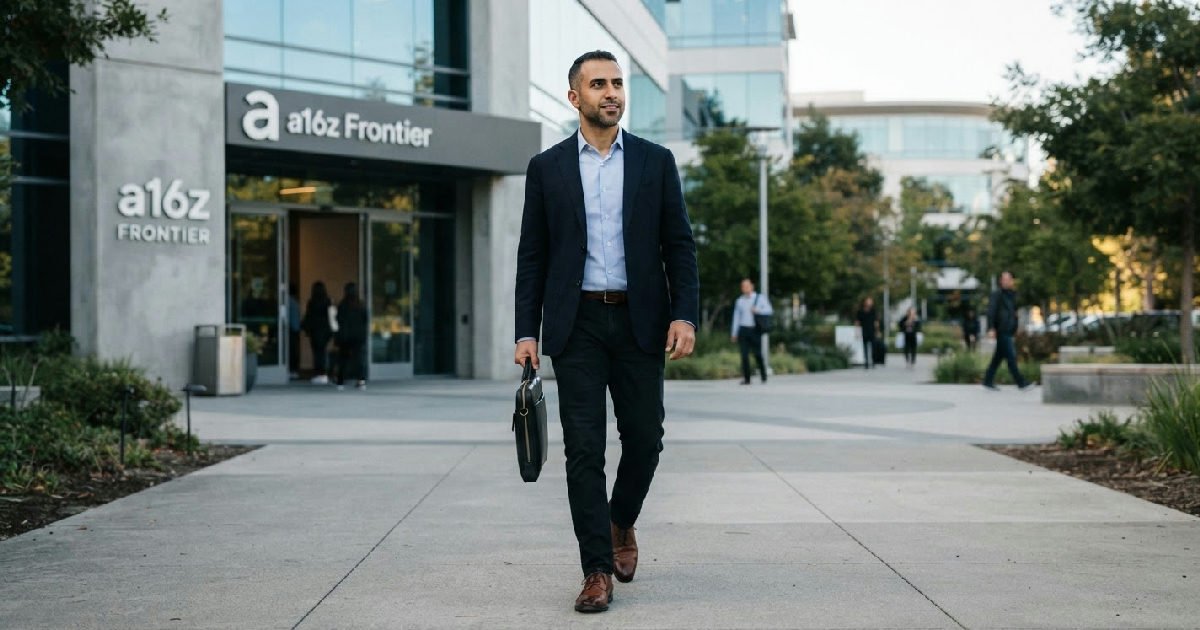
ali yahya exits a16z frontier to launch own company
Andreessen Horowitz (a16z) officially rebranded its blockchain investment arm, a16z Crypto, to a16z Frontier on Thursday, October 22, 2026. This strategic shift expands the firm’s $2.2 billion fifth fund beyond traditional crypto startups to a broader category of “frontier startups,” including Artificial Intelligence (AI) and robotics.
Coinciding with this announcement, General Partner Ali Yahya, a pivotal figure in a16z’s crypto endeavors, revealed his departure to launch his own company.
a16z Frontier’s new investment horizon
Managing Partner Chris Dixon confirmed the expansion, stating that the new entity, a16z Frontier, will now back emerging technologies whose markets may take years to fully develop.
Yahya, who joined a16z in 2017 as the first full-time member of its crypto team, will move to San Francisco to focus on building infrastructure for an open software ecosystem. His new venture targets AI-mediated operating systems and an AI-native developer ecosystem.
The transition from a16z Crypto to a16z Frontier marks a significant evolution for the prominent venture capital firm. This move redefines the scope of its latest $2.2 billion fund, Fund 5, which was previously dedicated solely to crypto entrepreneurs. It now embraces a wider array of nascent technologies, signifying a strategic pivot for Andreessen Horowitz.
Chris Dixon, who established a16z Crypto in 2018, explained the shift as an “expansion” rather than an abandonment of crypto. He believes that as blockchain technology becomes more integrated and less visible within mainstream products, defining companies by their underlying technology is less relevant. Instead, the firm will prioritize what these companies actually do and the problems they solve.
This expanded mandate now covers diverse sectors like AI, robotics, and other autonomous machines. It also includes biology and medicine, alongside startups that integrate software, hardware, and services. Networks where people and intelligent agents can transact are also part of this ambitious investment thesis, demonstrating a comprehensive approach to future tech.
Dixon will co-lead a16z Frontier with fellow General Partners Eddy Lazzarin and Guy Wuollet, as well as a16z co-founders Marc Andreessen and Ben Horowitz. This robust leadership team aims to steer the firm into these burgeoning markets while continuing to advocate for sensible crypto regulation. The firm maintains that crypto and related ventures remain a crucial part of their portfolio.
Ali Yahya embarks on a new venture
General Partner Ali Yahya announced his departure from a16z on October 22, 2026, marking the end of a significant chapter for both him and the firm. He made the announcement on X, stating his intention to establish a new company in San Francisco. This move had been reportedly circulated among investors earlier that day.
Yahya’s new venture will focus on creating infrastructure to support an “open software ecosystem,” specifically envisioning a future where AI use shifts. He sees a transition from individual interactions with single agents to complex collaborations between multiple users and intelligent agents. This perspective aligns with a broader vision for AI-native developer environments.
Yahya first joined a16z in 2017, becoming the crypto team’s first full-time member after a tenure at Google. At Google, he contributed to robotics projects as an engineer for Google Brain, bringing a deep technical expertise to a16z.
His promotion to General Partner in 2021 underscored his pivotal role in shaping the firm’s crypto investment strategy and he was reportedly seen as the “soul of the crypto team.”
During his time at a16z Crypto, Yahya was instrumental in numerous pioneering investments across Web3, cryptocurrency, and blockchain technologies. He supported companies such as Alchemy, Aleo, Aztec, EigenLayer, and Solana. His contributions cemented a16z’s position as a leading investor in the decentralized space, highlighting his foresight and influence.
Shifting tides in venture capital
a16z’s strategic pivot reflects a broader trend among major venture capital firms that initially focused on the crypto sector. Many are now diversifying their portfolios to include cutting-edge technologies like AI and robotics. This expansion signals an industry-wide recognition of new investment frontiers beyond Web3.
Other significant players have made similar moves. Paradigm, another prominent crypto investor, announced a $1.2 billion fund in July 2026, explicitly stating its intent to invest across AI, robotics, and other “frontiers.” The firm notably removed crypto and Web3 language from its homepage in 2023, showcasing its broadened focus.
Haun Ventures, another major player, raised $1 billion in May 2026 and also plans to back financial startups outside the crypto sphere. These concurrent shifts suggest a collective re-evaluation of market opportunities. It highlights a growing belief that the most disruptive innovations will emerge from the convergence of various advanced technologies, moving past singular sector definitions.
The timing of these changes also aligns with a challenging period for crypto startup funding. Private financing in the crypto sector hit a three-year low in Q3 2026, totaling $4.4 billion across 224 rounds. This figure represents the lowest number of deals observed since at least 2023, pointing to increased caution among investors.
Despite this Q3 financing data, the top ten largest financing rounds accounted for 58% of the total Q3 investment, with Polymarket’s $1 billion raise contributing nearly a quarter of the total.
The AI and blockchain convergence
Chris Dixon contends that blockchains are essential to the future development of AI-driven networks. He sees them enabling critical functions such as machine-to-machine transactions and providing new economic capabilities to automated systems. This perspective elevates blockchain from a niche technology to an integral component of a wider technological ecosystem.
Dixon points to investments in companies like Catena Labs, which develops financial infrastructure for AI agents, as evidence of this convergence. He argues that blockchains are uniquely suited for verifying human identity and facilitating seamless machine-to-machine economic exchanges. This vision positions blockchain as a foundational layer for the next generation of intelligent systems.
Ali Yahya’s new company also aligns with this convergence, focusing on infrastructure that supports collaborative AI environments. He believes that future AI applications will involve many people and agents working together in large-scale open networks. This collaborative model underscores the growing interdependence between AI and decentralized technologies.
Despite the expanded investment scope, a16z remains committed to the crypto space. The firm will continue to invest in crypto-related ventures and advocate for “sensible crypto regulation.” This ongoing commitment suggests a long-term view, even as the investment landscape evolves. They understand that a clear regulatory framework is vital for sustained innovation.
The firm also plans to leverage its Seoul office to engage with Korean AI and robotics startups. This will support broader business opportunities for its portfolio companies in the burgeoning Korean market. Such international outreach underscores the global nature of this technological shift and the firm’s ambition to stay at the forefront of innovation.
Market implications and future outlook
The rebranding of a16z Crypto to a16z Frontier and its broader investment thesis carries significant implications for the venture capital landscape. It signals a maturation of the crypto space, where the underlying technology is increasingly integrated into wider applications. The market is shifting focus from the “crypto” label to the practical impact of advanced technologies.
Chris Dixon’s assertion that “the label matters less now” encapsulates this evolving sentiment. It suggests that success will increasingly depend on a company’s functional contribution rather than its adherence to a specific technological category. This could encourage more cross-disciplinary innovation and investment in hybrid solutions.
For investors, this expansion presents both opportunities and challenges. While diversification reduces risk associated with a single sector, it also demands a broader understanding of complex emerging fields. The underlying trend points to a search for the next wave of disruptive technologies across various sectors.
The move also underscores the intense competition for capital among startups in both crypto and AI. As major players like a16z, Paradigm, and Haun Ventures broaden their mandates, they are pooling significant resources. This could intensify the race for promising early-stage companies and potentially reshape the venture funding ecosystem for frontier technologies, leading to more intense valuations.
Looking ahead, the convergence of AI and blockchain could unlock entirely new markets and business models. The focus on “frontier startups” indicates a long-term investment strategy, acknowledging that these technologies require significant time to develop and achieve widespread adoption. Continued regulatory clarity, particularly concerning US investment rules in emerging tech sectors, will remain crucial for fostering innovation and investor confidence.
The firm’s total funds raised across its five crypto funds, nearing $10 billion, highlights its substantial influence. This capital, now directed towards a wider frontier, could accelerate the development of groundbreaking innovations. This strategic shift may also influence other venture firms to re-evaluate their own investment theses in an increasingly interconnected technological world.
The latest crypto news, including the recent slowdown in private financing, suggests a need for diversified approaches.
Ali Yahya’s departure, while significant, also illustrates the dynamic nature of the tech and venture capital industries. Talented individuals often spin out to create new ventures, further enriching the ecosystem with fresh ideas and companies.
His vision for open software ecosystems, focusing on AI-mediated operating systems and an AI-native developer ecosystem, could complement a16z’s broader frontier strategy, even from outside the firm. This strategic alignment highlights the evolving landscape for Bitcoin investment vehicles and other digital asset strategies.