

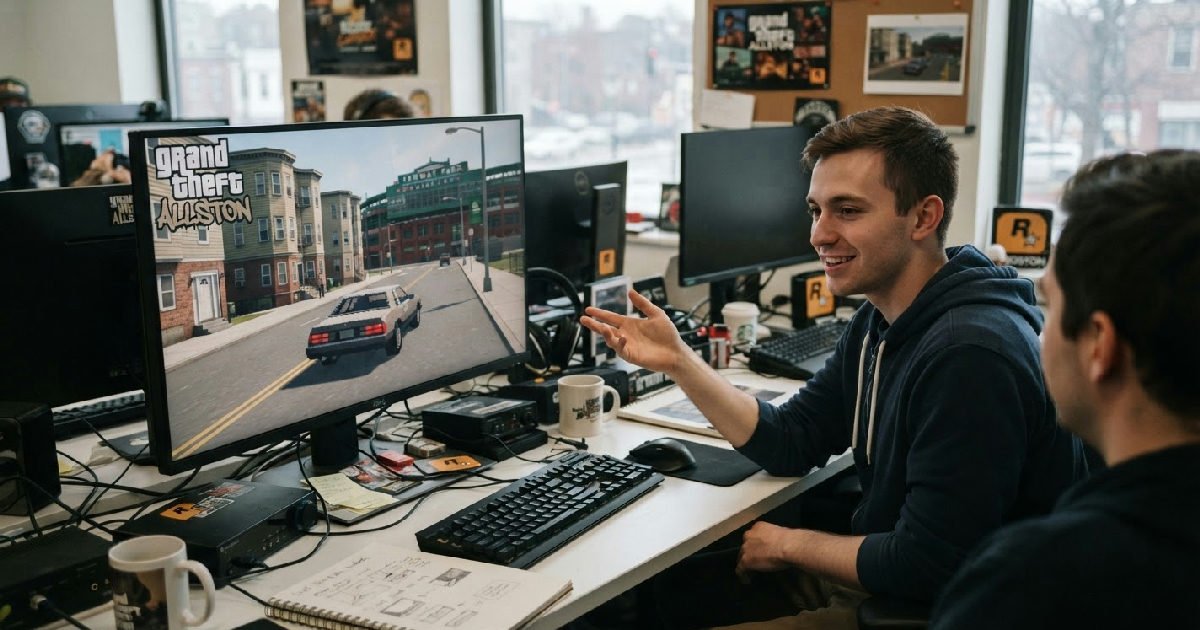
Grand Theft Allston Emerges as Fan-Made Boston GTA Vision
Grand Theft Allston is a fan-made parody game by a Boston software engineer, re-envisioning Grand Theft Auto in Massachusetts. Brighton engineer Sam McGrail’s creation gained significant traction online on Monday, November 25, 2026.
This surge of interest arrived just days after the highly anticipated release of Rockstar Games’ Grand Theft Auto VI on November 19, 2026.
“Grand Theft Allston” Captures City’s Unique Spirit
McGrail’s project taps into a long-standing desire among gamers for a GTA title set in Boston. It has resonated deeply with fans, particularly those from New England, who have long advocated for their home state as an ideal, satirical backdrop for the series.
The emergence of “Grand Theft Allston” has quickly become a focal point in discussions surrounding the future and creative possibilities within the open-world genre.
Sam McGrail began developing a prototype for “Grand Theft Allston” several weeks before Grand Theft Auto VI hit consoles. His goal was to “get ahead of the curve” and share a unique gaming experience with family and friends. The project offered a chance to explore how Boston would translate into a Grand Theft Auto-style environment.
The parody game immediately showcases familiar Bostonian elements. Players can “steal duck boats” near the historic Boston Common or fuel their crime sprees with “iced Dunkin’ coffee.” It wouldn’t be Boston without specific traffic challenges, so fleeing police in a box truck on Storrow Drive is a key feature. Even the famed Government Center “cop slide” is included for authentic, high-speed escapes.
McGrail’s attention to detail extends to cultural touchstones. Players can witness the iconic rivalry between the Yankees and Red Sox at Fenway Park. The game also features unexpected local fauna, such as “wild turkeys in Brookline,” and pays homage to local quirks like the “iconic Keytar Bear.”
And, of course, it simulates the often “erratic driving on the Mass Pike,” adding a layer of humor and relatability.
Innovative Development Behind the Parody
The technical foundation of “Grand Theft Allston” is as inventive as its concept. McGrail constructed the game using a blend of modern technologies, including “bots” and “artificial intelligence.” He meticulously integrated real-world geographical data, leveraging OpenStreetMap for streets, parks, and water bodies. Building footprints and heights were pulled from Boston Planning & Development Agency (BPDA) data.
This innovative approach even extended to simulating air traffic. McGrail incorporated “real air traffic control data” to model flights departing from Logan Airport. Since its debut, McGrail has observed thousands of players engaging with his creation.
He reported watching between 4,000 and 4,500 people play the game, many of whom were delighted to discover their own streets and share their findings with friends, underscoring the game’s deep local appeal.
Long-Standing Fan Demand for a Boston-Set Grand Theft Auto
The notion of a Grand Theft Auto game set in Boston is hardly new. Discussions among fans on platforms like Reddit about a “GTA Boston map concept” stretch back over a decade, with threads appearing as early as October 2013 and August 2021. These conversations often explore potential missions, landmarks, and the unique cultural elements Boston could offer to the satirical open-world series.
Prominent gaming publications have echoed this sentiment, arguing for Boston’s suitability. They highlight Massachusetts’ geographical diversity as a primary asset, much like the fictional Leonida (based on Florida) in Grand Theft Auto VI.
Boston offers a historic urban core, quaint suburban towns, deep wilderness to the west, and coastal areas like Cape Cod to the east. Islands such as Martha’s Vineyard and Nantucket would also provide varied exploration, creating an engaging experience.
Rockstar Games itself isn’t entirely unfamiliar with the New England region. Its 2006 title, Bully, was set in a fictional New England town, showcasing the developer’s ability to capture the specific suburban ennui of the area.
Furthermore, Rockstar New England, a studio based in Andover, Massachusetts, has contributed to major titles like Red Dead Redemption 2 and was responsible for the behavioral design of non-player characters in Grand Theft Auto VI. This local presence suggests insights into game development that could easily translate to a Boston-centric project.
Mapping Massachusetts for Mayhem
The geographical arguments for a Boston-based GTA are compelling. The city itself, with its distinct neighborhoods and historical architecture, provides a rich urban tapestry unlike any previously seen in the series. Outside the city limits, the landscape quickly shifts to sprawling suburbs with shopping malls and banks, prime targets for in-game activities.
Travel further west, and players would find themselves in extensive wilderness areas, similar to the northern expanses of Leonida. The eastern coast offers Cape Cod, a region defined by its fishing economy and vacation spots, providing a stark contrast. The presence of iconic islands would further enhance exploration and mission diversity, giving a distinct flavor to each district within a hypothetical “Grand Theft Massachusetts.”
Boston’s Cultural Quirks as Satirical Gold
Beyond its physical landscape, Boston and Massachusetts at large offer a wealth of cultural targets ripe for Rockstar’s signature satire. The state is home to a diverse array of personalities that could be lampooned, from the “loudmouthed bros” frequently found in bar fights to the “wealthy retirees living in beach bubbles.”
Hustling Italian-Americans in Boston’s North End and the artsy communities of towns like Northampton also present unique satirical opportunities.
Even Boston’s renowned sports culture, with its passionate Red Sox and Patriots fans, could be a central focus. The rise of sports betting also presents a fertile ground for storylines involving criminal enterprises, offering a fresh take on the franchise’s traditional themes. This rich cultural backdrop provides ample material for the satirical elements in gaming that Rockstar is known for.
Beyond “Allston”: The Broader Impact and Future Outlook
Sam McGrail isn’t stopping with the initial version of “Grand Theft Allston.” He actively solicits user suggestions and has ambitious plans for future updates. These include expanding the game to incorporate more surrounding areas like Lynn, Somerville, and Winthrop. He also aims to create more “lifelike” renditions of prominent institutions such as Boston College and Harvard University.
Further plans involve adding specific interior locations, including a bar fight scenario at the iconic Kowloon restaurant and the interior of TD Garden. This ongoing development highlights the potential for community-driven content to evolve and expand beyond its initial scope. It also demonstrates how a single, well-executed fan project can generate substantial enthusiasm and engagement within the gaming community.
The success of “Grand Theft Allston” reflects a broader trend of players engaging with game worlds in creative and unexpected ways. While Rockstar Games has not commented on fan-made Boston concepts, the viral attention garnered by McGrail’s game underscores the strong, persistent desire for new settings and localized experiences within the Grand Theft Auto series.
This kind of grassroots innovation can often inspire or inform developers, showcasing the narratives and environments that truly resonate with players.
Rockstar’s Open Worlds and the Lure of Local Flavor
Rockstar Games has consistently built its reputation on creating immersive, richly detailed open worlds that serve as biting satires of American culture. Grand Theft Auto VI‘s Leonida, a sprawling fictionalized version of Florida, exemplifies this approach.
It boasts a diverse geographical landscape, from bustling urban centers like Vice City to rural farmlands, serene beaches, and quiet islands. This variety ensures a dynamic and engaging player experience.
The success of titles like Grand Theft Auto VI lies not just in their technical prowess but in their ability to capture and exaggerate regional identities. Florida, with its unique cast of characters—conspiracy theorists, right-wing gun enthusiasts, and wealthy playboys—provides ample material for Rockstar’s cultural commentary.
Similarly, the widespread appeal of “Grand Theft Allston” suggests that local flavor, when authentically rendered, can be just as compelling, even on a smaller, fan-made scale.
This intersection of official releases and dedicated fan projects like “Grand Theft Allston” demonstrates the vibrant ecosystem surrounding major gaming franchises. It showcases not only player creativity but also the enduring power of local identity in gaming narratives.
Whether through official channels or independent endeavors that capture player ingenuity for early access, the desire for new, relatable, and satirically rich game worlds remains a driving force in the industry.
The passion displayed by communities for specific locations, such as Boston, offers a clear signal to developers about the untapped potential in regional storytelling.
As gaming worlds grow ever more complex and detailed, the ability to mirror and parody local cultures will likely continue to be a significant draw for players worldwide, eager to see their own unique corners of the world transformed into playgrounds for digital mayhem and satire.