

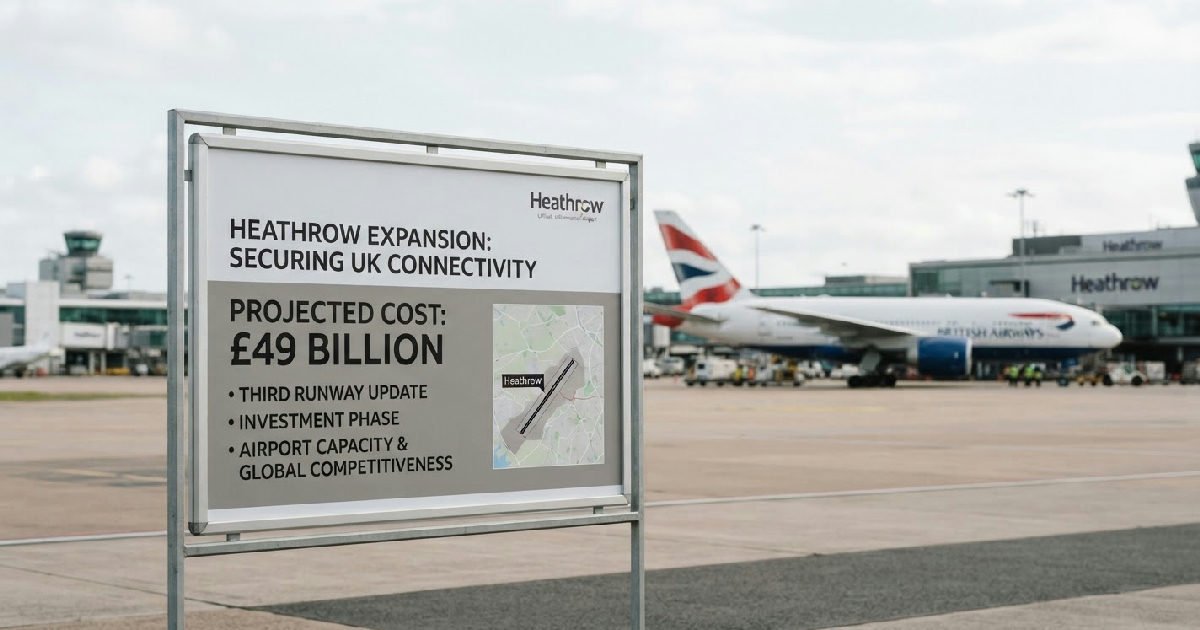
Heathrow expansion faces mounting pressure over “extortionate” £49 billion cost
The projected £49 billion Heathrow expansion cost for London Heathrow Airport’s third runway is under intense scrutiny, with leaders warning it could be unaffordable.
Critics, notably International Airlines Group (IAG), the parent company of British Airways, argue that the current cost model is unsustainable and risks cementing Heathrow’s position as the world’s most expensive major airport hub.
Escalating concerns over Heathrow expansion cost
The escalating debate pits the vital need for increased airport capacity against concerns that unchecked costs will ultimately burden airlines and passengers, leading to higher fares and potentially diverting traffic to more cost-effective international hubs. This stark warning comes as the UK government and the Civil Aviation Authority (CAA) weigh crucial decisions on the project’s financial framework.
The core of the dispute revolves around the estimated £49 billion cost for Heathrow Airport Limited (HAL)’s expansion proposal. This figure dwarfs comparable international projects and has drawn sharp criticism from major airline groups. IAG Chief Executive Luis Gallego has directly warned UK Prime Minister Andy Burnham that the current expansion scheme is “unaffordable and doomed to failure.”
The £49 billion estimate includes approximately £21 billion for the third runway and airfield infrastructure, £12 billion for new terminal and aircraft stand capacity, and a further £15 billion to modernise existing airport infrastructure. IAG, however, maintains that the expansion should not exceed £30 billion, highlighting a substantial £19 billion gap between Heathrow’s proposal and what airlines deem acceptable.
Willie Walsh, former IAG Chief Executive and current Director General of the International Air Transport Association (IATA), has long been a vocal critic of Heathrow’s cost management.
In October 2025, Walsh stated, “Heathrow’s long addiction to gold-plated construction costs has already earned it the unenviable standing as one of the most expensive airports in the world, if not the most expensive.” This sentiment underscores a persistent concern within the airline industry about the airport’s financial practices.
The economic fallout of unchecked airport charges
The financial burden of the Heathrow expansion is ultimately expected to fall on airlines, passengers, and businesses through increased airport charges. These charges directly influence ticket prices, cargo rates, and supply chain costs, impacting the UK economy more broadly.
Airlines have warned that average ticket prices could rise by £60 to £65 per person to fund the expansion, potentially costing a family of four an additional £250.
IAG estimates that even their preferred cost limit of £30 billion would translate to an additional £31.50 per passenger. The current average airport charge stands at £26.31 per passenger. While the CAA has proposed capping charges between £27.20 and £30.50 per passenger from 2027 to 2031, airlines fear that Heathrow’s plans could see these charges double, significantly eroding the airport’s competitiveness.
Sean Doyle, Chief Executive of British Airways, highlighted the crucial balance required in August 2025. “If we want to increase the number of passengers, we have to keep it competitive… If growth is at any price, it’s not going to happen,” he stated.
This perspective emphasizes that while expansion is desired, it cannot come at the expense of affordability, which could stifle the very growth it aims to foster.
The potential for such significant price hikes is already influencing global network planning decisions. Airlines evaluate airport charges when deciding where to base aircraft, allocate growth, and sustain commercial routes. A high-cost Heathrow risks becoming less attractive, leading to capacity and connectivity being deployed elsewhere, a loss that is notoriously difficult to rebuild once ceded.
Global precedents and competitive pressures
The debate around Heathrow’s expansion cost is set against a backdrop of fierce global competition, where rival hubs are expanding with greater cost control and operational efficiency. Airports in Europe, the Middle East, and Asia, such as Singapore Changi, Seoul Incheon, Munich Airport, and Hartsfield-Jackson Atlanta International Airport, demonstrate that large-scale expansion can be achieved without embedding structural inefficiencies or exorbitant costs.
These airports are not just growing; they are offering better value, making them increasingly attractive to airlines and passengers alike.
For instance, Beijing Daxing International Airport, opened in 2019, had initial cost estimates ranging from $10.5 billion to $17 billion for its core airport infrastructure, though the total project cost including extensive transportation links reached approximately $63 billion.
Meanwhile, Dubai’s Al Maktoum International Airport is undergoing a Dh128 billion (approximately $35 billion) expansion, aiming for massive capacity increases through modern financing and execution.
The stark contrast in cost efficiency raises questions about Heathrow’s proposed model. Critics argue that if Heathrow expands under its current framework, the UK risks a gradual erosion of its competitive position. Airlines and cargo operators could shift investment to better-value hubs, impacting the UK’s role in the global economy.
This is not merely a theoretical concern; early indicators of such shifts are already emerging in global aviation planning.
Maintaining a competitive edge is crucial for the UK. If Heathrow becomes an outlier in terms of cost, it could weaken the country’s attractiveness as a global hub for trade, tourism, and business connectivity. The challenge for policymakers is to ensure that the ambition for a larger Heathrow translates into sustainable economic benefits rather than a cost burden that undermines its strategic purpose.
Regulatory crossroads and the path forward
The ultimate decision on Heathrow’s regulatory and investment framework rests with the Civil Aviation Authority (CAA) and the UK government. Both entities face pressure to strike a balance between supporting necessary infrastructure expansion and protecting consumers from undue cost increases.
The CAA has previously authorized Heathrow Airport Limited (HAL) to recover up to £320 million in early expansion costs for planning and design work, which will incrementally increase passenger charges.
However, the broader financial model for the £49 billion project remains contentious. Airlines are advocating for a reformed approach that prioritises cost discipline, transparency, and genuine competitive tension in how infrastructure is financed, built, and operated. This would involve stronger incentives for measurable efficiency and service improvements, clearer governance over scope changes, and transparent links between spending and outcomes.
Tim Johnson, CAA Director of Consumers and Markets, stated in July 2026 that the authority’s decisions aim to balance timely progress on expansion with protecting consumers from unjustified costs. He emphasised that recoverable costs are capped, independently scrutinised, and subject to efficiency reviews. But critics, including IAG, argue that the current regulatory framework has not consistently aligned cost, delivery, and performance at Heathrow.
The choice before regulators is stark: either proceed with a model that risks locking in the world’s highest airport costs for a generation, potentially without commensurate efficiency gains, or reset the framework to ensure expansion is delivered with robust cost control and long-term competitiveness. This pivotal moment could define Heathrow’s future as a world-class hub or cement its reputation as a high-cost outlier.
The call for regulatory reform is not about limiting ambition but ensuring that the expansion delivers sustainable economic benefits for the UK. Without such reform, there is a significant danger that the expansion could reinforce Heathrow’s expensive status, thereby weakening the UK’s overall attractiveness as a global aviation gateway. This delicate balance between growth and affordability is now at the forefront of policy discussions.
The long-term vision for UK global connectivity
The debate surrounding the Heathrow expansion cost transcends a single infrastructure project; it touches upon the UK’s strategic role in a fiercely competitive global economy. The country unequivocally needs additional airport capacity to enable trade, strengthen global connectivity, and support long-term economic growth. Expanding Heathrow is central to this vision, but the manner in which it is delivered will determine its ultimate success.
A Heathrow spokesperson recently affirmed in November 2026 that “Expansion must be affordable for airlines and passengers, as well as financeable for investors, and we’re determined to deliver it.” This statement acknowledges the dual challenge of meeting financial viability for investors while ensuring the project remains accessible and competitive for its users. The tension between these objectives is palpable and requires a nuanced solution.
The stakes are high. If the expansion proceeds without adequate cost control, the UK risks losing its competitive edge in aviation, with airlines and cargo traffic potentially diverting to more efficient hubs. This would have ripple effects across various sectors, impacting trade, tourism, and foreign investment. The long-term implications for the UK’s economy and its global standing are significant.
Ensuring that Heathrow grows into a more efficient, resilient, and value-driven hub is paramount. This means not just building new infrastructure but also fostering a regulatory environment that rewards efficiency and demands transparency.
The success of the third runway project will hinge not just on its physical completion, but on its ability to integrate seamlessly into a global aviation market that increasingly prioritizes cost-effectiveness and operational excellence. The path forward demands a collaborative approach from all stakeholders to secure the UK’s future as a leading global aviation power.