

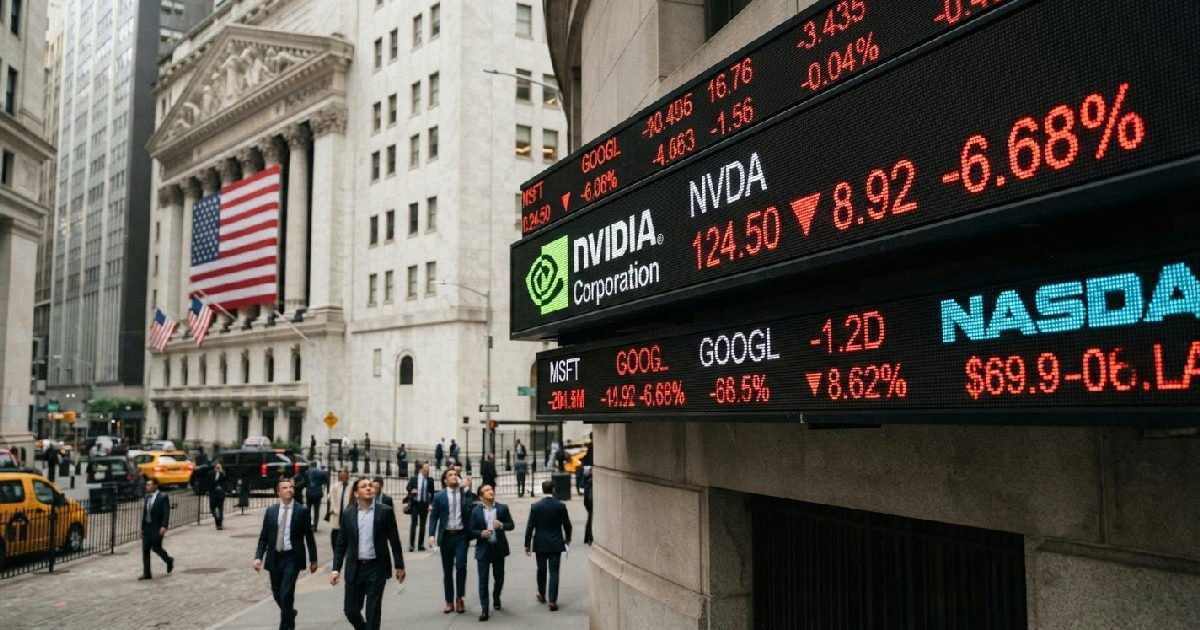
wall street eyes rebound after nvidia stock sell-off
Wall Street is bracing for a potential rebound on Monday, November 23, 2026, following a tumultuous week that saw an AI stock sell-off and major indices suffer their worst losses in years.
The anticipated market recovery comes after a significant sell-off on Friday, November 20, 2026, which dragged the S&P 500 down 3.7% for its deepest weekly decline in over 18 months and pushed the Nasdaq 100 into bear market territory.
The AI stock sell-off: a deep dive into market fears
This sharp downturn has ignited concerns among investors regarding the future profitability of artificial intelligence, rising borrowing costs, and potential restrictions on data-center construction. However, positive news from companies like CoreWeave and a more diversified U.S. market structure are now fueling expectations of a cautious recovery.
Unpacking the contributing factors
The catalyst for the recent market instability began brewing well before Friday’s crash. Concerns about the true return on investment for massive AI spending had been mounting, raising skepticism about the sector’s lofty valuations. A series of events then converged to trigger the sharp declines.
Democratic victories in the U.S. midterm elections, for instance, sparked worries about potential government restrictions on AI data center development and broader industry regulation. This political shift added a layer of uncertainty to an already volatile market. There were also growing fears that increasingly sophisticated AI tools could directly displace existing software companies, particularly those relying on per-user licensing models.
Individual stock performances highlighted the depth of the panic. Nvidia, a bellwether for the AI chip sector, reportedly fell approximately 14% on Friday, November 20, 2026, marking its ninth day of decline in ten trading sessions. Salesforce stock experienced its largest one-day fall since May 30, 2024, dropping 9.5% on Tuesday, November 17, 2026.
The initial public offering (IPO) of Anthropic, a prominent AI lab, further contributed to the tech sector’s woes. After an initial surge, its stock quickly fell, closing Friday, November 20, 2026, down 9.1% to $88.30. This reflected a 23% drop from its peak just two days earlier.
Exacerbating the market’s jitters was a scandal involving Nvidia CEO Jensen Huang, including revelations of extramarital affairs and alleged ties to a Chinese spy, which had a significant impact on investor confidence and the company’s stock price.
All these factors combined to create a sense of unease, suggesting that many AI stock prices had simply shot too high, creating a bubble ready to burst. This collective anxiety culminated in a widespread chip stock decline that reverberated across global markets.
Asian markets grapple with AI turbulence
The ripple effect of Wall Street’s AI stock sell-off was acutely felt across Asian markets on Monday, November 23, 2026. Major technology stocks experienced significant declines, reflecting the interconnectedness of global financial systems and the widespread apprehension surrounding the AI sector.
South Korean tech giants were particularly hit, with SK Hynix falling 3.1% and Samsung Electronics dropping 2.8%. The broader Kospi index consequently plummeted by more than 3%. Benchmark indices in China and Hong Kong also saw losses, declining by as much as 1% and 1.3% respectively.
However, not all Asian tech companies followed the downward trend. Taiwan Semiconductor Manufacturing Company (TSMC), a critical supplier in the global chip industry, managed to gain 2%, helping Taiwan’s Taiex index rise by 2.5%.
This positive movement for TSMC came after a challenging prior week where its shares had declined almost 15%, shedding 4.8% on Friday alone. The mixed performance in Asia underscored the selective nature of investor sentiment even amidst broader sector fears.
CoreWeave’s positive influence
Despite the recent bloodbath, U.S. markets are showing signs of resilience and are poised for a rebound, according to analysts. One key factor is the inherent diversification of the U.S. stock market compared to those in East Asia, as noted by Hao Hong, chief investment officer at Lotus Asset Management in Hong Kong.
He suggests this makes the U.S. less vulnerable to sharp, sudden reversals in AI sentiment.
A significant boost to market confidence came from CoreWeave, a cloud computing provider specializing in AI workloads. The company reported a smaller-than-expected loss and, crucially, raised its revenue forecast, which helped to allay some of the industry’s anxieties about AI profitability. CoreWeave’s positive outlook provided a much-needed counter-narrative to the prevailing negativity.
CoreWeave CEO Michael Intrator highlighted the company’s strong financial position, revealing approximately $9 billion in customer prepayments and deposits anticipated within the next three months. This substantial inflow of cash, combined with other financial resources, indicates progress toward self-funding and signals robust demand for its specialized services.
Individual stock performances reflected this renewed optimism. CoreWeave itself leaped by as much as 26.5%, while Micron Technology rallied up to 13.7%. Broadcom rose by 6.2%, and GE Vernova added 2.6%. Even Nvidia, which had been at the heart of the sell-off, climbed 5% on the back of this more positive sentiment.
This broader tech sector rally provided a sense of renewed hope, despite earlier concerns surrounding specific digital assets like those involved in the Anthropic IPO and its market impact.
The broader AI investment landscape
The recent volatility forces a critical examination of the broader AI investment landscape. Many analysts and investors have expressed concerns that the rapid ascent of AI stock prices had created a bubble, with valuations detached from realistic earnings potential. This skepticism is not unfounded, as the sector has seen unprecedented growth fueled by speculative interest.
The question of return on investment (ROI) for substantial AI spending remains a central theme. Companies are pouring billions into AI research, development, and infrastructure, but the path to widespread profitability for many of these ventures is still unclear.
This uncertainty makes investors highly sensitive to any news that could indicate a slowdown or a shift in the AI business model, prompting some to rethink their long-term investment strategies.
Furthermore, the U.S. midterm elections underscored how geopolitical and regulatory factors can significantly influence the tech sector. Democrat victories, and the subsequent concerns about potential restrictions on AI data center construction, demonstrate that policy decisions can have immediate and far-reaching impacts on investment decisions. The interplay between technological innovation, economic realities, and political landscapes will continue to shape the trajectory of AI stocks.
Outlook: navigating volatility in tech
As Wall Street looks to stabilize, the overall sentiment remains a complex mix of cautious optimism and underlying apprehension. The expected rebound on Monday, November 23, 2026, could provide a temporary reprieve, but the fundamental questions about AI profitability and sustainable growth persist. Investors are likely to remain vigilant, scrutinizing company earnings and guidance more closely than ever.
The recent events serve as a stark reminder of the inherent volatility in high-growth technology sectors. While AI undoubtedly holds immense transformative potential, its integration into traditional business models and its long-term financial viability are still evolving. This period of adjustment might see investors shift their focus from purely speculative growth to companies demonstrating clear revenue streams and robust financial health.
For the coming weeks, market watchers will be paying close attention to further corporate announcements and any new regulatory developments. The path forward for AI stocks will likely be characterized by continued fluctuations as the market seeks a more stable valuation for this revolutionary technology.
The focus will undoubtedly shift towards tangible progress and demonstrable value rather than just the promise of future innovation. Ultimately, the market will distinguish between genuine technological leadership and mere hype.