

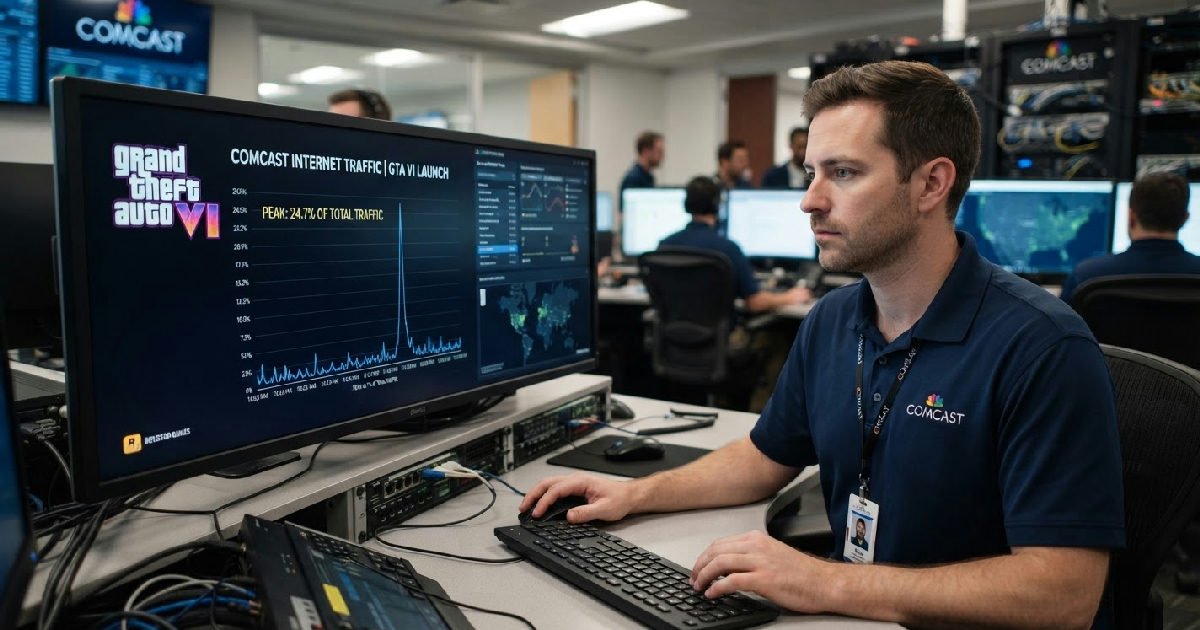
Comcast Grand Theft Auto VI launch consumed 25% of network
Comcast reported a colossal surge in internet usage following the September 17, 2025, launch of Rockstar Games’ Grand Theft Auto VI (GTA 6).
At its peak, the blockbuster game accounted for nearly a quarter of all network traffic across Comcast’s extensive infrastructure, marking the single biggest internet traffic day in the company’s history.
Comcast Grand Theft auto launch demand
This extraordinary demand saw overall network traffic climb by a staggering 31% above an average day, underscoring the immense cultural and technical footprint of major gaming releases. The figures highlight not only the commercial success of Grand Theft Auto VI but also the increasing strain such events place on global internet infrastructure.
Comcast shared these striking statistics in a post to X, detailing how the game’s debut on PlayStation 5 and Xbox Series X/S translated into an immediate and massive download rush. The company’s network experienced an unparalleled surge, with traffic comparable to that generated by major live sporting events or significant software updates.
The sheer volume of data being downloaded by millions of eager players pushed Comcast’s systems to their limits, demonstrating the scale of modern gaming phenomena. It’s a clear indicator that when a title like Grand Theft Auto VI hits the market, the impact extends far beyond the gaming community, touching the core infrastructure of the internet itself.
This monumental traffic spike underscores the game’s status as a generational release. Analysts had predicted significant demand, but the real-world network impact illustrates the true scale of player anticipation and immediate adoption. Internet service providers must now increasingly factor such events into their long-term capacity planning.
The data released by Comcast offers a rare glimpse into the immediate, tangible effects of a global entertainment release on digital infrastructure. While other titles generate significant traffic, few have ever commanded such a substantial proportion of an entire major ISP’s network at a single moment.
The monumental scale of Grand Theft Auto VI’s release
The release of Grand Theft Auto VI was always slated to be a landmark event, but its effect on internet traffic provides a concrete measure of its colossal footprint. Developed by Rockstar Games, the title arrived with immense anticipation, following years of speculation and a record-breaking trailer release in December 2023.
Players began pre-loading the massive 212GB game file as early as November 10, 2026, creating significant traffic surges even before the official launch. This pre-load period alone accounted for some of Comcast’s busiest days on record, illustrating how staggered distribution can still create concentrated demand peaks.
Initial sales figures for Grand Theft Auto VI further underscore its unprecedented success. The game reportedly sold 32.5 million units in pre-release, generating an astounding $3.79 billion in day-one retail sales. This made it the biggest entertainment launch in history across any medium, far surpassing previous records.
The game’s critical reception has also been stellar, achieving a near-perfect score of 99 on Metacritic. This combination of critical acclaim and overwhelming public demand has solidified Grand Theft Auto VI‘s place as one of the most significant entertainment products of the decade, driving digital consumption to new heights.
ISPs grapple with gaming’s growing footprint
Internet Service Providers like Comcast have been preparing for years to handle the escalating demands of online entertainment, including massive game downloads. The launch of Grand Theft Auto VI served as a real-world stress test for these advanced network infrastructures.
Comcast, a multinational mass media and telecommunications conglomerate, has proactively invested in virtualizing its network and deploying edge delivery systems. These technologies allow popular files, such as game downloads, to be served from caches closer to customers, significantly reducing latency and network strain.
Elad Nafshi, Chief Network Officer at Comcast, previously noted that Grand Theft Auto VI “could be one of the biggest moments in Internet history,” a prediction that has now been demonstrably proven. Such events validate years of strategic investment in network capacity and smarter infrastructure design.
Other ISPs reported similar experiences. Spectrum saw a 49% increase in traffic during the pre-load period, while BT and EE in the UK also experienced their highest broadband traffic peaks ever. These trends highlight a global challenge and a shared industry effort to keep pace with consumer demand.
Gaming’s evolving infrastructure demands
The colossal data traffic generated by Grand Theft Auto VI is a stark reminder of the ever-growing demands placed on internet infrastructure by the gaming industry. Modern video games are not only larger in file size but also require increasingly stable and low-latency connections for online play and updates.
Network capacity planning has become a critical discipline for ISPs. This involves meticulous analysis of historical data, forecasting future demand, and deploying scalable infrastructure to accommodate both expected and unexpected surges. Organizations like DE-CIX, a leading internet exchange, aim to maintain infrastructure utilization at or below 75% to ensure sufficient headroom for such events.
The success of pre-loading mechanisms, which allow players to download game files ahead of release, has proven invaluable in distributing bandwidth load over a longer period. However, even with pre-loads, the simultaneous launch of a title like Grand Theft Auto VI can still create unprecedented spikes.
As gaming continues its trajectory of growth and innovation, including advancements in cloud gaming and immersive virtual experiences, the reliance on robust and high-capacity internet infrastructure will only intensify. This necessitates continuous investment from operators who have already injected over $355 billion into network expansion over the past two decades.
Precedent and the future of online entertainment
While the Grand Theft Auto VI launch stands out, it isn’t the first time gaming has significantly impacted internet traffic. Previous events offer a comparative scale to the current phenomenon. In October 2024, the pre-launch of Call of Duty: Black Ops 6 accounted for 19% of total network traffic on some networks.
The official availability of Call of Duty: Black Ops 6, combined with live sports, accounted for 26% of total network traffic, showcasing how multiple high-demand events can converge. Looking further back, the 2004 launch of Halo II quadrupled Microsoft Xbox Live traffic on ISP networks, a significant event for its era.
Beyond gaming, major live streaming events have also tested network limits. For instance, an AFC Wildcard game streamed on Peacock in January 2024 consumed 30% of internet traffic and set a record for the most-streamed live event in U.S. history. This demonstrates the broad range of digital content now challenging internet infrastructure.
The ongoing trend signals a future where entertainment consumption, particularly in gaming, will continue to demand more from global broadband networks. ISPs and content providers face an ongoing imperative to innovate and expand, ensuring that the digital highways can accommodate the ever-increasing volume and velocity of traffic driven by titles like Grand Theft Auto VI.
Implications for game developers and players
The extraordinary traffic statistics surrounding Grand Theft Auto VI‘s launch also carry significant implications for game developers and the player experience. For developers like Rockstar Games, understanding these network dynamics is crucial for planning future releases and ensuring a smooth global rollout.
The sheer scale of downloads, especially for games with massive file sizes, emphasizes the need for efficient content delivery networks and potentially more staggered release strategies. While pre-loading helps, the peak demand moments remain intense. Developers often work closely with ISPs to optimize delivery during these critical periods.
For players, the reliability of their internet connection has become as important as their gaming hardware. Fast and stable downloads are now a baseline expectation. This event reinforces the value players place on a seamless day-one experience, free from download bottlenecks or network issues.
The success of Grand Theft Auto VI, both commercially and in its ability to monopolize a significant portion of internet bandwidth, sets a new benchmark for the entertainment industry. It highlights the increasingly intertwined relationship between digital content and the underlying infrastructure that delivers it to millions worldwide.
Gamers eagerly anticipating the next big release will undoubtedly watch how future launches stress test network capabilities.