

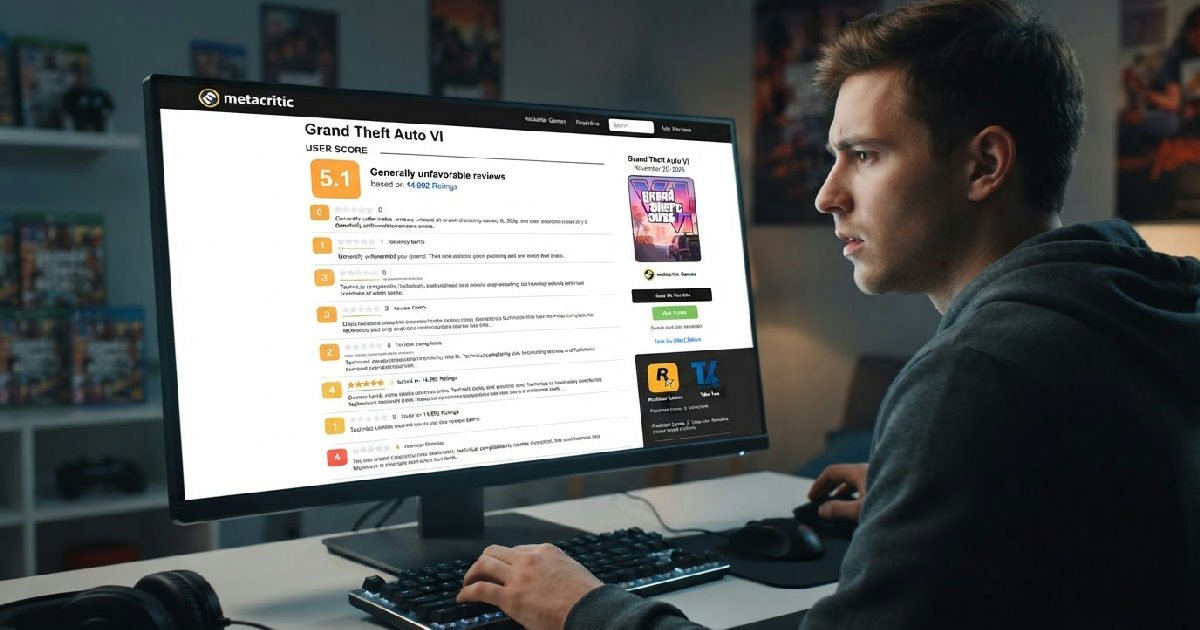
grand theft auto user review bombing hits metacritic user score
Grand Theft Auto VI, the highly anticipated title from Rockstar Games, has been hit by a coordinated mass review bombing campaign on Metacritic, plummeting its user score to 5.1 out of 10. The sudden drop occurred on November 20, 2026, just 36 hours after the game’s official release, as Metacritic opened its user review section.
This dramatic backlash starkly contrasts with the game’s near-universal critical acclaim, raising questions about the evolving landscape of online game reception.
Politically charged reviews swamp Grand Theft Auto VI
Many of the overwhelmingly negative reviews, which now constitute nearly half of the more than 10,000 user ratings, cite politically charged objections to the game’s content, with some users openly admitting they have not even played the title.
Publisher Take-Two Interactive had previously voiced concerns about such coordinated attacks, highlighting a growing trend in the gaming industry where player sentiment often diverges sharply from professional critical assessments.
The user review section for Grand Theft Auto VI on Metacritic rapidly filled with negative feedback shortly after it went live on November 20. Users on platforms like X highlighted the influx of overtly critical assessments.
The game, released on November 19, 2026, for PlayStation 5 and Xbox Series X|S, quickly saw its user score drop to 5.1 out of 10, with almost 50% of the more than 10,000 submitted ratings falling into the “Negative” category (scores of 49 or below out of 100).
A significant portion of these low scores arrived with comments labeling the game “woke slop” and a “cuck simulator,” primarily targeting its relationship gameplay mechanics. Other complaints revolved around the game being digital-only and claims of game-breaking bugs.
Critically, many negative reviews were submitted by users who explicitly stated they had not played the game, indicating a targeted effort to artificially depress the score. This rapid descent in user rating has ignited further debate about the integrity of community-driven review platforms.
Critics praised Rockstar’s record-breaking new release
The contentious user reception stands in stark opposition to the critical consensus that greeted Grand Theft Auto VI. Prior to the user scores going live, the game achieved a Metascore of 99 out of 100 from professional critics, based on between 109 and 152 reviews.
This score signified “Universal Acclaim” and a “Must Play” status, tying it with The Legend of Zelda: Ocarina of Time as the highest-rated game in Metacritic’s history.
Detailed metrics showed that 83% of the 132 scored PlayStation 5 reviews were perfect 100s, with not a single score falling below 90. Prominent outlets such as IGN and GameSpot each awarded the game a perfect 10/10.
Beyond critical praise, Grand Theft Auto VI also broke entertainment industry sales records, with 32.5 million copies sold prior to release, making it the most preordered video game of all time.
Players were eager to dive into the expansive world set in the fictional US state of Leonida, a rendition of Florida that includes a Miami-inspired Vice City. Some players even found an early access method to begin playing ahead of the official launch in their region.
The game, featuring criminal duo Jason Duval and Lucia Caminos, has been a monumental release for Rockstar Games, a subsidiary of Take-Two Interactive Software, Inc.
Take-Two’s enduring concerns about review bombing tactics
The publisher of Grand Theft Auto VI, Take-Two Interactive, had publicly expressed apprehension about the potential for review bombing long before the game’s release. This concern materialized with the onslaught of negative user reviews on Metacritic. The video game holding company, which owns Rockstar Games, has witnessed similar campaigns affect other high-profile titles across the industry.
Metacritic itself has measures in place to mitigate such events. Since 2020, following a notable incident with The Last of Us Part II, the platform has enforced a 36-hour delay between a game’s release and when user reviews can be posted.
This policy aims to ensure players have adequate time to experience the game before submitting feedback. Despite this preventative step, the recent events surrounding Grand Theft Auto VI demonstrate that review bombing remains a persistent challenge for user review aggregators.
There was even a precursor to this current wave of negative reviews. On November 17, 2026, Metacritic had to remove fake user reviews for Grand Theft Auto VI that surfaced before the game was officially available, leading to a temporary block on new user submissions. This earlier incident highlighted the pre-release intent among some users to influence the game’s public perception negatively.
A history of user scores diverging from critical acclaim
The review bombing of Grand Theft Auto VI is not an isolated incident but rather the latest example in a broader trend within the video game industry. High-profile releases have frequently become targets of coordinated negative review campaigns, often driven by factors beyond a game’s intrinsic quality. These factors commonly include perceived political messaging, technical issues, or controversial developer decisions.
Previous instances include The Last of Us Part II, which faced massive review bombing in 2020 due to plot leaks and the inclusion of LGBTQ+ characters. Its remastered version also experienced similar backlash in January 2024.
Other titles like Death Stranding in 2019, Battlefield 2042 in 2021 and 2025, and the Horizon Forbidden West: Burning Shores DLC in 2023 have all seen their user scores significantly impacted by coordinated efforts. The Burning Shores DLC, for instance, received low user ratings largely due to protagonist Aloy’s queer romantic relationship.
This recurring pattern illustrates a growing chasm between critical reception, which often focuses on technical achievement, narrative depth, and gameplay mechanics, and user scores, which can be influenced by broader cultural debates or pre-existing biases. The phenomenon challenges the utility of user review systems as objective barometers of game quality, especially when campaigns are fueled by motivations unrelated to gameplay.
Where Grand Theft Auto VI’s user reception might settle
As the initial storm of negative reviews subsides, it remains uncertain where Grand Theft Auto VI’s user score on Metacritic will ultimately land. While many early negative reviews appear to be driven by external factors, genuine criticisms regarding console performance, control schemes, or absent franchise features have also emerged. These legitimate concerns risk being obscured by the noise of the coordinated bombing campaign.
However, industry observers suggest that the game’s initial overwhelming critical success and record-breaking sales figures will likely buffer its long-term reputation. Rockstar Games has a history of titles, such as previous Grand Theft Auto installments, that maintain high regard despite initial controversies.
The eventual release of a PC version, expected in Q1 2027, and the full rollout of its multiplayer components could also introduce new player demographics and potentially shift overall user sentiment.
The cultural impact of Grand Theft Auto VI is already palpable, extending beyond gaming into broader entertainment spheres. This widespread influence suggests that while the current review bombing is a significant event, the game’s standing as a major cultural product is unlikely to be permanently diminished by these early user score fluctuations.