

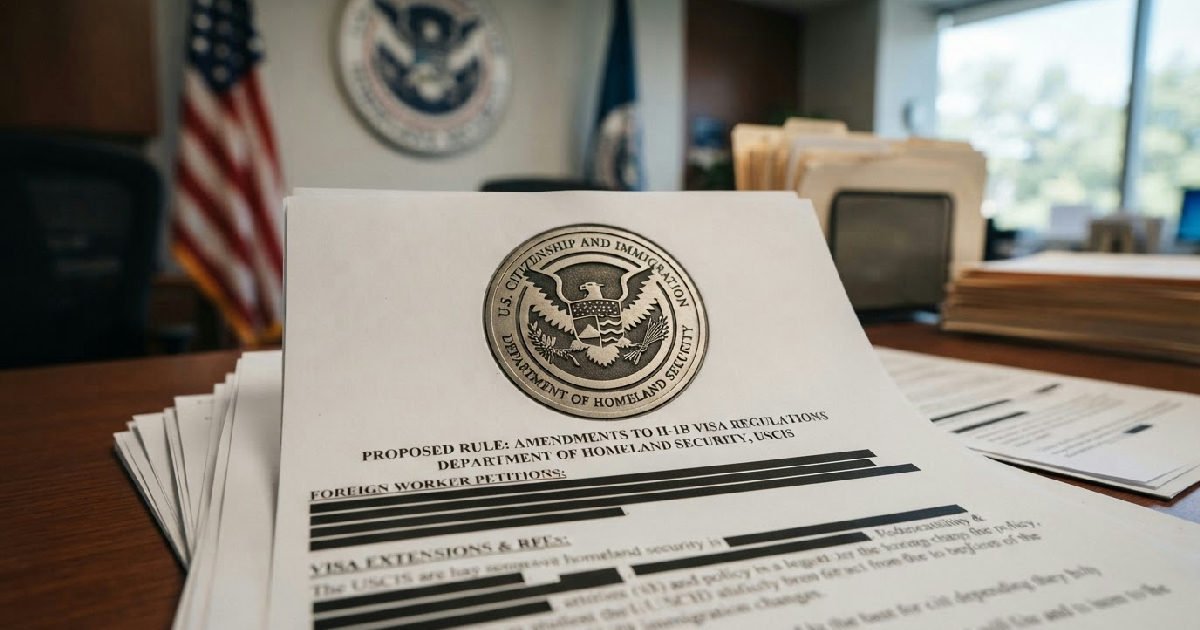
uscis tightens foreign worker visa rules
The Department of Homeland Security (DHS) has formally published a proposed rule on October 14, 2026, aimed at tightening U.S. Citizenship and Immigration Services (USCIS) visa rules for foreign workers.
This significant policy shift seeks to eliminate a long-standing requirement for immigration officers to defer to their own prior approvals when processing routine visa extension applications. The change impacts thousands of professionals on temporary employment visas, particularly those in the critical H-1B category.
Understanding the Proposed Policy Shift as US USCIS Tightens Visa Rules
This proposed alteration, officially titled ‘Removing Deference to Prior USCIS Determinations of Eligibility,’ could introduce substantial uncertainty for both foreign workers and their sponsoring companies. It specifically targets the regulation requiring U.S.
Citizenship and Immigration Services officers to give weight to their own earlier decisions when adjudicating routine visa extensions, even when the underlying facts remain unchanged. This shift may also affect how firms approach investing in America. The public comment period for this proposal concluded on November 13, 2026.
The core of the Department of Homeland Security proposal involves deleting 8 CFR 214.1(c)(5), a federal regulation that currently mandates USCIS officers to generally defer to previous approvals for Form I-129 extensions. This applies when the parties and underlying facts of a petition remain the same. The current rule allows exceptions only for material error, changed circumstances, or new adverse information.
By marking this paragraph as ‘[Reserved],’ the proposed change would empower U.S. Citizenship and Immigration Services officers to review every extension application from scratch. They would no longer be bound by prior favorable determinations. DHS officials argue this is necessary to ensure officers feel unencumbered in requesting additional evidence when eligibility hasn’t been fully established.
The department also believes it prevents potentially questionable decisions from influencing future petitions. This reinforces the principle that the petitioner bears the burden of proof in every filing.
Potential Impacts on Workers and Employers
This policy shift is projected to have wide-ranging consequences. The Department of Homeland Security estimates approximately 208,429 petitions annually would no longer benefit from the deference policy. For foreign professionals on H-1B, L-1, O-1, TN, and E visas, this means increased scrutiny during routine extensions.
This creates significant instability for visa holders and their families, even if their job role and employer haven’t changed. The Department of Homeland Security anticipates around 6,044 additional Requests for Evidence (RFEs) each year as a direct result of this change. An increase in RFEs will inevitably lead to longer processing times for visa extensions, creating uncertainty for workers.
This can push more cases towards the 240-day work authorization limit. It could potentially force employees to stop working if their approval isn’t granted in time. Longer adjudication timelines could also force employees to delay international travel, and immigration attorneys warn of widespread processing bottlenecks in technology, healthcare, and engineering sectors.
The H-1B visa category accounts for over 75% of all Form I-129 filings, making it the most affected by these changes. A substantial 77.6% of H-1B approvals for continuing employment in fiscal year 2025 were for workers born in India. Small businesses, which filed 57% of H-1B extensions in FY 2025, also face considerable new administrative burdens and costs.
A History of Shifting Visa Deference Policies
The concept of deference in immigration adjudication has a contentious history. The policy was first formalized in April 2004 when U.S. Citizenship and Immigration Services issued an internal memorandum directing adjudicators to respect prior approvals. This provided a degree of predictability for foreign workers and their employers.
However, this stability was disrupted in October 2017 when the Trump administration rescinded the 2004 memo. The immediate aftermath saw a sharp increase in Requests for Evidence and processing backlogs, particularly for H-1B renewals. Denial rates for continuing H-1B employment surged by 140%, climbing from 5% in fiscal year 2017 to 12% in both FY 2018 and FY 2019.
RFE rates also escalated dramatically during this period, increasing from 21.4% to over 40%. The Biden administration then sought to reverse this trend. In April 2021, the deference policy was restored within the USCIS Policy Manual.
Further solidifying this approach, DHS formally codified deference into the Code of Federal Regulations (8 CFR 214.1(c)(5)) as part of the H-1B Modernization Final Rule in December 2024. This codification took an effective date of January 17, 2025. The current proposed rule aims to undo this recent action, bringing the policy full circle back to a state of non-deference.
Broader Landscape of US Immigration Changes in 2026
This proposed elimination of deference isn’t an isolated event. It’s part of a broader series of regulatory changes and proposals impacting foreign workers in 2026. The U.S. government has been actively implementing adjustments to strengthen program integrity and respond to evolving economic and labor market conditions.
These concerted efforts signal a comprehensive review and tightening of various visa categories. For instance, the Department of Labor (DOL) has submitted a final rule to the Office of Management and Budget (OMB). This rule proposes significantly increased prevailing wage minimums for H-1B, H-1B1, E-3 nonimmigrant programs, and the PERM labor certification program.
It aims to better align foreign worker wages with those of U.S. workers.
This could potentially add an estimated $1.46 billion to employer costs in the first year. The rule originated from a presidential proclamation in September 2025. Another significant change is the weighted H-1B lottery selection process. For the FY 2027 H-1B cap season, U.S.
Citizenship and Immigration Services replaced the traditional random lottery with a system that favors higher wage levels. This aims to give greater weight to higher-skilled and higher-paid workers.
Separately, USCIS reported a 26.9% decrease in H-1B registrations for FY 2026 compared to FY 2025. Registrations dropped from 470,342 to 343,981 for that fiscal year. This shift in the lottery design for FY2027 also led to a positive trend towards higher-skilled and higher-paid workers, with registrations for beneficiaries holding U.S. Master’s degrees rising from 45.1% in FY 2026 to 66.1% in FY 2027.
Moreover, several proposals and increases related to fees and surcharges have emerged. The premium processing fee increased to $2,965 as of March 1, 2026. A $4,000 ‘9-11 Biometric Fee’ was also extended to H-1B or L-1 workers extending their status under certain employer conditions.
Most notably, DHS issued a proposed rule in August 2026 to establish a new, substantial $103,265 fee for each cap-subject H-1B petition. This is aimed at generating revenue for immigration system administration. Beyond these, the Department of Labor is advancing comprehensive updates to the Permanent Labor Certification (PERM) program.
These are intended to revise recruitment requirements and strengthen protections for American workers, particularly those affected by layoffs.
These proposals, which completed Office of Management and Budget review by October 27, 2026, will impose additional compliance obligations on employers seeking to sponsor green cards. Additionally, in September 2026, DHS proposed eliminating a 60-day grace period. This period currently allows H-1B and certain other temporary workers to remain legally in the country after termination.
If finalized, workers could lose legal status the day their employment ends.
This would create a much more precarious situation for them. The array of proposed and implemented changes suggests a concerted push to re-evaluate and restrict various avenues for foreign employment in the U.S.
Navigating Future Uncertainties and Economic Implications
The proposed elimination of deference, coupled with other concurrent policy adjustments, signals a more challenging environment for firms sponsoring foreign workers and for the workers themselves. The increased administrative burden and potential for delays could deter some companies. This is especially true for smaller entities, from fully utilizing visa programs.
Immigration attorneys and corporate sponsors have voiced concerns that implementing these rules could revive widespread processing bottlenecks. These impacts are anticipated across the technology, healthcare, and engineering sectors. These industries heavily rely on foreign talent.
Increased bureaucratic hurdles could impact their ability to innovate and compete globally. The current proposed rule is not yet finalized, meaning the existing deference policy remains in effect unless DHS issues a final rule and it officially takes effect.
The outcome of this proposed rule, combined with other ongoing changes, will shape the future landscape of skilled immigration to the United States. These include increased prevailing wages and the potential elimination of the grace period. Businesses and foreign professionals will need to closely monitor these developments.
They must adapt to what appears to be a continuing trend of stricter immigration enforcement and higher compliance demands.