

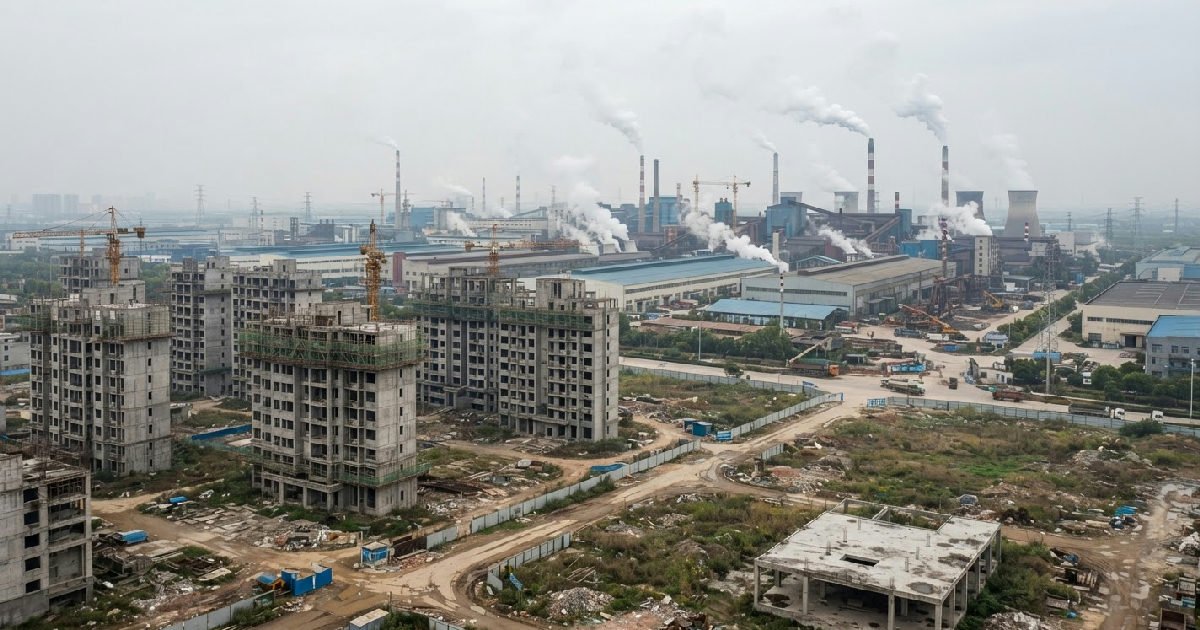
China’s economic engine sputters in October
China’s economic slowdown deepened in October 2026, with key indicators for industrial output, retail sales, and fixed-asset investment all missing analyst estimates. Data released by the National Bureau of Statistics (NBS) on November 16, 2026, painted a clear picture of persistent underlying weaknesses in the world’s second-largest economy, impacting China’s economic engine.
This latest set of figures suggests that Beijing’s efforts to stimulate growth aren’t gaining sufficient traction. The continued struggles highlight a structural imbalance, where robust manufacturing and exports often overshadow a more hesitant domestic consumer base and a troubled property sector.
October’s disappointing metrics for China’s economic engine
Industrial output expanded by 4.8% year-on-year in October, a noticeable drop from September’s 5.5% and below Reuters’ forecast of 5.3%. This slowdown occurs even as some carmakers ramped up vehicle shipments, anticipating potential tariff increases between Beijing and Brussels. The year-to-date value-added industrial output still saw a 5.3% increase through October, but the monthly dip raises concerns.
Meanwhile, retail sales, a crucial barometer of consumer spending, rose by only 0.4% year-on-year. This figure fell significantly short of the 0.8% predicted by Reuters and the 1.07% forecasted by Chinese financial data provider Wind. It also marked a deceleration from September’s 1.1% growth, underscoring ongoing consumer caution despite the week-long National Day holiday, which typically boosts consumption.
Fixed-asset investment collapse deepens
Perhaps the most concerning data point came from fixed-asset investment (FAI), which shrank by 8.1% year-to-date through October. This decline was worse than analysts’ expectations of a 7.0% fall and Wind’s forecast of a 6.92% decrease. It also represented a further deterioration from the 7.2% contraction recorded for January-September, signaling a deep and persistent investment slump unprecedented outside the Covid-19 pandemic period.
The property sector, a major component of FAI, continues to be a significant drag on the economy. Investment in real estate development plummeted by 21.6% during the first ten months of the year. Sales of new homes by floor area also contracted, falling by 13.7% in the same period, slightly worsening from the 13.2% drop seen in the first three quarters.
Persistent structural imbalances and policy challenges
The latest numbers underscore China’s ongoing battle with weak domestic demand. Consumers remain wary, holding back on spending for more than four years, a direct consequence of eroding household wealth and a lack of confidence in the economic outlook. This persistent consumer reticence is a critical challenge for Beijing’s long-term growth ambitions.
The property market downturn remains at the heart of this cautious sentiment, now entering its fifth year. The crisis has not only hit developers hard but has also significantly impacted household balance sheets, with many Chinese families having a substantial portion of their wealth tied up in real estate.
The reverberations from this sector are felt across the economy, creating a ripple effect that further dampens domestic spending.
Fu Linghui, a spokesperson for the National Bureau of Statistics (NBS), acknowledged these challenges on Monday. While stating the economy was “generally stable,” he pointed to “unstable and uncertain factors in the international environment.”
He also highlighted the “domestic imbalance between strong supply and weak demand,” describing it as acute and a foundation for stable economic improvement that needs consolidation. This frank assessment from a senior official points to the depth of the issues at hand.
Beijing’s response has largely centered on “measured stimulus,” focusing primarily on maintaining factory output and supporting exports rather than directly boosting household incomes or creating stable jobs.
This approach, while shoring up the manufacturing base, has done little to address the fundamental lack of consumer confidence or the need for a rebalancing towards domestic consumption, as many economists have long advocated. The broader global investment climate also remains a key factor, with bitcoin buyers grappling with market volatility.
Inflation, employment, and the global picture
Beyond the headline growth figures, China is also contending with rising producer prices. The Producer Price Index (PPI) increased by 5.7% year-on-year in October, the fastest annual increase since June 2022. This surge was primarily driven by escalating energy costs, partly linked to the Iran war, and higher prices for AI-related electronics.
This upward pressure on input costs could squeeze manufacturers’ margins, even as industrial output slows, creating a challenging environment for profitability.
Conversely, the Consumer Price Index (CPI) increased by a modest 0.7% year-on-year in October, a decrease from 0.9% in September and below economists’ expectations of 0.8%. This reading falls well below Beijing’s official target of around 2%, indicating that inflationary pressures are not being passed on to consumers, which further highlights weak domestic demand.
Core inflation, which strips out volatile food and energy prices, also eased to 0.8% from 1.0% the previous month.
The labor market offered a mixed picture. The surveyed urban unemployment rate edged down to 5.1% in October from 5.2% in September. The jobless rate for young people aged 16 to 24, excluding students, stood at 18% in September, near its highest level in a year.
While the overall urban unemployment rate improved slightly in October, this September youth unemployment figure highlights a persistent challenge, posing a significant social and economic risk.
Despite these domestic challenges, China’s economy has found some support from a robust export performance. Exports surged an impressive 35.2% in October on a yearly basis, partly fueled by the global demand for AI-related products. This reliance on external markets, however, makes the economy vulnerable to shifts in global trade dynamics and potential tariffs.
Moreover, the broader financial markets continue to exhibit sensitivity, as seen with crypto crash discussions tied to major IPOs.
The path ahead for China’s economy
The economic outlook for China in 2026 remains uncertain, with a combination of shaky exports, stalled domestic consumption, and persistently low business and consumer confidence. Meanwhile, the bitcoin price continues to show significant movement.
The official manufacturing Purchasing Managers’ Index (PMI) declined to 49.3 in October, signaling contraction, even as a private manufacturing PMI stayed above 50 at 52.0. This divergence suggests a two-speed economy, where state-backed enterprises might be faring better than private firms.
The government faces a delicate balancing act. While the National Bureau of Statistics spokesperson acknowledged the “unstable and uncertain factors in the international environment,” and the “domestic imbalance between strong supply and weak demand,” the policy response has so far avoided large-scale stimulus. Instead, it has opted for targeted measures, which some analysts argue are insufficient to kickstart a comprehensive recovery.
Critics suggest that Beijing’s deep-seated reliance on manufacturing and infrastructure investment as primary growth drivers needs to evolve. A sustainable recovery likely requires a more concerted effort to boost household incomes, strengthen social safety nets, and restore confidence in the housing market.
Without these fundamental shifts, the world’s second-largest economy risks prolonged stagnation, with significant implications not just for its own citizens but for global trade and economic stability.