

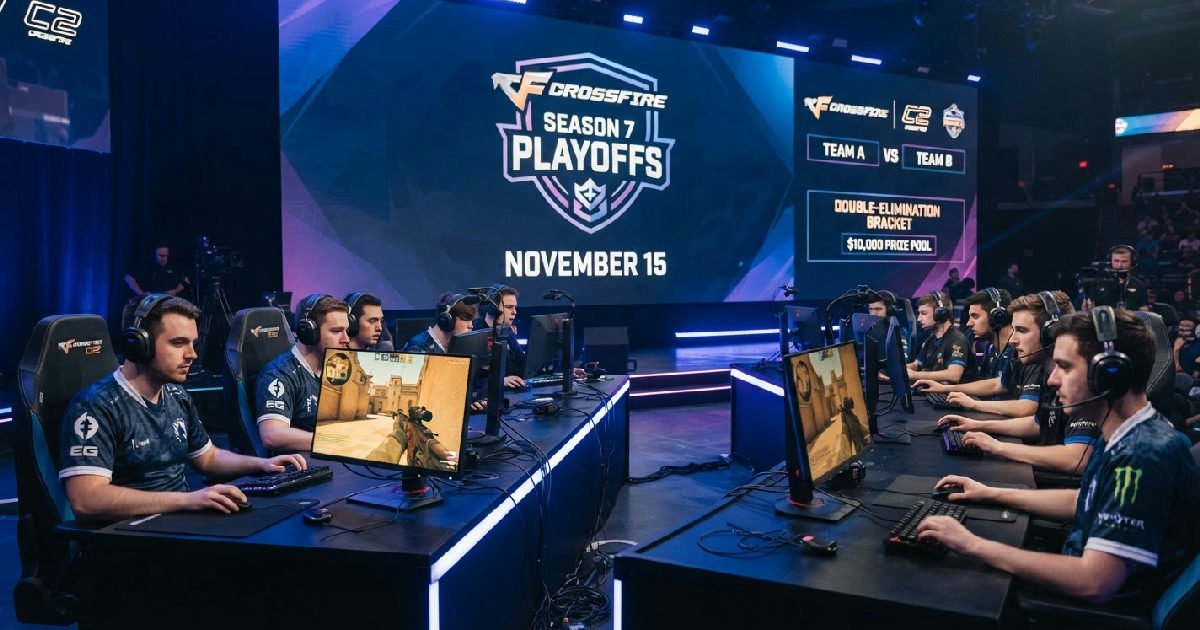
crossfire season 7 playoffs begin november 15
The stage is set for one of North America’s significant online Counter-Strike 2 tournaments as the CROSSFIRE Season 7 playoffs officially commenced on November 15, 2026. A massive field of 32 teams has advanced to the main event, where they will battle through a grueling double-elimination bracket for a share of the $10,000 prize pool.
This C-Tier event, which serves as a crucial proving ground for aspiring professional teams, whittled down an initial pool of 56 competitors over two weeks of group stage play.
Understanding the CROSSFIRE Season 7 Playoffs Structure
The final bracket, running through December 13, is a mix of 24 squads that fought their way through the groups and eight top-ranked teams that received direct invitations based on their VRS rank, setting the scene for a month of intense competition.
With the group stage now complete, the real test of endurance and strategy begins. The CROSSFIRE Season 7 playoffs utilize a 32-team double-elimination format, a structure known for producing dramatic storylines and rewarding consistency. For teams, this means a single series loss isn’t the end of their tournament life; it simply sends them to the lower bracket for a second chance.
However, a second defeat results in immediate elimination, ratcheting up the pressure on every single match. All contests leading up to the Grand Final are scheduled as Best-of-3 (Bo3) series, requiring a broad map pool and adaptable strategies from every roster.
Teams must be prepared for a marathon, not a sprint, demonstrating deep tactical knowledge and resilience to navigate through multiple opponents. This format often sees meta loadouts and innovative strategies emerge as teams adapt.
The tournament culminates in a Best-of-5 (Bo5) Grand Final on December 13, 2026. In a significant twist that heavily rewards a flawless run, the team that advances through the upper bracket will start the Grand Final with a 1-0 map advantage.
This built-in lead provides a powerful incentive for teams to avoid dropping to the lower bracket, where the path to the championship is significantly longer and more perilous.
It also adds a layer of strategic depth to the final, as the lower-bracket finalist must win three maps before their opponent wins two, demanding exceptional performance under pressure.
Top Seeds and Notable Challengers
While the group stage largely saw favored teams advance, the eight squads that received direct playoff byes enter with a distinct advantage. These teams, invited due to their high standing in the VRS rankings, bypassed the initial phase entirely.
They include reigning Season 6 champion Without a Roof, alongside other formidable rosters like LAG, Marsborne, regain, Iowa Stormboar, Overtake, and Chicken Coop. These established teams are widely considered the frontrunners, carrying the weight of expectation into the main event.
But the 24 squads that emerged from the group stage are battle-tested and carrying crucial momentum. Teams like DETONATE, Swole Patrol, and Phantom Sense successfully navigated the rigorous round-robin groups to earn their spot in the main event.
Their recent match experience and proven ability to perform under pressure could prove invaluable against the “cold” top seeds, who haven’t played official matches in the tournament’s current stage. The full roster of contenders showcases the depth of talent across North America, including:
- United States Without a Roof
- United States Axial
- United States NuTorious
- United States KODEX
- United States FarmVille
- United States Celestial
- EMPIRE
- United States Old Meta
- United States Marsborne
- Mexico Club 333
- United States NorthForge
- United States Elusive
- United States Overtake Sector
- United States Endless
- United States Wanted Goons
- United States DETONATE
- United States LAG
- United States NXG
- United States Villainous
- Canada Phantom Sense
- United States Chicken Coop
- United States Swole Patrol
- United States feinstein
- NZ
- United States regain
- United States Addice Inc.
- United States Milk
- Olympus
- United States Iowa Stormboar
- United States NineFly
- United States Vlandian Knights
- United States Without a Roof (listed twice in source)
CROSSFIRE’s Enduring Role in CS2 Esports
CROSSFIRE Season 7 isn’t just another tournament; it’s a critical component of the North American Counter-Strike 2 ecosystem. Classified as a C-Tier event and a Valve Tier 2 tournament, it occupies a vital space below the elite international competitions. This positioning means it serves as a crucial proving ground for emerging talent and established semi-professional teams looking to break into the global spotlight.
The event’s VRS-enabled status further amplifies its importance. The VRS ranking system provides a standardized measure of team strength and performance, directly influencing invitations to higher-tier events and seeding in future tournaments. Performing well in CROSSFIRE can significantly boost a team’s standing, offering a clear pathway for progression in the highly competitive online gaming world.
For many players, these tournaments are the most direct route to gaining recognition and potentially attracting scout attention from top-tier organizations.
A Legacy of Champions: Tracing the Series’ History
The CROSSFIRE series has a rich history in the North American scene, fostering rivalries and celebrating consistent excellence. Over its six prior seasons, several teams have etched their names into the tournament’s lore. regain stands out with an impressive three titles, securing victories in Season 1, Season 4, and Season 5. This consistent performance underscores their pedigree within the regional circuit.
Other past champions include Zomblers, who claimed the Season 2 title, and Chicken Coop, who triumphed in Season 3. Most recently, Without a Roof secured the Season 6 championship, setting a high bar for their competitors this season.
These previous winners highlight the dynamic nature of the competition, with established teams consistently performing at a high level while new challengers frequently emerge to shake up the standings.
The $10,000 Prize Pool: More Than Just Cash
While $10,000 might seem modest compared to international majors, for teams competing at the C-Tier level in North America, it represents significant stakes. For many players, success in CROSSFIRE provides not only a direct financial reward but also invaluable exposure and validation.
This prize money can help support aspiring professionals, covering costs like equipment upgrades, travel to smaller LAN events, or simply providing recognition for their dedication.
Beyond the monetary value, winning or performing strongly in a tournament like CROSSFIRE Season 7 elevates a team’s profile within the regional scene. This increased visibility can lead to greater opportunities, including attracting potential sponsors, securing better organizational backing, or even individual players catching the eye of higher-tier teams looking to recruit.
It serves as a tangible marker of progress in a competitive field, making every map and every round in these intense matchups crucial for long-term aspirations.