

Eduardo Diaz’s EYM Diner bankruptcy follows IRS debt
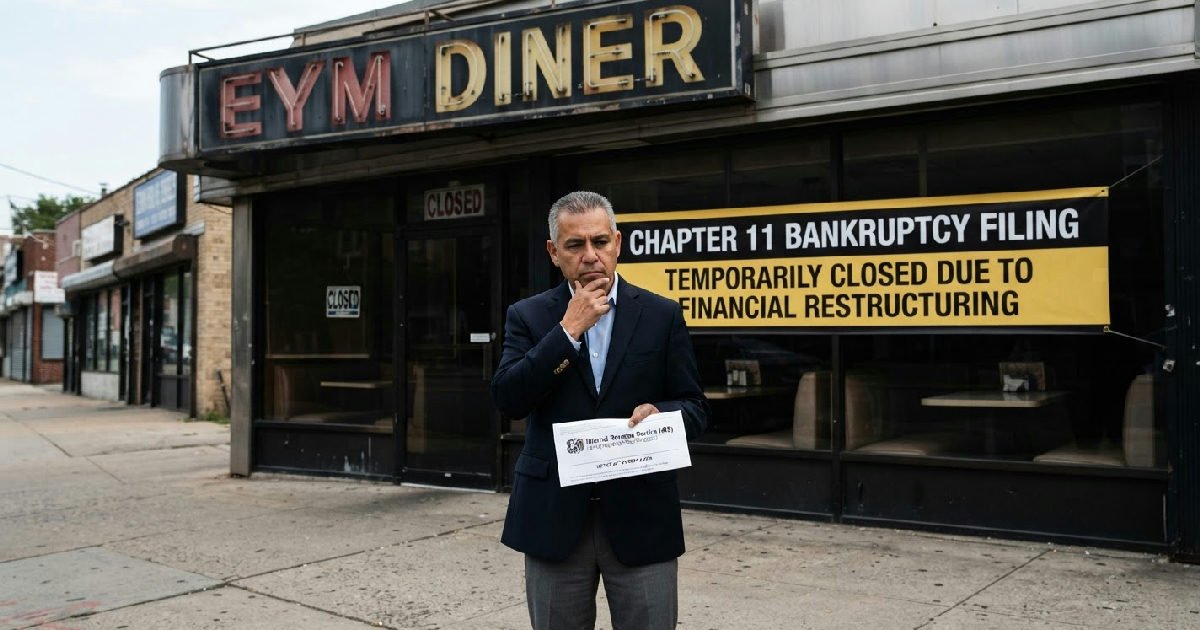
EYM Diner, a Texas-based operator of 30 Denny’s restaurants, officially filed for Chapter 11 bankruptcy on October 29, 2026, in a North Texas court. This latest development adds to a challenging period for EYM Group, founded by former McDonald’s executive Eduardo Diaz, which has seen several of its multi-brand franchise operations falter in recent years.
The filing reveals significant financial strain, with the company reporting less than $50,000 in assets against liabilities ranging from $10 million and $50 million.
EYM Diner bankruptcy and IRS debt
The largest unsecured creditor in this bankruptcy case is the Internal Revenue Service (IRS), which is owed nearly $3.5 million in unpaid payroll taxes. This substantial debt highlights the severe financial difficulties EYM Diner has been navigating. The Chapter 11 filing aims to provide the company with a framework to restructure its debts and operations.
The recent bankruptcy filing by EYM Diner underscores a precarious financial situation. Court documents detail assets totaling less than $50,000, a stark contrast to its liabilities that span between $10 million and $50 million. This considerable imbalance reflects deep-seated issues within the company’s operational finances.
A critical component of these liabilities is the nearly $3.5 million owed to the IRS for unpaid payroll taxes. Such a large sum of overdue taxes can indicate significant cash flow problems or mismanagement. It represents a serious legal and financial obligation that typically carries severe penalties for non-payment.
For the 30 Denny’s restaurants operated by EYM Diner across Texas and Florida, the bankruptcy filing initiates a period of uncertainty. These locations employ numerous individuals whose livelihoods depend on the outcome of the restructuring process. The immediate future for these restaurants hinges on successful asset sales or new ownership.
The entrepreneurial journey of Eduardo Diaz
Eduardo Diaz, the founder of EYM Group, embarked on an ambitious entrepreneurial path after a distinguished career at McDonald’s. He previously served as president of McDonald’s Mexico, gaining valuable experience in large-scale restaurant operations. This background laid the foundation for his own venture into the franchise world.
In 2007, Diaz established EYM Foods, initially focusing on operating McDonald’s restaurants in Dallas. He quickly grew this portfolio to six locations before selling them in 2011. This successful initial phase propelled his expansion into a diverse range of popular restaurant brands, including Denny’s, Panera Bread, KFC, Burger King, and Pizza Hut.
At its peak, EYM Group managed over 200 locations across Texas and Florida, reflecting Diaz’s ambition to build a formidable multi-brand empire. He leveraged his expertise in the fast-food sector, with a strategy involving acquiring multiple franchises. This aimed to diversify revenue streams and expand market reach, evident in the group’s rapid growth.
However, the rapid expansion also brought increased complexity and financial exposure. The challenges of managing a vast portfolio across different brands ultimately led to the current series of financial setbacks. Despite his initial successes, the broader economic environment and operational hurdles proved formidable obstacles for the group.
A troubling pattern of bankruptcies across EYM Group brands
The Chapter 11 filing for EYM Diner is not an isolated incident; it follows a troubling pattern of financial distress within EYM Group. Since 2023, several of Diaz’s other franchise holdings have faced bankruptcy filings and widespread closures. This indicates systemic issues affecting the broader organization.
One of the earliest and most significant issues involved EYM King of Michigan, the group’s Burger King franchisee. In 2023, a contractual dispute and a lawsuit over late royalty payments from Burger King led to the closure of all 26 Burger King restaurants in the state.
This abrupt shutdown left numerous employees without jobs and highlighted operational and financial strain. US job growth figures illustrate the importance of employment stability.
EYM Chicken, operating KFC locations, also experienced severe difficulties. In 2023, 25 KFC restaurants across Illinois, Indiana, and Wisconsin were closed.
This was followed by EYM Chicken itself filing for bankruptcy in 2025, resulting in dozens more restaurant closures. Such widespread shutdowns across multiple states signal profound challenges in maintaining profitability and meeting franchise obligations.
The Pizza Hut segment, EYM Pizza, also saw a dramatic decline. Diaz had grown EYM Pizza to more than 140 locations. A deal to sell the business for $97 million in 2021 fell through as economic conditions deteriorated. Pizza Hut subsequently sued EYM for underperformance and unpaid royalties.
In early 2025, EYM Pizza sold off 77 of its Pizza Hut restaurants for less than $12 million. The remaining 65 locations were then shuttered completely, effectively dissolving a significant portion of EYM Group’s portfolio. This sequence of events demonstrates a rapid and severe contraction of the business.
EYM Café, the group’s Panera Bread franchisee, also faced legal action. Panera sued EYM Café in 2025 over late royalty payments and alleged violations of food safety standards.
A federal judge ordered EYM Café to cease using Panera’s trademarks, leading to its bankruptcy filing in August 2025. This resulted in the closure of 15 Panera locations in the Greater Houston area, marking another significant loss for the group.
Denny’s corporation responds and plans for continuity
In the wake of EYM Diner’s bankruptcy, Denny’s Corporation has been working to ensure continuity for its brand. Mark Burgess, Senior Vice President and Chief Development Officer of Denny’s, issued a statement addressing the situation. He confirmed the chain is actively seeking new owners for the affected restaurants.
“There are viable restaurants in this group, and franchise partners within our system are willing to step in to help secure their future,” Burgess stated. This proactive approach aims to minimize disruption for customers and employees while protecting the Denny’s brand presence. The company has reportedly been working with Eduardo Diaz for two years to facilitate the sale of his Denny’s locations.
This current situation unfolds after a major ownership shift for Denny’s Corporation itself. In January 2026, the company was taken private in a deal valued at approximately $620 million. A consortium comprising TriArtisan Capital Advisors, Treville Capital Group, and Yadav Enterprises completed the acquisition, aiming to revitalize the well-known family dining chain.
The new ownership group, particularly Yadav Enterprises—one of Denny’s largest franchisees—brings extensive experience in restaurant operations. Their involvement could prove beneficial in navigating the transition of EYM Diner’s locations to new operators. The overall health of the Denny’s franchise system remains robust, despite individual franchisee challenges.
Broader implications for the restaurant franchise landscape
The series of bankruptcies affecting EYM Group offers a stark illustration of the intense pressures facing multi-brand restaurant franchisees. Operating several different quick-service or casual dining brands under one umbrella can create significant efficiencies, but it also amplifies risks during economic downturns or periods of rising costs.
Rising labor costs, increased food prices, and higher operational expenses have squeezed profit margins across the restaurant industry. Franchisees often operate on thin margins, making them particularly vulnerable to these external economic shifts.
Moreover, businesses today must navigate an increasingly complex regulatory environment, with FinCEN orders highlighting stringent financial compliance requirements across various sectors.
Moreover, the relationship between franchisors and franchisees can become strained when performance lags or royalty payments are missed. Lawsuits from Burger King, Pizza Hut, and Panera against EYM Group subsidiaries highlight the franchisors’ efforts to protect their brand integrity and financial interests. This dynamic can accelerate a franchisee’s downfall if they struggle to meet their contractual obligations.
The case of Eduardo Diaz and EYM Group serves as a cautionary tale for aspiring multi-brand franchise operators. Diversification’s allure is strong, but inherent complexities and financial demands require robust capital, stringent operational control, and clear strategies for adverse market conditions. The future of the affected Denny’s locations now rests on new franchise partners stepping in to continue their operations.