

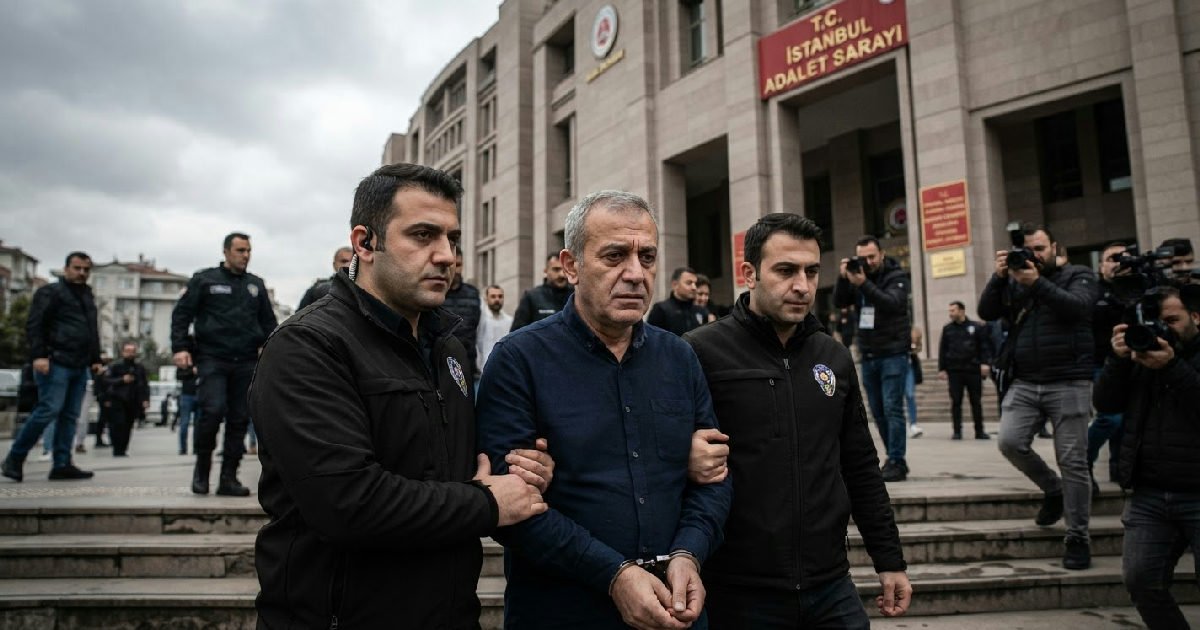
Turkish Authorities Arrest Former SPK Deputy Chair Enver Usca
Turkish authorities have formally arrested Enver Usca, the former deputy chairman of the country’s Capital Markets Board (SPK), on bribery charges. This latest development on November 7, 2026, significantly expands a growing fund probe that has already implicated a former minister and the ex-CEO of Borsa İstanbul.
The investigation by the İstanbul Chief Public Prosecutor’s Office is unraveling a complex web of alleged financial misconduct and market manipulation, sending ripples across Turkey’s financial sector.
Deputy Chair Enver Usca expands high-level net
The widening scandal has led to hundreds of detentions and has exposed alleged irregularities in capital market transactions. Key figures, including former government officials and top executives from major financial institutions, are now under intense scrutiny. The unfolding events highlight a determined effort by Turkish authorities to address deep-seated issues within its financial regulatory framework.
Enver Usca, whose four-year term at the SPK concluded on October 31, 2026, was taken into custody following a court order. State-run Anadolu Agency reported his arrest on Saturday, November 7, 2026, on suspicion of accepting bribes. This move comes as part of a broader crackdown targeting several former regulatory officials.
Prosecutors issued detention warrants for six additional suspects, including other former senior officials of the Capital Markets Board. Among those detained were Bülent Murat Haholu, a former SPK board member, and Kürşat Sait Babuçcu, the former head of the SPK’s Corporate Finance Department. The dragnet also included Ercan Urkan, former head of the SPK’s Market Surveillance and Supervision Department.
Beyond the SPK, the investigation reached Mustafa Alper Taş, who heads the Banking Regulation and Supervision Agency (BDDK)’s Fourth Implementation Department. Ümit Sincanlı, administrative affairs director at Tera Holding, was also detained. These arrests underscore the extensive reach of the probe into various layers of Turkey’s financial oversight bodies.
The scope of the investigation suggests a systemic issue rather than isolated incidents. Authorities appear focused on identifying and dismantling any perceived criminal networks that may have exploited regulatory loopholes. This rigorous approach aims to restore confidence in the integrity of Turkey’s capital markets, which have been under considerable strain.
Broader implications of the scandal
Usca’s arrest follows closely on the heels of other high-profile detentions in the ongoing probe. Korkmaz Enes Ergun, the former Chief Executive Officer of Borsa İstanbul, was formally arrested on bribery charges on November 3, 2026. He had been initially detained on October 31, 2026, on suspicion of bribery and membership in a criminal organization, sparking concerns about the stability of the exchange.
Ergun, who served as Borsa İstanbul’s general manager since March 2021, was a prominent figure in Turkey’s financial landscape. His arrest led to the immediate appointment of Atila Türeli, deputy chief executive, as acting chief executive on November 1, 2026. Ergun also held the position of deputy chairman at Türkiye’s Settlement and Custody Bank (Takasbank), further highlighting the gravity of his alleged involvement.
Political figures drawn in
The scandal’s reach has extended into the political sphere, with the arrest of Fatma Betül Sayan Kaya, a former Minister of Family and Social Policies and former deputy chair of President Recep Tayyip Erdoğan’s ruling Justice and Development Party (AKP). She was arrested on November 6, 2026, facing charges of membership in a criminal organization and violating Turkey’s Capital Markets Law.
Kaya resigned as AKP deputy chair in September 2026 amid allegations of selling shares worth tens of millions of dollars just before regulators liquidated investment funds due to alleged manipulation. Turkey’s main opposition party accused her of receiving a staggering 2.17 billion liras (approximately $43 million) from a 163 million liras ($3 million) investment.
Her husband, İlyas Kaya, was released under judicial supervision, including a travel ban. The accusations against Kaya underscore how deeply this probe has penetrated elite circles. The widening Turkey fund probe has highlighted potential vulnerabilities in the regulatory oversight of high-ranking individuals.
The Financial fallout and investor impact
The sheer scale of the investigation is striking, with Justice Minister Akın Gürlek confirming on November 3, 2026, that the probe covers 433 suspects. As of that date, 112 individuals have been jailed pending trial, and 186 are under judicial supervision. Arrest warrants remain outstanding for 38 more suspects, indicating the ongoing nature of the crackdown.
The crisis originated in September 2026, when several investment funds found themselves unable to meet investor withdrawal requests. Prosecutors are investigating allegations that fund managers artificially inflated share prices by buying thinly traded stocks. This manipulation allegedly boosted the reported value of the funds holding these shares, defrauding numerous investors.
Economic repercussions
The Capital Markets Board (SPK) responded by ordering the liquidation of 131 funds managed by seven different companies on September 17, 2026. These funds collectively impacted 455,758 individual investors, highlighting the widespread damage caused by the alleged misconduct. The financial repercussions have been severe, with approximately 30 billion lira (€536 million) in cash, real estate, and shares collected through voluntary returns.
The market has reacted sharply to the unfolding events. The BIST 100 index plummeted by roughly 25.6% between September 11 and October 30, 2026, falling from 14,467 points to 10,759.56. This decline translated into a loss of approximately $173.5 billion in combined market capitalization for listed companies during the same period. Such significant drops reflect deeply shaken investor confidence in the market.
Regulatory changes and ongoing investigation
In an attempt to fortify the system, the SPK revised its guidelines for investment funds in early September 2026. The new rules now mandate greater diversification, prohibiting funds from investing all their assets in a single stock. This measure aims to prevent future instances of concentrated risk and potential manipulation, providing a stronger framework for investor protection.
Finance Minister Mehmet Simsek has indicated a tough stance, stating that individuals who made significant gains of 10 million lira ($202,000) or more would be approached. Legal procedures would be initiated against those who refuse to voluntarily return their illicit profits. This directive signals the government’s determination to recover funds and penalize wrongdoers.
Scrutiny of oversight
The investigation has also brought into focus the conduct of past regulatory leaders. İbrahim Ömer Gönül, who chaired Turkey’s Capital Markets Board from April 2022 to April 2026, was summoned as a suspect. Prosecutors sought and obtained permission to investigate him for alleged abuse of office.
Gönül was subsequently released under judicial supervision, but the inquiry into his tenure highlights potential lapses in regulatory oversight during the period of alleged manipulation.
Further unsettling events have also marked the probe. Ali Emre Balli, chairman of distressed-asset manager Adil Varlik Yonetim, was found dead in a vehicle in October after suffering a gunshot wound. Authorities have not publicly established the circumstances of his death, adding a grim note to the unfolding scandal.
This incident, while not directly tied to the arrests, casts a long shadow over the intense pressure surrounding the investigation.
Unraveling a complex criminal network
Justice Minister Akın Gürlek previously declared on November 3, 2026, that the investigation had uncovered a “comprehensive criminal network” that had infiltrated high-level financial institutions. This declaration frames the individual arrests as part of a much larger, coordinated effort to expose and dismantle organized financial crime within Turkey. The ongoing probe continues to yield new detentions and revelations.
Investigators have identified 214 individuals and companies associated with approximately TL187.65 billion (more than $3.7 billion USD) in gains stemming from funds linked to Tera, Pusula, and Hedef. These staggering figures include 141 individuals and 73 legal entities. Approximately TL90 billion in gains were associated with Tera, TL79 billion with Pusula, and TL18 billion with Hedef, underscoring the massive scale of the alleged illicit activities.
The crackdown has also led to the arrests of various fund managers and executives from firms like Tera Yatirim Holding, Tera Portfoy, and Pusula Holding. The sheer number of implicated parties and the significant financial sums involved illustrate the depth of the corruption.
This extensive investigation aims to bring accountability to those who allegedly manipulated the markets for personal gain, ensuring a fairer and more transparent financial environment for all participants.
The overall impact on Turkey’s financial markets and its international reputation remains a key concern. The government’s aggressive pursuit of those involved signals a commitment to cleaning up the sector, but the process is likely to be protracted. Restoring investor trust and ensuring robust regulatory enforcement will be crucial steps in the aftermath of this significant financial upheaval.