

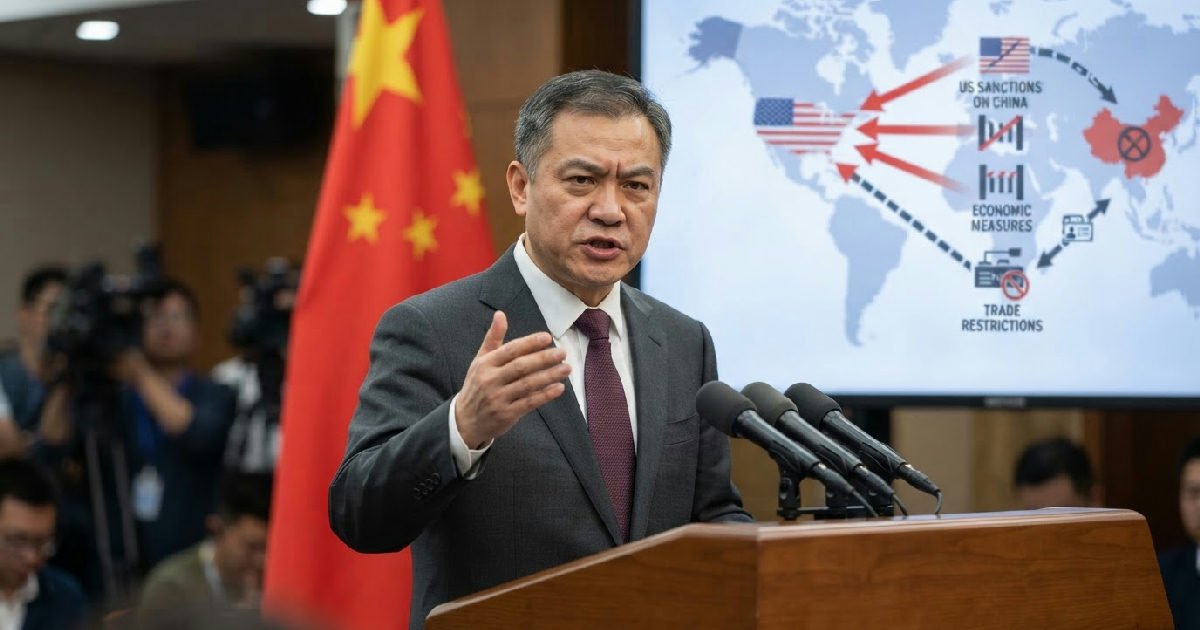
China vows retaliation for new US sanctions on its companies
China’s Ministry of Commerce (MOFCOM) issued a sharp rebuke to Washington on November 7, vowing to take “necessary measures” after the United States imposed new US sanctions on China-based companies. The statement condemns the latest American action and signals a potential escalation in the ongoing economic rivalry between the two global powers.
In its announcement, Beijing said the US has recently stepped up its use of sanctions and “discriminatory” restrictions. It claims these actions damage the rights of local companies and undermine stability in trade relations, urging Washington to “correct its wrong practices” immediately.
Details of the latest US sanctions
The latest flashpoint in the tense relationship centers on sanctions the US imposed on November 5, 2026. The measures target two Chinese firms: China National Electronic Import and Export Company (CEIEC) and Beijing H&C Technologies.
US officials allege the two companies supplied military equipment to Cuba, working directly with the island nation’s military procurement company, Sociedad Mercantil Duna. The ongoing tensions have created significant market volatility, similar to how the Nasdaq suffers steepest drop on fears of new regulation.
CEIEC, a subsidiary of the state-owned China Electronics Corporation, has been in Washington’s crosshairs before. It was first hit with US sanctions in November 2020 for allegedly helping Venezuela restrict internet services. Beijing H&C Technologies is described by the US as a subsidiary of CETC International that supplies security equipment.
The sanctions, imposed under a May 2026 executive order related to repression in Cuba, effectively block the companies’ property and interests within US jurisdiction. They also broadly prohibit any US persons or entities from conducting transactions with them.
A wider pattern of economic pressure
These actions are not isolated incidents but part of a protracted economic conflict that began in 2018. The US has consistently leveraged sanctions and export controls, citing a range of justifications from national security risks to human rights abuses and intellectual property theft.
This sustained pressure campaign signifies a fundamental recalibration of Washington’s approach to Beijing, moving beyond traditional trade disputes to address deeper concerns about technological supremacy and geopolitical influence.
The broader strategy aims to impede China’s economic and technological ascent, particularly in areas deemed critical for future military and economic dominance. By systematically deploying various tools, from targeted company sanctions to comprehensive export bans, the US seeks to contain specific Chinese industries and limit the country’s access to advanced Western technologies.
This multifaceted approach has intensified over several years, creating an increasingly complex operational environment for global businesses and policymakers alike.
The technology and semiconductor front
A primary battleground has been the technology sector, particularly advanced semiconductors and artificial intelligence. Since October 2022, the US has aggressively worked to restrict China’s access to high-performance computing chips and the equipment needed to manufacture them.
The explicit goal is to inhibit the development of China’s technological capabilities, especially for military applications. These controls have been expanded multiple times, adding hundreds of Chinese firms to the Commerce Department’s “Entity List” and even restricting US citizens from working at certain Chinese semiconductor facilities.
This “tech war” has had a chilling effect on global supply chains and investment strategies. The uncertainty has rattled investors in a way that recalls how Marshall Wace funds hit by a market rout in the AI sector.
Human rights and military fusion
Beyond technology, Washington has also imposed sanctions on Chinese government officials and companies since 2020. These measures have been justified by citing the persecution of Uyghurs in Xinjiang, the crackdown on democracy in Hong Kong, and China’s military-civil fusion strategy.
The US has also used its economic power to sanction Chinese entities for providing material assistance to other nations. This includes actions against companies for supporting Russia’s military with technology and for involvement in Iran’s missile program, further complicating the geopolitical landscape.
Key Sanctions and Countermeasures in US-China Economic Conflict (2018-2026)
How China plans to hit back
Beijing’s warning of “necessary measures” is backed by a sophisticated legal and regulatory framework developed specifically to counter foreign sanctions. The government has several potent tools at its disposal, creating a new layer of risk and uncertainty for international businesses operating in the country and potentially complicating global supply chains.
This systematic development of countermeasures reflects China’s strategic intent to build resilience against external economic coercion. By establishing clear legal avenues for retaliation, Beijing aims to protect its national interests and assert its sovereignty in the face of what it perceives as unilateral and discriminatory actions from foreign powers. This framework signals a long-term commitment to defending its economic and technological trajectory.
For multinational corporations, this means navigating an increasingly complex legal and political landscape where compliance with one nation’s regulations could lead to penalties from another. The activation of China’s retaliatory mechanisms has the potential to disrupt established business models, force companies to re-evaluate their presence in the Chinese market, and ultimately contribute to a more fragmented global economic order.
The Unreliable Entity List
China’s most direct retaliatory tool is its Unreliable Entity List (UEL), officially launched in September 2020. It is designed to target foreign organizations or individuals that are deemed to have harmed China’s national interests or disrupted contracts with Chinese firms for non-commercial reasons.
Once a company is added to the UEL, it can face a range of penalties. These include restrictions or outright prohibitions on its trade with China, a ban on new investments in the country, and the denial of work permits or residency for its personnel.
As of late 2025, Beijing had placed 72 US entities on this list. Most were added for their role in arms sales to Taiwan, with prominent defense contractors like Lockheed Martin Corporation and Raytheon Missiles & Defense being key targets.
Export controls and tariffs
China is also prepared to weaponize its own industrial strengths through export controls. In a notable move in October 2026, the Ministry of Commerce and the Ministry of Science and Technology proposed adding 40 different technologies to its Catalogue of Technologies Prohibited and Restricted from Export.
The proposed list included 23 technologies related to artificial intelligence, 5 in biopharmaceuticals, and 12 in photovoltaics, signaling an intent to protect its dominance in key emerging sectors. This mirrors the US strategy of restricting its own tech exports.
Finally, retaliatory tariffs remain a potent option. Throughout the trade war that began in 2018, China consistently responded to US tariffs with its own levies on hundreds of billions of dollars worth of American goods, hitting agricultural products, energy, and industrial machinery particularly hard.
Outlook and global implications
The latest back-and-forth suggests a continued cycle of sanctions and countersanctions with no clear end in sight. With neither Washington nor Beijing showing any willingness to de-escalate, the global economic environment is set to become even more fragmented and unpredictable.
For multinational corporations, this sustained conflict presents immense challenges. Companies with significant supply chains or markets in both the US and China face growing compliance burdens and the constant threat of being caught in the geopolitical crossfire. The relative health of the domestic economy, where recent data showed US job growth smashed forecasts, may embolden American policymakers to maintain their hardline stance.
The intense focus on technology leadership, especially in semiconductors, will almost certainly remain the central arena of conflict. The global race for AI supremacy and next-generation computing is now inseparable from national security concerns, which will have profound, long-lasting consequences for industries across the board.
As Beijing formulates its specific response to the latest US sanctions, the international business community watches closely. Whether China opts for a targeted, proportional retaliation or a more sweeping set of measures could determine the next phase of this critical great-power competition. The coming weeks will be crucial in revealing the path forward.
What are the latest US sanctions against Chinese companies about?
The latest US sanctions, imposed on November 5, 2026, target two Chinese firms, China National Electronic Import and Export Company (CEIEC) and Beijing H&C Technologies. US officials allege these companies supplied military equipment to Cuba, working with its military procurement company, Sociedad Mercantil Duna.
Which Chinese companies are targeted by the recent US sanctions?
The two primary Chinese companies targeted by the November 2026 US sanctions are China National Electronic Import and Export Company (CEIEC) and Beijing H&C Technologies. CEIEC has been sanctioned previously in 2020 for allegedly helping Venezuela restrict internet services.
What is China’s “Unreliable Entity List”?
China’s Unreliable Entity List (UEL), launched in September 2020, is a retaliatory tool designed to target foreign organizations or individuals deemed to have harmed China’s national interests or disrupted contracts for non-commercial reasons. Companies on the list can face restrictions on trade, investment, and personnel activities in China.
By late 2025, 72 US entities, including Lockheed Martin and Raytheon, were on this list, mostly for arms sales to Taiwan.
How has the US sanctioned China beyond the recent actions?
Beyond the recent Cuba-related sanctions, the US has a long history of economic pressure on China.
This includes restricting China’s access to advanced semiconductor technology since October 2022, imposing sanctions on Chinese officials and companies since 2020 for human rights abuses in Xinjiang and Hong Kong, and targeting entities for supporting Russia’s military or Iran’s missile program. These actions fall under a wider pattern of economic conflict dating back to 2018.
What are the global implications of this ongoing economic conflict?
The continuous cycle of sanctions and countersanctions suggests increasing global economic fragmentation and unpredictability. Multinational corporations face significant challenges, including growing compliance burdens and the risk of being caught between the US and China. The intense focus on technology leadership, particularly in AI and semiconductors, will have long-lasting consequences for industries worldwide.