

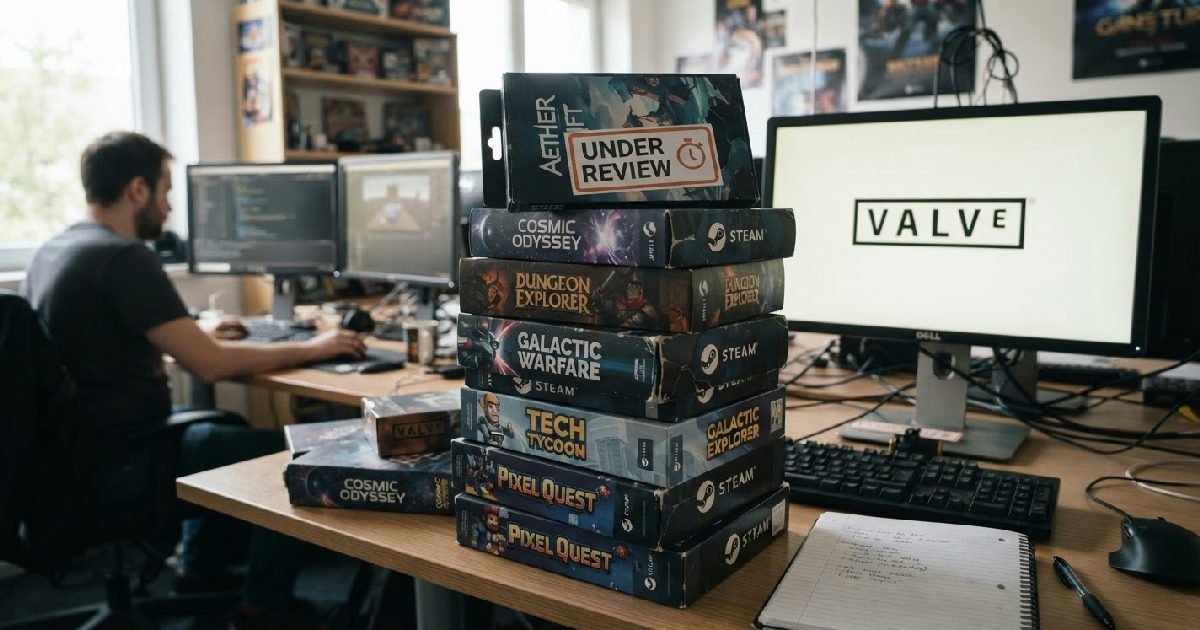
Valve cites re-reviews for Steam game approval delays
Steam game approval delays are a significant issue, with Valve acknowledging a substantial backlog in its review process for new games and updates. The company has acknowledged a significant backlog in the Steam game approval process, leaving many developers waiting longer than usual for their new games and updates to go live on the world’s largest PC gaming platform.
In a message sent to developers, Valve attributed the slowdown to an increasing need to re-evaluate games that had already passed an initial review.
Valve blames re-review cycle for Steam game approval delays
The company explained the bottleneck by stating, “We’re currently running behind on reviewing new builds and new releases. This is because we’re having to re-review a lot of games that are submitting new builds after their initial review.”
However, it was the message’s closing line that raised eyebrows across the industry: “This surely has nothing to do with AI.” This statement, viewed by many as sarcastic, points directly at the ongoing and complex debate surrounding AI-generated content in video games.
On the surface, Valve’s explanation is straightforward. The Steam Direct platform allows developers to submit their games for review, and once approved, they can set a launch date. Developers often continue working on their games post-approval, submitting updated “builds” that include bug fixes, performance improvements, or even last-minute content additions before the title becomes available to the public.
According to Valve, this process of re-reviewing updated builds is creating a bottleneck. Each time a developer submits a new version, it seemingly re-enters the queue, requiring Valve’s human review team to verify the changes.
This can range from minor patch validation to a more thorough inspection if significant alterations have been made, creating a loop that consumes valuable reviewer time and pushes back the queue for everyone else.
This creates a difficult situation for developers. They are incentivized to submit for review early to secure a release window and prepare marketing. Yet, they also need to continue polishing their product up until the final moments before launch. The current backlog suggests this long-standing process is now straining Valve’s operational capacity, leading to frustrating and potentially costly delays.
The unspoken factor: Navigating the AI content minefield
Despite Valve’s official reasoning, the company’s wry comment about AI has led most observers to believe the issue is far more complex. The proliferation of generative artificial intelligence has presented a major challenge for platform holders, who are grappling with the legal and ethical implications of AI-created assets. Valve itself has a complicated history with its own AI policy.
The company’s position has evolved significantly over the past couple of years. In June 2023, reports first emerged of Valve rejecting games that contained AI-generated art due to uncertainty around copyright and ownership of the data used to train AI models.
By January 2024, the company had escalated its stance, temporarily halting submissions of most games utilizing the technology while it tried to formulate a more coherent long-term strategy.
Then, in April 2024, Valve released its updated guidelines. It would now allow games with AI-generated content, but with a critical new requirement: developers must disclose their use of AI during the submission process.
This includes answering specific questions about whether the content is pre-generated or live-generated and confirming they hold the necessary rights for all assets. This policy mirrors actions by other platforms, with some like Itch.io implementing new AI disclosure filters to manage what some critics call “AI slop.”
It’s this disclosure and verification process that is the likely culprit behind the re-review pile-up. If a developer submits a build and later adds or changes AI-related content, it would trigger a mandatory re-review to ensure compliance with the April 2024 policy.
Verifying that a developer has the “necessary rights” to AI-generated assets is not a simple checkbox; it can be a legally fraught investigation, especially if the AI model was trained on copyrighted material.
How the Steam approval bottleneck impacts developers
For game developers, particularly smaller independent studios, these delays are more than just an inconvenience. A delayed launch can disrupt carefully planned marketing campaigns, cause a studio to miss key sales seasons like holidays or Steam festivals, and create a frustrating experience for a community anticipating a release. When a launch date becomes a moving target, it erodes trust and can kill momentum.
Furthermore, the delay affects not just new releases but also updates to existing games. A critical patch to fix a game-breaking bug or address a security vulnerability could be stuck in the review queue, leaving players with a broken product. This directly impacts a game’s reputation and commercial viability, as negative reviews pile up while the developer waits for Valve’s approval on the fix.
The uncertainty makes financial planning incredibly difficult. Many indie developers operate on tight budgets, relying on launch-week revenue to stay afloat. Unpredictable approval times make it nearly impossible to forecast income or commit to post-launch content plans. This pressure is immense and can jeopardize a studio’s future, all while they wait in a queue of indeterminate length.
A new reality for digital storefronts
The challenges Valve faces are not unique. Every major digital platform, from app stores to content marketplaces, is being forced to confront the AI boom. The sheer volume and velocity of AI-generated content are testing moderation and review systems that were designed for a different era. This widespread impact underscores how foundational artificial intelligence is becoming across the gaming industry and beyond.
The core of the issue is a conflict between two philosophies. On one hand, platforms like Steam have thrived on an open, democratized approach, allowing almost anyone to publish a game via programs like Steam Direct. This has led to an explosion of creativity and diversity.
On the other hand, platforms also have a responsibility to curate their stores, protecting users from low-effort content, scams, and legally dubious products.
AI-generated content sits squarely at this intersection. It can be a powerful tool for small teams to create assets they couldn’t otherwise afford, potentially fostering innovation. However, it can also be used to flood the store with generic, low-quality “slop” that buries genuine, handcrafted games.
Finding a policy that encourages the former while preventing the latter is the tightrope Valve and its competitors must now walk.
What’s next for Valve’s content curation?
Valve has not publicly announced a specific plan to address the backlog, but several possibilities exist. The company could invest in hiring more human reviewers to increase its capacity, though this is often a slow and expensive solution that may not scale with the exponential growth of AI tools.
Alternatively, Valve could further refine its submission policies, perhaps creating stricter rules around when and why developers can submit new builds after an initial approval.
Another path involves technology itself. Valve might develop its own AI-powered tools to pre-screen submissions, flagging potential policy violations for human review. This could help automate the initial stages of verification, freeing up human experts to focus on the more nuanced cases. However, this approach carries its own risks of false positives and a lack of human oversight.
Ultimately, this situation highlights the growing pains of a new technological era. Maintaining platform integrity is paramount, as demonstrated by other digital ecosystems making strong efforts to boost security and user trust.
How Valve navigates this challenge will have lasting implications not just for the thousands of developers who rely on its platform, but for the future of content curation in the age of artificial intelligence.