

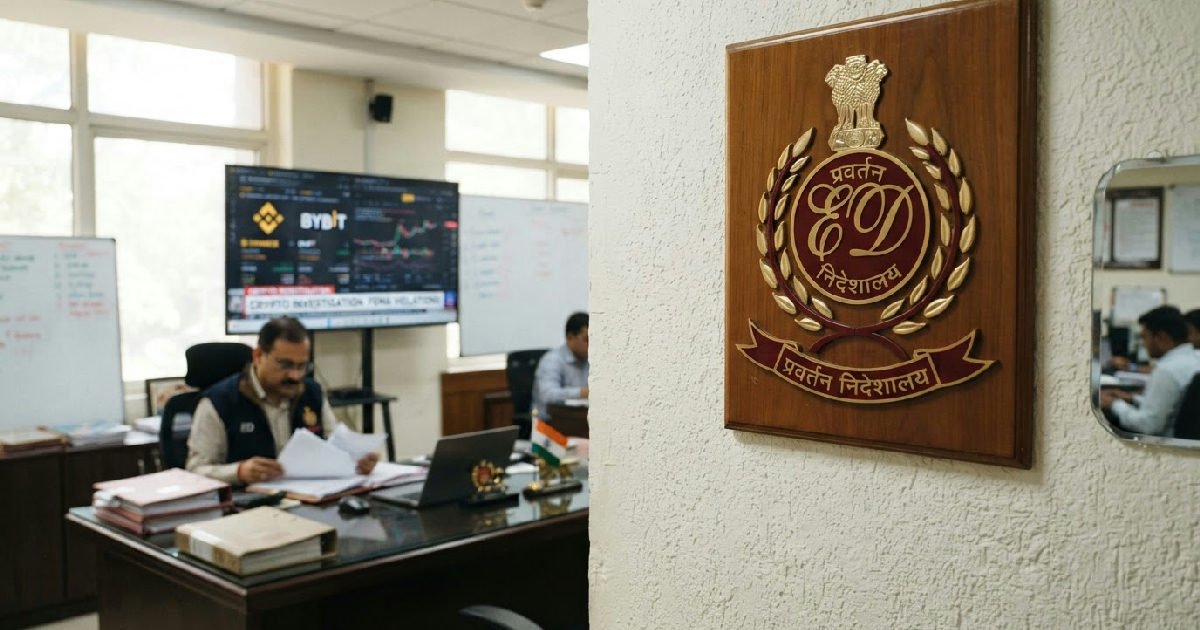
India’s ED names Binance in $527 million crypto foreign payout investigation
India’s Enforcement Directorate (ED) has named global cryptocurrency exchanges Binance and Bybit as platforms allegedly used for unauthorized foreign payouts totaling over ₹5,000 crore, approximately $527 million. This development follows a series of searches conducted on October 27, 2026, across four premises in Bengaluru and Madhya Pradesh as part of an ongoing investigation into cross-border crypto transfers.
The probe, overseen by India’s foreign-exchange enforcer, focuses on alleged violations of the Foreign Exchange Management Act (FEMA). It highlights the ED’s intensified scrutiny of crypto-related transactions suspected of circumventing India’s financial regulations, involving several Indian entities like RPFAS Technologies, which operates Mudrex and Saber.money, and DeFi protocol Instadapp, now known as Fluid.
ED expands probe into crypto foreign payout investigation
The Enforcement Directorate’s Bengaluru office initiated the latest round of searches on October 27, targeting three locations in Bengaluru and one in Madhya Pradesh.
These operations were carried out under the provisions of the Foreign Exchange Management Act, 1999, which classifies such violations as civil matters subject to penalties, distinguishing them from more severe money-laundering offenses.
The ED’s proactive stance against the misuse of crypto platforms for illicit financial activities helps frame the broader context of cross-border illicit finance in India.
According to a press release the agency attached to its X post on October 29, the investigation uncovered alleged “shell entities in tax haven countries,” “massive OTC deals,” and “illegal foreign payouts” processed through platforms including Binance and Bybit. While the ED has identified these platforms as routes for the alleged transfers, it has not made any direct allegations against either exchange in its statement.
The ED’s allegations center on transactions that reportedly crossed India’s borders without proper authorization, circumventing the established financial channels. This approach, involving shell entities and over-the-counter (OTC) crypto transactions, suggests a deliberate effort to obscure the flow of funds and bypass regulatory oversight.
Such cross-border transactions highlight the challenges regulators face in monitoring the rapidly evolving cryptocurrency market. The nature of these alleged activities complicates efforts to track money flows and ensure compliance with national financial laws.
Mudrex and Instadapp under scrutiny
Among the Indian entities flagged in the ED’s probe is RPFAS Technologies Private Limited, a Bengaluru-based company that operates the popular Mudrex and Saber.money platforms. The agency estimates preliminary FEMA contraventions linked to RPFAS Technologies at more than ₹4,600 crore, or approximately $538 million. These contraventions reportedly stem from unauthorized cross-border transfers and crypto balances held on foreign platforms.
A representative for Mudrex, backed by Y Combinator and Nexus Venture Partners, stated the company believes its operations fully comply with applicable laws and regulations. They also affirmed that the platform continues its normal operations and that user funds remain secure, seeking to reassure their customer base of over 3 million users in India.
The probe also implicates the DeFi protocol Instadapp, which primarily operates under the name Fluid. The ED alleges FEMA contraventions of about $40 million in the Instadapp case. Sources indicate Instadapp founder Sowmay Jain allegedly managed the protocol from India, even while presenting it as US-based, raising questions about its operational structure and regulatory adherence.
Neither Instadapp nor Fluid had issued a public comment on the ED’s release as of Friday afternoon. The ongoing nature of these investigations means that specific details and further actions could emerge as the ED continues its extensive review of the alleged violations.
WazirX saga provides historical context
This latest action by the Enforcement Directorate isn’t an isolated event. It draws parallels with a significant probe initiated on August 5, 2022, when the ED targeted WazirX, an Indian cryptocurrency exchange operated by Zanmai Labs Pvt Ltd. That investigation, a money laundering case, led to the freezing of WazirX’s bank balances totaling ₹64.67 crore, roughly $8 million.
The ED alleged that WazirX had played a crucial role in assisting instant loan app companies, many reportedly backed by Chinese investors, in laundering fraud money through the acquisition and transfer of virtual crypto assets.
A public dispute between WazirX founder Nischal Shetty and Binance CEO Changpeng Zhao (CZ) further complicated the situation. While Binance had announced its acquisition of WazirX in 2019, CZ later stated that the transaction was never completed and Binance did not hold equity in Zanmai Labs. Shetty, however, maintained that Binance owned WazirX, highlighting an intricate and often opaque ownership structure within the crypto industry.
Minister of State for Finance Pankaj Chaudhary had also informed the Rajya Sabha on August 3, 2022, that the ED was investigating WazirX for alleged money laundering worth ₹2,790 crore. This long-standing scrutiny of WazirX illustrates the persistent regulatory challenges facing crypto exchanges operating within India.
India’s evolving crypto regulatory landscape
India’s journey with cryptocurrency regulation has been dynamic, characterized by periods of caution, outright bans, and eventual attempts at integration. Initially, the Reserve Bank of India (RBI) issued stern warnings about the risks associated with virtual currencies, culminating in an April 2018 circular that effectively barred regulated financial entities from engaging with crypto businesses.
The landscape shifted dramatically in March 2020 when the Supreme Court of India overturned the RBI’s ban, deeming it unconstitutional. This landmark decision paved the way for Indian crypto exchanges to resume normal banking operations, injecting a degree of legitimacy into the nascent sector.
However, regulatory uncertainty persisted, with proposals for a bill to ban most private cryptocurrencies emerging in 2021, though it never passed into law.
A significant step towards formal recognition came in February 2022 with the introduction of a taxation framework for Virtual Digital Assets (VDAs). This included a 30% flat tax on income from VDA transfers and a 1% Tax Deducted at Source (TDS) on transfers exceeding ₹10,000 annually. While providing quasi-legal status, these tax measures also tightened the financial net around crypto transactions.
More recently, in March 2023, the Ministry of Finance brought Virtual Asset Service Providers (VASPs), including crypto exchanges, under the purview of anti-money laundering laws. This move necessitated registration with India’s Financial Intelligence Unit (FIU-IND), leading to a crackdown on non-compliant platforms. Binance and KuCoin registered with India’s Financial Intelligence Unit (FIU-IND) in 2024.
Bybit, already a registered reporting entity, had its Indian access restored in January 2025, demonstrating ongoing efforts to operate within India’s regulatory framework.
Binance, the world’s largest cryptocurrency exchange, has faced a barrage of regulatory challenges globally, including a substantial $4.3 billion fine in the United States in November 2023 for anti-money laundering violations. The exchange also reportedly suffered a $6.3 billion hack in October 2026, marking a significant operational disruption that underscored the security risks inherent in large-scale crypto platforms.
Implications for foreign exchange control
The ED’s intensified focus on crypto transfers under the Foreign Exchange Management Act highlights the Indian government’s determination to maintain stringent control over capital flows. FEMA, enacted in 1999 to replace the stricter FERA, aims to facilitate external trade and payments while promoting an orderly foreign exchange market.
However, alleged violations, particularly those involving substantial sums like ₹5,000 crore, pose a direct challenge to these objectives.
Violations under FEMA are treated as civil offenses, typically resulting in monetary penalties rather than criminal charges. These penalties can be considerable, reaching up to three times the amount involved in the contravention. Such enforcement actions serve as a powerful deterrent against individuals and entities attempting to bypass official banking channels for international transfers.
The alleged use of shell entities in tax haven countries and large over-the-counter (OTC) crypto deals suggests a sophisticated mechanism to obscure the origin and destination of funds. This directly undermines India’s efforts to combat illicit financial flows and maintain financial stability.
Regulators are particularly concerned about how easily cryptocurrencies can be converted into stablecoins like USDT and then sold through exchanges, bypassing traditional financial oversight. This scrutiny extends to understanding how entities navigate these systems, especially with new rules emerging, such as those allowing stablecoin rewards in other jurisdictions.
This ongoing probe signifies a broader global trend where financial intelligence agencies are grappling with the complexities of regulating decentralized digital assets. For India, a country with significant capital controls, ensuring compliance with FEMA remains a critical aspect of its economic sovereignty. The outcome of these investigations will likely shape future regulatory approaches to cryptocurrency within the nation.