

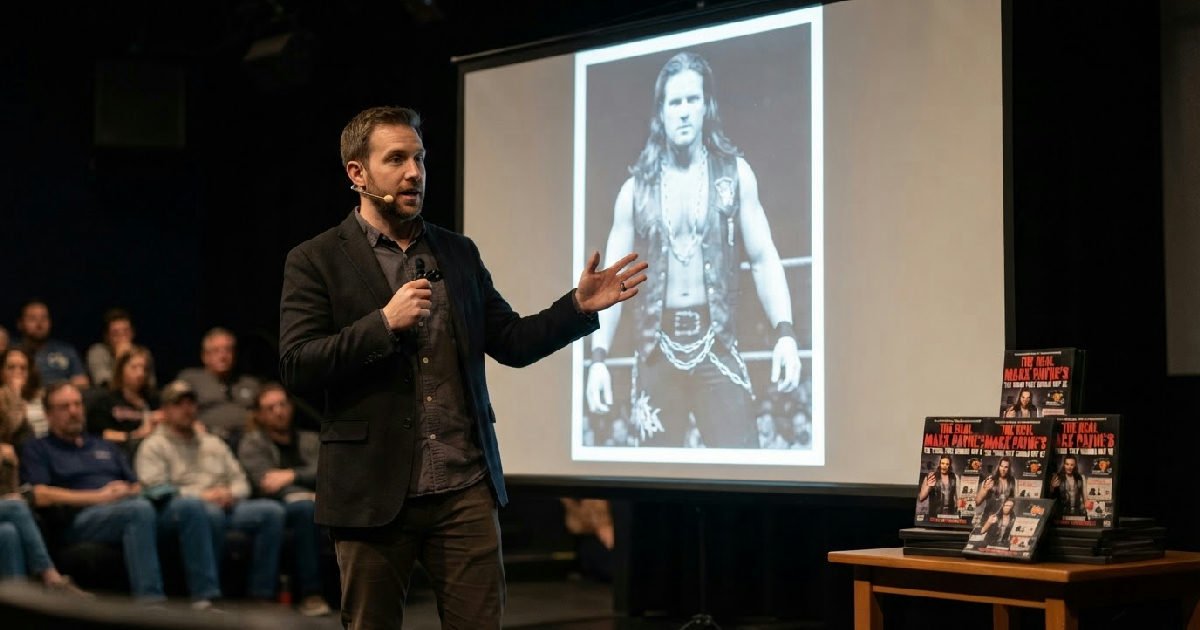
Joe Dombrowski unveils Maxx Payne documentary on 1995 WWF tour
Joe Dombrowski’s new Maxx Payne documentary, “The Real Maxx Payne’s The Thing That Should Not Be,” unearths lost professional wrestling history from his 1995 WWF European tour.
This documentary, now shipping as of October 29, 2026, features never-before-seen backstage footage filmed by former World Wrestling Federation (WWF) Superstar Darryl “Maxx Payne” Peterson during a pivotal European tour in October 1995.
Unearthing a lost era of professional wrestling with the Maxx Payne documentary
The project offers an unfiltered look into the lives of wrestlers during a challenging era for the industry, providing a candid time capsule that was nearly lost forever.
Dombrowski meticulously edited the archival material, which captures the raw, unscripted moments of a two-week tour, away from the glitz and kayfabe of televised events. For decades, this footage remained hidden, with previous attempts to release it never coming to fruition. Its long-awaited arrival provides an invaluable resource for understanding the true nature of professional wrestling at a critical juncture in its evolution.
The journey of “The Real Maxx Payne’s The Thing That Should Not Be” began with Darryl Peterson’s foresight in October 1995. Armed with a video camera, Peterson, then known in the WWF as Man Mountain Rock, captured candid moments during the European tour.
He envisioned creating a motion picture that no one else had conceived, inspired by the reality-TV format of shows like MTV’s Road Rules.
For nearly 30 years, this unique footage lay dormant, its existence whispered about but rarely seen. Early teasers for the project circulated around 2008 but quickly disappeared, leading to speculation that legal challenges or other obstacles had derailed its release. Peterson himself had expressed that many individuals had shown interest in the footage over the years, yet none followed through until Dombrowski’s intervention.
Joe Dombrowski, a respected figure in wrestling media, first connected with Peterson at WrestleCon in Dallas in 2022. This encounter proved to be the catalyst for the documentary’s eventual completion. Dombrowski recognized the historical significance of the footage and took on the monumental task of compiling and editing the extensive material.
Inside the candid world of a 1995 WWF European tour
The mid-1990s represented a tumultuous period for the WWF, often referred to as the “New Generation Era.” The company was navigating the fallout from the infamous steroid scandal involving chairman Vince McMahon, while also grappling with declining business and intense competition from World Championship Wrestling (WCW). This backdrop forms the canvas for Peterson’s raw footage.
The documentary provides an unparalleled perspective on the daily grind of professional wrestlers, far removed from the scripted narratives of the ring. It delves into the realities of life on the road, including grueling travel schedules, backstage politics, and a nascent party scene.
The footage shows realities of professional sports, revealing moments of vulnerability and camaraderie that were rarely, if ever, seen by the public during an era where kayfabe was still fiercely protected.
Peterson himself highlighted the footage’s unique nature, stating there isn’t “one second of wrestling in this movie.” Instead, viewers witness wrestlers out of character, a rarity in 1995.
Among the notable figures appearing in the candid shots and subsequent interviews are Kevin Nash, Scott Hall, Owen Hart, Ted DiBiase, Bam Bam Bigelow, Sid, Shane Douglas, Bob Holly, Fatu, Rodney Anoa’i, Louie Spicolli, Henry Godwinn (Mark Canterbury), Tony Garea, and Carl “PCO” Ouellet.
Even Vince McMahon makes an appearance in the documentary’s trailer, hinting at the breadth of the behind-the-scenes access.
The driving forces behind the documentary’s release
The collaboration between Darryl “Maxx Payne” Peterson and Joe Dombrowski was crucial for bringing this long-lost material to a wider audience. Dombrowski took on the extensive editing work and conducted new interviews with wrestlers and personalities who were part of the 1995 tour. These contemporary reflections add another layer of depth, providing current perspectives on the footage and the era it depicts.
Peterson’s motivation for holding onto the footage for so long, and his eventual decision to release it, is a compelling narrative in itself. He famously remarked, “If I would have stayed in the wrestling business, I would not be alive. I had a dream to create a motion picture that nobody else had ever created.
And I was too afraid to release that movie until now.” This quote underscores the personal weight of the project and the difficult realities that some wrestlers faced.
Dombrowski describes the documentary as both “nostalgic” and “cautionary,” suggesting its dual role as a fond look back at a different time and a warning about the industry’s darker aspects. The film’s release, therefore, isn’t just about entertainment; it’s about historical preservation and providing context to a critical period in wrestling lore.
The dedication of both individuals over more than four years to complete this project speaks volumes about its importance.
Beyond the main feature: extensive bonus content
The documentary “The Real Maxx Payne’s The Thing That Should Not Be” goes well beyond its two-hour and 13-minute main feature. It’s presented as a comprehensive 5-disc set, boasting over 10 hours of bonus material. This extensive collection ensures fans receive a deep dive into the subject matter, offering context and further revelations that expand on the primary narrative.
Among the supplementary features is an in-depth interview with Darryl “Maxx Payne” Peterson himself. In this segment, Joe Dombrowski explores Peterson’s reflections on the film, his motivations behind shooting the original footage, and his tumultuous 1995 WWF run. This interview provides critical insight into the mind of the man who captured these raw moments.
Another compelling bonus is the series of “Watch-Alongs,” where several wrestlers who were on the European tour watch the footage for the first time, reacting authentically to their younger selves and the bygone era. These candid reactions highlight the changing landscape of professional wrestling and the personal impact those times had on the performers.
Deleted scenes, additional road stories, and archival footage further enrich the experience. There’s even an extra feature that follows Peterson to a CWA appearance in Hanover, Germany, immediately after his departure from the WWF, offering a glimpse into his immediate post-WWF career.
Fans also contributed material, including footage of wrestlers arriving at hotels and emerging from tour buses, making it a truly collective historical effort.
A lasting look at wrestling’s challenging mid-90s landscape
The release of “The Real Maxx Payne’s The Thing That Should Not Be” serves as a significant historical document, shedding light on a specific, often turbulent, chapter of professional wrestling. The mid-90s, characterized by the “New Generation Era,” saw the WWF battling various internal and external pressures.
Financial struggles, the fallout from the steroid scandal, and the rise of rival promotions like WCW all contributed to a challenging environment for talent and management alike. This documentary, through its raw, unpolished lens, captures the human element of that struggle.
The contrast between the strictly controlled presentation of wrestling on television and the candid, off-screen realities depicted in Peterson’s footage is particularly striking. It helps demystify an industry that meticulously guarded its secrets.
For modern fans, accustomed to a more transparent wrestling world, the documentary offers a valuable perspective on how much the business has evolved, particularly in terms of wrestler welfare, media scrutiny, and the management of public personas.
It reminds us of a time when the lines between performer and private individual were blurred in unique ways.
While the wrestling industry today operates with vastly different standards and public expectations, this documentary offers lessons and insights into its past. It underscores the personal sacrifices, the intense camaraderie, and the often harsh realities faced by those who dedicated their lives to the profession during a period of immense change.
The decision to release such deeply personal and unvarnished footage, after decades of silence, also speaks to a broader cultural shift towards transparency and historical reflection within the sport entertainment world. It’s an essential viewing for anyone looking to truly understand the evolution of professional wrestling.
Availability and future prospects for “The Real Maxx Payne”
Fans and historians of professional wrestling can now acquire “The Real Maxx Payne’s The Thing That Should Not Be” through several formats. The documentary, which began shipping around October 29, 2026, is available on DVD, Video On Demand (VOD), and a limited edition VHS for those seeking a truly nostalgic experience.
The VHS version, however, contains only the main feature and none of the extensive bonus content found on the 5-disc DVD set.
The standard DVD is priced at $34.99, while a limited autographed DVD, featuring signatures from Peterson, Henry Godwinn, Tony Garea, and Shane Douglas, is available for $74.99.
For audiophiles and music enthusiasts, an official motion picture soundtrack, performed by LivingInSanity – the world’s first all-pro wrestler rock band – is also available exclusively on CD for $19.99. Purchases can be made via ProWrestlingLibrary.com, with Joe-Dombrowski.com also listing the product.
The success and reception of this inaugural documentary have already spurred discussions about potential future projects. Joe Dombrowski and Darryl “Maxx Payne” Peterson have reportedly considered a sequel or prequel, suggesting that Peterson might possess additional unreleased footage from his wrestling career. Such future endeavors could continue to peel back the layers of wrestling history, offering more rare glimpses into a past era.