

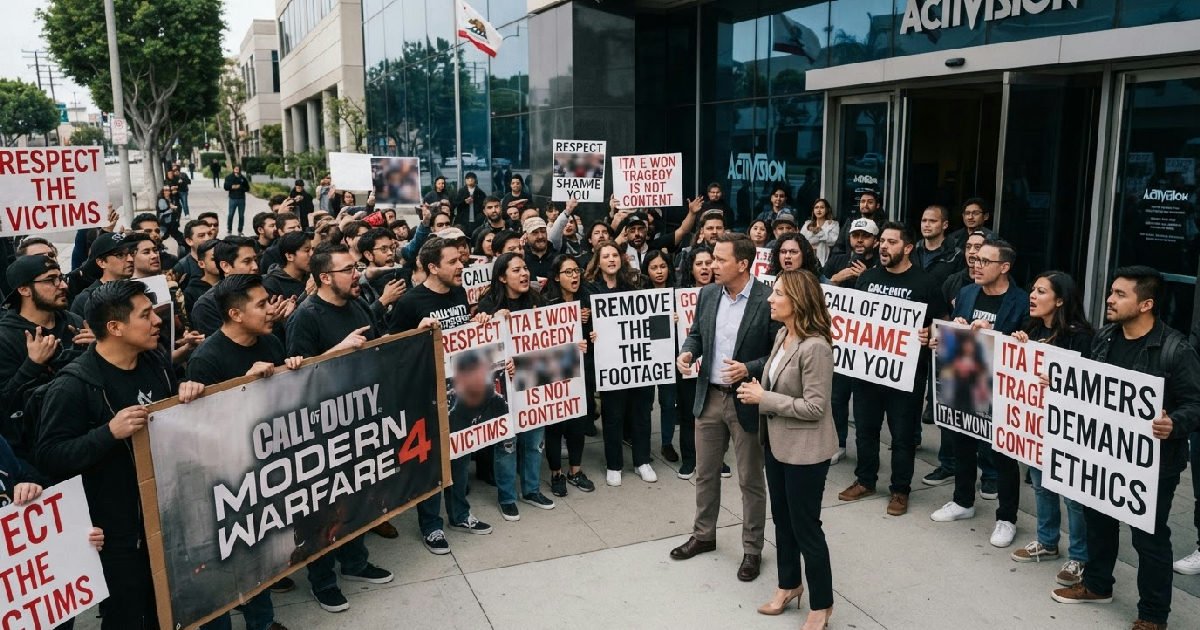
activision faces backlash over modern warfare 4
Activision, the publishing giant behind the *Call of Duty* franchise, is currently facing significant backlash over its recently released title, Call of Duty: Modern Warfare 4.
The controversy stems from the game’s opening cinematic, which allegedly incorporates real-world footage of the tragic Itaewon crowd crush that occurred on October 29, 2022, in Seoul, South Korea. Bereaved families and a coalition of civic groups are now demanding the immediate removal of these insensitive clips.
activision modern warfare backlash over sensitive content
The issue gained prominence on October 29, 2026, just days after the game’s global launch on October 23. Critics argue that using such imagery, which depicts fictional civilian casualties during a North Korean invasion of South Korea, is deeply inappropriate, causing renewed trauma for those affected by the real-world disaster.
The controversial footage in Modern Warfare 4 shows harrowing scenes: paramedics performing CPR on collapsed individuals, bodies lying in the street, and victims being carried away on stretchers. Korean broadcasters have conducted side-by-side comparisons, highlighting striking similarities between the in-game clips and actual news coverage from the Itaewon tragedy.
While the game’s footage is rendered with monochrome tones and noise filters to fit a war-torn aesthetic, the resemblance to the real-world disaster is undeniable.
The Itaewon Disaster Bereaved Families Association and the Citizens’ Countermeasures Meeting for the Itaewon Disaster issued a joint statement condemning Activision, labeling the inclusion of such material as “highly inappropriate and a senseless act.”
These groups stress that survivors, victims’ families, and even first responders continue to suffer from the psychological aftermath of the crush, making the game’s use of the imagery particularly egregious.
Calls for removal and formal apology
In their joint statement, the bereaved families expressed profound shock, stating they were “appalled that the chaotic and desperate scenes of citizens performing CPR to save one another, with victims lying in the cold streets, were used unchanged to create a scene in a game.”
They plan to escalate the issue by collecting signatures from foreign bereaved families attending memorial events in South Korea, aiming for a broader international appeal for the removal of the footage.
Cho In-young, who leads the joint situation department of the Itaewon Citizens’ Countermeasures Association, sharply criticized the game developers. She stated that Activision had been “extremely insensitive to the pain felt by the bereaved families, victims, and citizens.”
Cho also highlighted a failure to consider the fundamental dignity of the victims in the development process.
Korean Game Consumers Association weighs in
The Korean Game Consumers Association (KGCA), another influential advocacy group, has also voiced strong objections. They called for a clear explanation and a formal apology from Activision regarding the utilization of tragic disaster footage that bears no contextual relevance to the gameplay narrative.
The KGCA insists the controversial clips be replaced through a game update.
However, the KGCA also emphasized that this controversy should not be misconstrued as a demand for blanket censorship within the gaming industry. Their focus remains squarely on the respectful handling of real-world tragedies.
The association seeks accountability without stifling creative expression or imposing unreasonable restrictions on game content more broadly.
Activision’s measured response to Modern Warfare 4 Itaewon footage claims
In response to the mounting criticism, Activision released a statement to local media, including Yonhap news agency. The company acknowledged that “some actual news footage included in the game’s opening cinematic was utilised as an element to convey the fictional story within the work.”
This marks the first official acknowledgment from Activision regarding the ongoing controversy.
The statement continued, asserting that Activision had “absolutely no intention of mentioning or treating lightly any actual tragic events, including the Itaewon tragedy.” The publisher claims to have approached the subject matter with care and respect.
However, their response did not explicitly confirm whether the controversial footage would be removed or altered in future game updates. This omission has done little to assuage the concerns of the grieving families and advocacy groups.
Activision Blizzard, the parent company, has faced various controversies throughout its history. This includes allegations of patent infringement and, notably, a major lawsuit in July 2021 alleging a “frat boy” culture with widespread sexual harassment and discrimination.
Such incidents have put the company under intense scrutiny before, often requiring careful navigation of public sentiment.
The shadow of the Itaewon crowd crush
The Itaewon crowd crush, which occurred on October 29, 2022, remains a deeply painful event in South Korean history. It unfolded in a narrow alley of Seoul’s bustling Itaewon nightlife district during Halloween festivities, the first major post-pandemic celebrations in the city.
The disaster resulted in 159 fatalities, primarily young adults, including 27 foreign nationals. Investigations by the Korean National Police Agency (KNPA) later concluded that inadequate preparation by both police and government officials, despite prior warnings of overcrowding, contributed significantly to the tragedy.
In October 2024, a South Korean court sentenced three police officers to prison for professional negligence related to the event, highlighting official accountability.
Gaming industry sensitivity and past precedents
This isn’t the first time a Call of Duty title has drawn controversy for its use of real-world elements. The 2019 release of Call of Duty: Modern Warfare faced criticism for including white phosphorus as a killstreak reward in its multiplayer mode.
Critics then argued that the weapon’s inclusion, given its real-world use and horrific effects, was insensitive, especially with the game’s push for realism.
Infinity Ward, the developer behind many *Call of Duty* titles, including the current *Modern Warfare 4*, defended the choice at the time. They stated that multiplayer was a “playground” separate from the single-player campaign’s darker themes and was not intended to comment on actual warfare.
However, the use of real news footage of a civilian tragedy takes the current debate to a different level, directly touching upon unhealed national wounds.
South Korean regulatory landscape and future implications
The controversy could intensify scrutiny from South Korean regulatory bodies. The Game Rating and Administration Committee (GRAC) is the nation’s official video game content rating board, ensuring all games sold in South Korea comply with content standards. Non-local companies typically require a local publisher or proxy to secure ratings.
Beyond ratings, the Game Industry Promotion Act (GIPA) was amended on October 1, 2026. This amendment specifically strengthens the responsibility of overseas game companies to protect domestic users and address complaints, potentially requiring them to appoint local representatives.
Should Activision fail to adequately address the concerns, the Minister of Culture, Sports and Tourism could mandate a domestic agent if the game causes “substantial harm to Korean users.” The outcome of this particular Modern Warfare 4 controversy may set new precedents for how game content is reviewed and regulated, especially in culturally sensitive markets.
Modern Warfare 4 sales performance amidst the storm
Despite the significant ethical and public relations challenge, Modern Warfare 4 has seen strong commercial success. Shortly after its release, the game quickly climbed to the top of South Korea’s sales charts on Steam.
This sales performance suggests that while the controversy has generated considerable media attention and public outcry, it has not, as of yet, significantly deterred a large segment of the gaming consumer base from purchasing the title.
The game’s plot, which features a realistic portrayal of a North Korean invasion of South Korea, initially garnered attention for its detailed depiction of recognizable Korean streets and a South Korean marine private fighting the invasion.
This localized realism may contribute to its popularity, even as the ethical questions surrounding its opening cinematic persist. As for future updates, it remains to be seen whether Activision will respond to demands for footage removal, or if current public sentiment will influence Activision’s future content policies.
The decision Activision makes concerning the footage could have lasting implications. It affects not only its relationship with the South Korean gaming community and government but also its reputation globally regarding corporate social responsibility and content ethics.
The balancing act between artistic freedom and respect for real-world suffering remains a complex challenge for developers navigating increasingly globalized and interconnected audiences.