

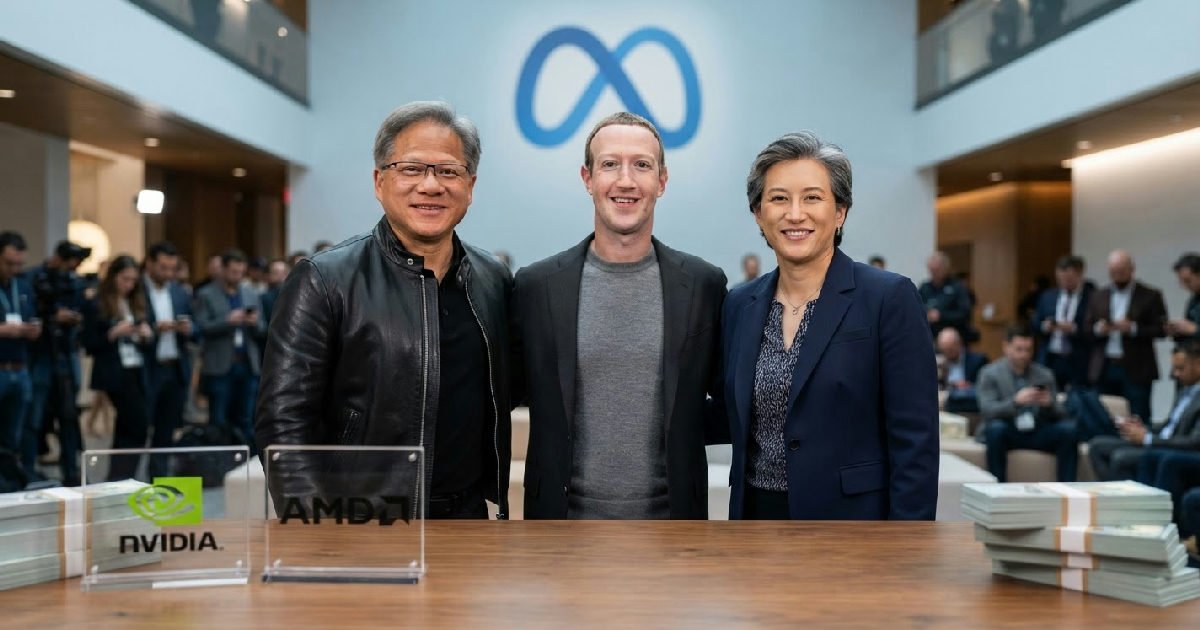
Nvidia invests 3 billion AMD 1 billion in Meta
In a major consolidation of power within the artificial intelligence sector, chipmakers Nvidia and Advanced Micro Devices (AMD) confirmed on October 27, 2026, a combined $4 billion investment into Meta Platforms. Nvidia will contribute $3 billion, with AMD adding $1 billion, to back Meta’s colossal $95 billion fundraising effort aimed at building out its AI infrastructure and advancing its new AI agent, Muse.
The move cements a critical alliance between the world’s leading social media company and two of its most essential hardware suppliers. This investment is part of Meta’s massive capital-raising strategy, which includes an initial $37.5 billion in public equity offerings and a subsequent $60 billion at-the-market program.
The Nvidia AMD Invest in Next-Generation AI
This enormous financial undertaking highlights the sheer cost of competing at the frontier of AI, where access to cutting-edge chips and data center capacity defines the winners and losers. The scale of the financing reflects a wider market trend where companies are exploring new avenues for AI financing opportunities.
This partnership is fundamentally about securing the computational power needed for the next wave of artificial intelligence. Meta is betting its future on AI agents, and its recently launched Muse, a family of AI models and agents, has already garnered significant attention.
Nvidia CEO Jensen Huang emphasized the transformative potential, stating, “AI agents represent a new computing paradigm — software that understands our goals, reasons, uses tools and gets work done on our behalf. This changes how we use computers, from operating applications to working with intelligent agents.”
Nvidia’s $3 billion commitment will facilitate Meta’s expanded deployment of advanced Nvidia infrastructure. This includes the Vera Rubin and Vera CPU platforms, alongside cutting-edge Spectrum-X Ethernet networking and BlueField-4 technologies. The deepened collaboration builds upon a multiyear chip deal Meta inked with Nvidia earlier in February 2026, solidifying a crucial supply chain for Meta’s ambitious AI roadmap.
AMD also plays a significant role in Meta’s expansive AI infrastructure, having already deployed millions of its EPYC processors across various generations. Meta functions as a lead customer for AMD’s 6th Gen EPYC™ CPUs and leverages AMD Instinct GPUs for critical training, ranking, and recommendation engines.
The social media giant was also an early definition customer for the AMD Instinct™ MI450 architecture, and will soon deploy a custom AMD Instinct GPU within its systems. AMD’s Helios server racks are set to power a substantial portion of Meta’s evolving AI models and services.
Meta’s ambitious AI infrastructure drive
Meta’s overall strategy involves raising an astounding $95 billion to bolster its artificial intelligence capabilities, reflecting the unprecedented investment required to remain at the forefront of the AI race.
The financing plan includes an initial $35 billion raised through underwritten public equity offerings, which later increased to $37.5 billion with the addition of a depository share offering.
This initial phase saw a Class A common-stock tranche boosted to $25 billion, priced at $625 per share, complemented by a $12.5 billion depository share offering at $50 per share.
Beyond these immediate capital infusions, Meta intends to secure an additional $60 billion through an at-the-market offering program. This second stage is anticipated to commence after Class C shares begin trading in the first quarter of 2027. These funding mechanisms underscore Meta’s determination to fully finance its expansive vision for AI development and deployment.
The sheer scale of Meta’s AI ambition is further evidenced by its capital expenditures. The company expects to spend between $135 billion and $145 billion in 2026 alone, with $85.82 billion already expended in the first nine months of the year.
Much of this investment, totaling $83.06 billion in purchases of property and equipment, is directly channeled into servers, data centers, and advanced network infrastructure necessary to power its AI initiatives.
Meta also holds $10.80 billion in restricted cash, earmarked for escrow requirements tied to multiyear infrastructure purchase agreements, and its total noncancelable contractual commitments stood at $454.52 billion as of September 30, primarily for cloud capacity, network infrastructure, and energy services.
Strategic play amid the AI boom
For Nvidia, this investment transcends a mere financial transaction; it is a strategic move to solidify its indispensable role in Meta’s AI ecosystem. By deeply embedding its hardware and expertise, Nvidia ensures it remains the preferred partner for Meta’s AI expansion, potentially warding off Meta’s own ambitions to develop custom AI chips.
This proactive approach is characteristic of Nvidia’s aggressive market strategy, which has seen it participate in 121 investment rounds so far in 2026, a sharp increase from just 13 in 2022, according to Dealroom data. This reflects a broader trend of institutional investment in emerging technologies.
Similarly, AMD’s $1 billion investment reinforces its long-standing relationship with Meta, securing its position as a critical supplier for Meta’s vast computing needs. Both companies are navigating a competitive landscape where securing large-scale clients like Meta is paramount for sustained growth in the booming AI sector.
The indication of interest from Broadcom, another major chipmaker whose CEO Hock Tan advises Meta’s board, further highlights the intense jockeying among hardware providers for a share of this lucrative market.
The collaborative financing structure, where chip suppliers invest in a key customer, has prompted some discussion, termed by observers as a “circular financing concern.” However, Mizuho analyst Lloyd Walmsley noted that “the Meta equity financing helping remove part of the equity overhang” provided a positive signal.
Investors had feared a delay until the establishment of Class C shares in January 2027, making the pull-forward of this funding a welcome development.
The strategic move also illustrates how major tech players are intertwining their fates in the pursuit of AI dominance, potentially creating new dependencies and synergies that will shape the industry for years to come.
The future of AI agents and corporate collaboration
The deep alliance between Meta, Nvidia, and AMD is more than just a capital injection; it represents a foundational shift in how future AI capabilities will be developed and deployed.
As Jensen Huang articulated, AI agents like Meta’s Muse are not simply new applications, but a “new computing paradigm” that promises to redefine human interaction with technology. Meta CEO Mark Zuckerberg has similarly described Muse as a way to bring “personal superintelligence to everyone,” underscoring the high stakes and transformative potential.
This vision necessitates an unprecedented level of integration between software and specialized hardware, making strategic partnerships with leading chipmakers essential.
This concentrated investment and technological collaboration could accelerate the development of sophisticated AI agents, pushing the boundaries of what these intelligent systems can achieve.
The financial backing and technical expertise from Nvidia and AMD provide Meta with the resources to scale its AI infrastructure rapidly, fostering innovation that could impact billions of users across its platforms.
However, such deep alliances also raise questions about market concentration and the potential for a few dominant players to dictate the pace and direction of AI development globally. The broader context of tech investment policies remains dynamic.
Ultimately, the substantial investment by Nvidia and AMD in Meta underscores the intertwined destinies of hardware manufacturers and AI developers in the race for technological supremacy. This collaboration is set to drive significant advancements in artificial intelligence, shaping how individuals interact with digital agents and how businesses leverage advanced computational power for decades to come.
The financial commitment reflects not just the current valuation of AI, but the profound belief in its future impact across every facet of the global economy.