

rick rieder global bonds sees historic opportunity
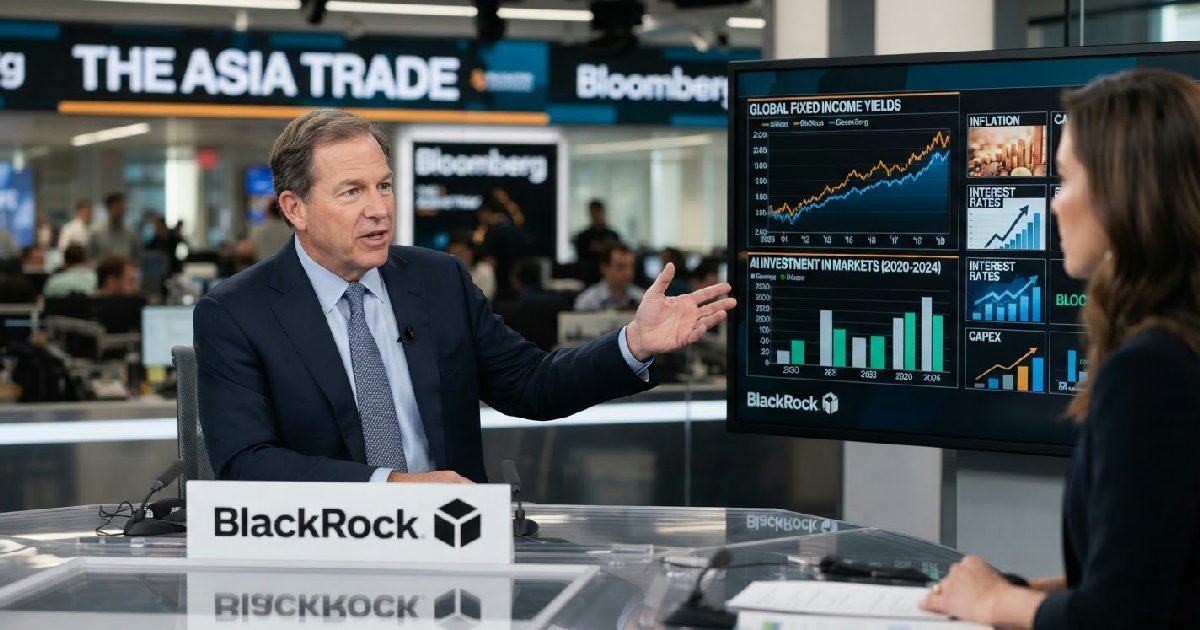
Rick Rieder, BlackRock’s Chief Investment Officer for Global Fixed Income, sees a “historic opportunity” emerging in high-quality bonds. His latest commentary, shared during an interview on Bloomberg’s “The Asia Trade,” outlines a strategy for investors to build diversified portfolios yielding over 7% with both low duration and strong credit quality.
Rieder’s insights, most recently elaborated in BlackRock’s Q4 Fixed Income Outlook around October 21, 2026, also delve into the transformative influence of Artificial Intelligence on global markets. He highlights how AI is reshaping labor dynamics, inflation, and investment strategies, particularly concerning the massive capital expenditure required for AI infrastructure build-out.
Rick Rieder on Global Bonds and AI Financing
Investors can now construct portfolios offering attractive returns typically associated with higher risk environments. Rieder noted that these diversified portfolios could yield above 7%, maintain an average credit rating of A-, and feature an effective duration of under three years.
“Not only are these yields at historically unprecedented levels right now, but such yields typically only appear when there is some kind of problem, such as economic issues or defaults,” Rieder told CNBC. He emphasised that current market strength means “you really don’t need to worry about any major defaults.”
This outlook marks a shift for BlackRock, which had previously expressed caution regarding certain segments of investment-grade credit earlier in the year. The firm’s iShares Flexible Income Active ETF (BINC) reflects this positive stance, reporting a 30-day SEC yield of 5.66% and an effective duration of three years. Its investment-grade allocation has risen to 14.3% from 8.5% in July.
Such conditions present a compelling entry point for fixed income investors. Rieder stated he “hasn’t said this in a very, very long time” when referring to the current opportunities in investment-grade corporate bonds.
BlackRock upgraded U.S. Treasuries in October 2026, citing higher starting yields as a cushion against potential further rate increases. The firm suggests markets might have over-priced Federal Reserve tightening.
Artificial Intelligence’s Dual Impact on Finance
Artificial Intelligence continues to be a defining force, fundamentally altering economic growth trajectories and corporate investment patterns. Rieder points to the substantial capital being raised by technology giants for AI infrastructure.
Hyperscale cloud providers, including Alphabet, Amazon, Meta, and Oracle, have collectively issued approximately $228 billion in debt during 2026 to finance their ambitious AI projects. This massive fundraising indicates the scale of the ongoing infrastructure build-out.
However, Rieder maintains a cautious approach to certain aspects of this rapid expansion. He warns that “some parts of the data center supply chain are not backed or supported by hyperscale cloud providers.” BlackRock plans to remain vigilant in these less secure areas.
The projected capital expenditure for hyperscalers is set to reach $610 billion in 2026, a significant increase from $360 billion in 2025. This accelerating investment underscores AI’s insatiable demand for computing power and infrastructure.
AI Reshapes the Labor Landscape
The impact of AI extends profoundly into the labor market, demonstrating divergent effects across various sectors. Industries with high AI exposure have seen a three-month annualized job growth of -0.29%, indicating job displacement or significant restructuring.
Conversely, sectors with medium AI exposure experienced a 1.63% job growth, while those with low AI exposure saw a 1.55% increase over the same period. This suggests a complex rebalancing, rather than uniform decline, across the workforce.
Major companies are already reporting substantial efficiency gains from AI adoption. Microsoft noted that 35% of its code is now written by AI, while Meta cut 21,000 jobs even as its productivity rose. Firms like Intuit, ServiceNow, and Salesforce have achieved efficiency improvements ranging from 15% to 30%.
Government Debt and Market Pressures
Alongside the private sector’s AI investment, ballooning government debt is adding another layer of complexity to global markets. The US budget deficit has climbed to $2 trillion for fiscal year 2026, creating fiscal headwinds.
Rieder expressed concern about the long-term implications of rising interest rates on sovereign balance sheets. “The more central banks raise rates, the higher the debt costs for these already heavily indebted governments become, which is something we must handle carefully in the long term,” he stated.
The sheer volume of new bond issuance, driven both by government borrowing and AI-related infrastructure financing, risks crowding out other borrowers. This could elevate financing costs across the board, impacting economic activity.
J.P. Morgan Global Research estimates that a $260 billion increase in net bond issuance by tech companies for 2026 could add 10-15 basis points of upward pressure on global aggregate bond index yields. This highlights the need for efficient capital allocation and can influence demand for innovative bond structures.
BlackRock’s modeling for the Bloomberg US Treasury index illustrates the sensitivity of returns to central bank policy. A 50 basis point rate cut by the Federal Reserve could yield a 7.2% return over a year, while rates holding steady would still offer 6.4%. Even with a 100 basis point hike, investors could see a 2.5% return.
BlackRock’s Strategic Fixed Income Posture
BlackRock, as the world’s largest asset manager with $15.3 trillion in assets, operates a substantial active fixed income platform managing $1.3 trillion. Rieder’s role as Chief Investment Officer of Global Fixed Income is pivotal to the firm’s strategy.
His investment philosophy emphasizes extreme diversification and a keen understanding of macro regime changes, particularly in inflation, central bank policy, and yield curve dynamics. Rieder likened his approach to managing a casino, focusing on tilting probabilities rather than chasing single large wins, and stressing humility and adaptability.
The firm upgraded US Treasuries in October 2026, citing higher starting yields as a buffer against further rate increases. They believe that markets might have overestimated the extent of Federal Reserve tightening. Rieder noted that “gaining a little edge a lot of times may be the secret to being a better bond investor.”
BlackRock’s Q4 Fixed Income Outlook underscores the importance of precision in risk allocation. Rieder highlighted that “income may be abundant, but it is not interchangeable; similar yields can carry very different risks.” This underlines the need for careful selection in the current market.
The Future Landscape of AI Investment
The global investment cycle for AI infrastructure is projected to be immense, expected to surpass $2.2 trillion by 2028. This includes a significant $1 trillion in 2026 alone, as data centers evolve into “AI factories” focused on high-density GPU clusters.
Despite the huge capital inflows, substantial financing challenges persist. Gartner research indicates that enterprise and consumer AI revenue might not be sufficient to support profitable returns on all planned capital expenditures through 2030, potentially exposing over $3.5 trillion of AI infrastructure spending to impairment.
Gartner projects that data center owners would need to generate $8.5 trillion in revenue by 2030 to cover capital spending, financing costs, and a 12% return on invested capital. However, total attributable revenue is forecast to be no more than $3.6 trillion, influencing retail investor interest in emerging asset classes.
BlackRock views AI as a generational capital-formation opportunity, but also acknowledges its demand for immense capital, power, and materials. This elevated demand, while boosting economic growth and earnings, also contributes to a higher cost of capital across the financial system.