

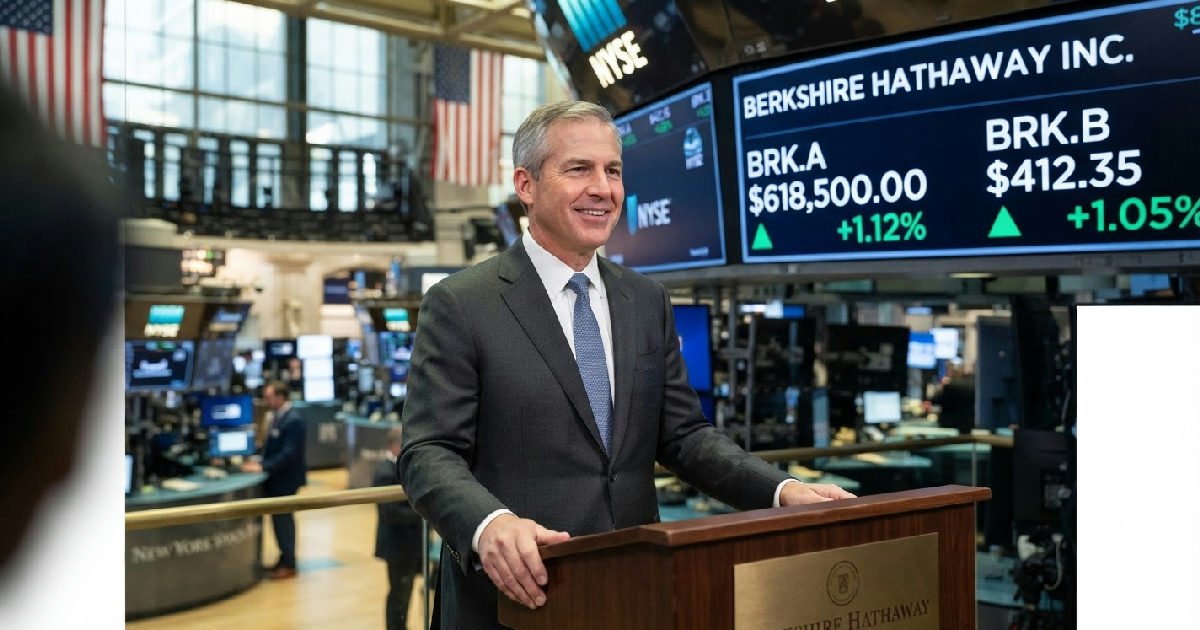
Berkshire Hathaway shares surge after Greg Abel takes over
Berkshire Hathaway shares have soared to new all-time highs on the New York Stock Exchange, nearly 18 months after legendary investor Warren Buffett announced his departure as CEO. shares have soared to new all-time highs on the New York Stock Exchange, nearly 18 months after legendary investor Warren Buffett announced his departure as CEO.
This remarkable recovery marks a significant vote of confidence in current chief executive Greg Abel, dispelling earlier market anxieties about the conglomerate’s future without its iconic leader.
Both Class A (BRK.A) and Class B (BRK.B) shares reached unprecedented levels on October 21 and 22, 2026, demonstrating a robust rebound from the significant dip that followed Buffett’s surprise announcement in May 2025.
Recasting the Post-Buffett Narrative for Berkshire Hathaway Shares
Warren Buffett’s decision to step down as CEO at the end of 2025, announced during the 2025 shareholders’ meeting on May 3, sent tremors through the market. On May 2, 2025, prior to the announcement, Class A shares closed at a then-record $809,350, with Class B shares at $539.80. The following trading day, May 5, saw BRK.A plummet 4.9% and BRK.B drop 5.1%.
This initial downturn was compounded by a reported 14% decline in first-quarter operating earnings for 2025, which was also announced that Saturday. Analysts like Brian Meredith at UBS had tried to reassure investors, predicting Berkshire’s culture and strategy would remain unchanged under Greg Abel. But the market remained skeptical, fearing an erosion of the long-standing “Buffett premium.”
Initial Market Reaction and ‘Buffett Premium’ Fears
Within three months of Buffett’s announcement, both share classes had seen substantial losses. Class A shares had shed 14.3% of their value, while the more widely held Class B shares were down almost 15% from their pre-announcement peaks. This period reflected deep investor concern about the future direction and performance of the Omaha-based giant without its long-time architect.
The sentiment shifted dramatically in the ensuing months, culminating in an 18% rally. On October 21, 2026, Class A shares hit an all-time high of $824,765.16, with Class B shares reaching an intraday peak of $543.06. Just a day later, BRK.A closed at a new record of $823,750, indicating sustained momentum.
Abel’s Strategic Capital Deployment
Greg Abel officially assumed the CEO role on January 1, 2026, and his tenure has been marked by decisive capital deployment strategies that have clearly resonated with investors. His actions have demonstrated a proactive approach to managing Berkshire’s colossal cash reserves, which stood at approximately $360 billion as of October 17, 2026, and a record $397 billion by October 22.
The firm repurchased $4.5 billion of its own shares in the second quarter of 2026, signaling confidence in its intrinsic value. These buybacks, coupled with strategic investments, have underscored Abel’s leadership and commitment to maximizing shareholder returns, proving doubters wrong.
Key Investments and Share Buybacks
Abel hasn’t shied away from significant investments. Berkshire Hathaway expanded its homebuilding operations by acquiring assets from Taylor Morrison Home Corp. for an estimated $6.8 billion in cash.
The conglomerate also made a substantial bet on artificial intelligence, investing an estimated $10 billion in Alphabet, Google’s parent company, making it one of Berkshire’s five largest common stock holdings. This move highlights a pragmatic approach to technological advancements.
Furthermore, Berkshire increased its stake in Bending Spoons, an Italian-based quasi-private equity firm, with an additional $330 million investment in October 2026. These diversified moves signal a clear direction under Abel, reinforcing investor confidence in his ability to steer the company effectively. For more on global market shifts, consider reading about Amaggi tender offer results.
Strong Financial Performance Underpinning Growth
Beyond strategic maneuvers, Berkshire Hathaway’s impressive financial results have played a crucial role in its stock resurgence. The company reported a significant 16% year-over-year increase in second-quarter 2026 operating earnings, reaching $12.983 billion. This comfortably surpassed market expectations.
Net income more than doubled, soaring to $25.67 billion in Q2 2026 from $12.37 billion a year earlier. Adjusted operating earnings per share for the quarter hit $6.02, beating the consensus estimate of $5.24 by nearly 15%. This strong performance validates the diversified business model and efficient management.
Q2 2026 Earnings Exceed Expectations
The robust earnings were partly driven by a recovery in unrealized investment gains, which nearly doubled GAAP net income. Additionally, Berkshire benefited from substantial interest income generated by its vast cash reserves, capitalizing on the prevailing high short-term interest rates. This financial strength provides a solid foundation for future growth and further strategic initiatives under Abel.
The consistent profitability and effective management of its substantial capital base highlight Berkshire Hathaway’s enduring appeal. Its ability to generate significant earnings across diverse sectors offers a compelling narrative for long-term investors.
A Defensive Play in a Shifting Market
Berkshire Hathaway’s rally is also interpreted by many market participants as a victory for a defensive investment thesis. This comes at a time when the broader market is witnessing volatility, particularly in the AI semiconductor sector, and facing corporate debt pressures. Investors are rotating out of high-flying tech and AI stocks amid concerns that massive spending on computing infrastructure won’t yield envisioned sustained profits.
Berkshire, with its diverse group of businesses generating close to $50 billion in annual after-tax earnings, stands as a stark contrast. It’s increasingly seen as the “ultimate anti-AI play,” offering stability and strong cash flows. Adam Patti of VistaShares, whose ETF tracks Berkshire’s portfolio, noted that the market’s turn away from a “momentum-driven frenzy” benefits Berkshire immensely.
Patti asserted that the market has finally accepted Abel’s leadership. “The market spent a year pricing Berkshire without Buffett,” he said on CNBC’s “Morning Call” on Monday. “I think it’s finally decided Abel can, in fact, run it and likes that he’s taking advantage of the company’s cash.” This shift in perception underscores a broader market recalibration towards value and stability.
Berkshire’s current market capitalization exceeds $1.1 trillion, a testament to its scale and resilience. Its gains have also narrowed its year-to-date deficit against the benchmark S&P to less than four percentage points. The company’s vast cash reserves provide an unparalleled buffer against economic uncertainties and offer immense flexibility for future investments.
The Path Ahead for Berkshire Hathaway
The journey from the “Buffett blues” to new record highs illustrates Berkshire Hathaway’s inherent strength and the successful transition under Greg Abel. The market has moved beyond the initial shock of Warren Buffett’s reduced role, recognizing Abel’s capability to lead the sprawling conglomerate.
Analysts now largely concur that Berkshire’s foundational strengths—its diversified holdings, robust cash generation, and disciplined capital allocation—are well-maintained under the new leadership. The focus will likely remain on prudent investments, opportunistic share buybacks, and leveraging its substantial cash pile in a volatile economic landscape.
Looking forward, the company’s strategic investments in areas like homebuilding and its measured entry into AI-related ventures suggest a balanced approach to growth. The enduring principles of value investing, deeply embedded in Berkshire’s DNA by Buffett and the late Charlie Munger, continue to guide its trajectory.
The market’s embrace of Berkshire’s post-Buffett era could serve as a blueprint for other long-standing companies navigating leadership transitions. It highlights the importance of strong underlying fundamentals and a clear strategic vision. Such movements can often impact related markets, much like the recent shifts in Bitcoin ETFs.
The conglomerate’s ability to attract investors seeking stability amidst broader market fluctuations positions it strongly for the future.
The narrative surrounding Berkshire has fundamentally shifted from concern about a premium evaporating to appreciation for its defensive qualities and Abel’s stewardship. This positive momentum is expected to continue as the company consistently delivers strong financial results and executes its growth strategies. The strong performance of Spotify stock and the contrasting dip in Hermès shares highlight varying investor sentiments across different sectors.