

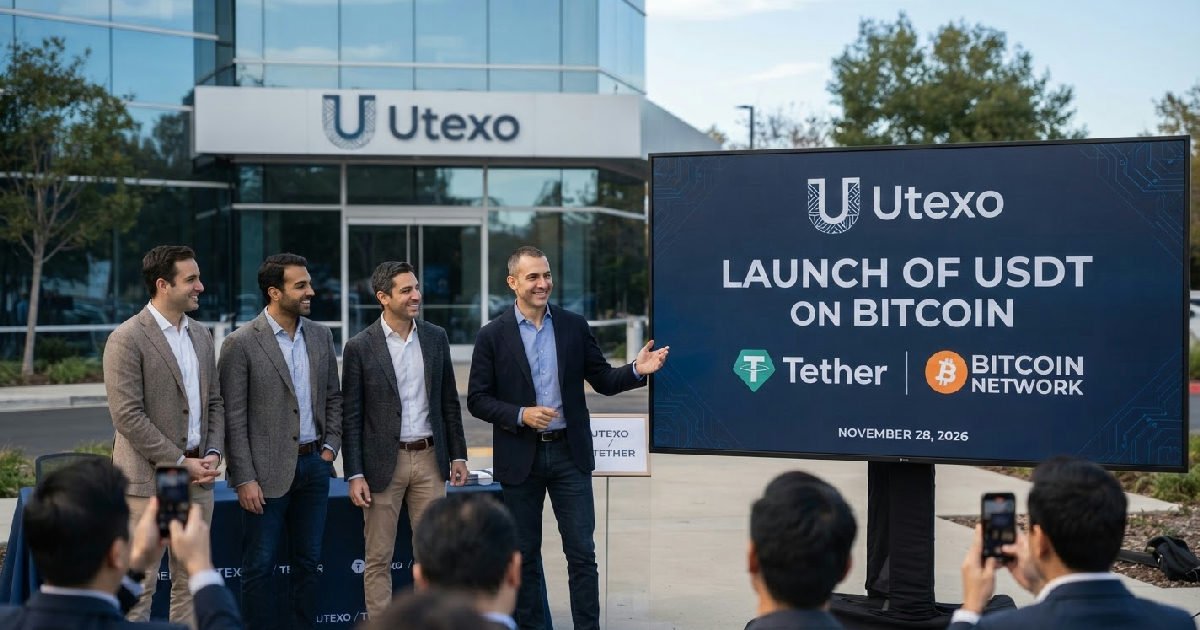
utexo launches usdt on bitcoin november 28 2026
Utexo, a Dubai-based financial technology company backed by Tether, has officially set November 28, 2026, as the public launch date for its bridged Tether (USDT) on the Bitcoin network. This marks a significant move to integrate the world’s largest stablecoin more deeply into the Bitcoin ecosystem.
The Utexo Mint, a dedicated platform for professional operators, already opened on October 22, 2026, allowing early access for testing and preparation.
Tether’s strategic return to USDT on Bitcoin
This initiative aims to bring substantial dollar liquidity directly onto Bitcoin, facilitating new avenues for trading and Bitcoin-backed lending. Tether’s CEO, Paolo Ardoino, has long championed Bitcoin as central to the stablecoin’s vision, a sentiment echoed by Utexo’s co-founders. The launch leverages the innovative RGB protocol and Bitcoin’s Unspent Transaction Output (UTXO) model for its technical foundation.
Tether’s renewed focus on Bitcoin represents a strategic evolution in its deployment of USDT. The stablecoin first appeared on Bitcoin in 2014 via the Omni Layer protocol, but later expanded predominantly onto Ethereum and Tron due to limitations in speed and transaction costs on Bitcoin at the time. This latest move signals a maturation of Bitcoin’s underlying technology.
Paolo Ardoino, Tether’s CEO, announced the stablecoin’s return to Bitcoin on X in September 2026 with the evocative message, “It’s coming home.” This sentiment underscores a long-held belief within Tether that Bitcoin is a crucial foundation for its stablecoin operations. The company had even announced its Bitcoin RGB deployment plans back in August 2025.
For years, most bitcoin exchange transfers for stablecoins bypassed the native blockchain, opting for faster and cheaper alternatives. This new solution from Utexo directly addresses those historical challenges, potentially transforming how liquidity flows within the crypto market. It’s a bold step that could redefine Bitcoin’s utility beyond just a store of value.
RGB protocol redefines Bitcoin transactions
The technical backbone of this new USDT on Bitcoin relies on the RGB protocol. RGB, a smart contract system for Bitcoin, enables asset issuance and management without directly modifying Bitcoin’s core protocol. It uses client-side validation, meaning that transaction details and contract logic remain off-chain, ensuring enhanced privacy and scalability.
Utexo co-founder Viktor Ihnatiuk noted the potential for “free USDT transactions” for wallet users, highlighting the efficiency of the new system. This privacy-by-design approach means that transaction amounts, timings, and counterparties are visible only to the involved parties. It’s a departure from public ledger transparency that could attract a new wave of users.
Furthermore, Utexo implements Trusted Execution Environments (TEEs) running on AWS Nitro Enclaves to secure bridge transfers between networks. Both mint and burn transactions undergo independent validation. This robust security framework is crucial for maintaining trust and integrity in a bridged asset environment, addressing common concerns about cross-chain operations.
Utexo’s operational framework and funding
Utexo, founded in 2025, quickly gained traction, securing $7.5 million in seed financing in March 2026. This round was notably co-led by Tether, Big Brain Holdings, and Portal Ventures, indicating strong industry backing. Other significant investors included Franklin Templeton and Maven11 Capital, among others.
The Utexo Mint platform is designed for professional operators, offering a sandbox environment for thorough testing before the main launch. It supports minting from Ethereum, Arbitrum, Plasma, Polygon PoS, and Tron. A fixed 0.1% fee is charged per transfer, providing clear cost predictability for users.
Co-founder Chris Hutchinson emphasized the system’s design: “We built Utexo so that USDT could move on Bitcoin the way money should move: instantly, privately, with no surprises on costs.” This focus on efficiency and predictability is a direct response to the market’s demand for reliable stablecoin transactions. Over 450 businesses have reportedly expressed interest in the platform.
Expanding Bitcoin’s DeFi capabilities
This launch significantly bolsters Bitcoin’s nascent decentralized finance (DeFi) capabilities. By bringing a liquid stablecoin directly onto the network, Utexo opens doors for new financial instruments and services. These include private transfers, direct Bitcoin swaps, and a robust platform for Bitcoin-backed loans.
The move also empowers businesses to maintain confidentiality in their payment activities while retaining necessary information for compliance and audit purposes. Bitcoin’s inherent security, combined with RGB’s privacy features, creates a compelling environment for enterprise-grade financial operations. This innovation leverages bitcoin’s robust performance as a secure, decentralized network.
Utexo provides software connections, developer tools, and cloud services, enabling businesses to integrate Bitcoin-based USDT products seamlessly. This infrastructure is vital for payment providers, exchanges, wallets, and high-frequency trading firms looking to leverage Bitcoin as a global rail for dollar transactions. It effectively broadens the utility of the world’s premier cryptocurrency.
The future of stablecoins on Bitcoin
Looking ahead, Utexo plans a second phase of integration, extending USDT to the Lightning Network for payments in Q1 2027. This ambitious roadmap aims to unlock near-instant, low-cost transactions, further enhancing Bitcoin’s utility as a settlement layer. The Lightning Network integration is expected to drastically reduce transaction times, with collaborations like x402 aiming for 50-millisecond real-time transactions.
The backing for this bridged USDT will sit in USDT locked on Arbitrum, an Ethereum Layer 2 scaling solution. This mechanism ensures that the value remains pegged to the US dollar, providing stability and trust in the system. Arbitrum’s role as an optimistic rollup helps manage the underlying liquidity efficiently.
This development is set to intensify the competition among stablecoins and their underlying networks. While ethereum ETF outflows and other market dynamics frequently capture headlines, the direct integration of a major stablecoin like USDT onto Bitcoin through advanced protocols like RGB could shift significant activity.
It emphasizes a growing trend where stablecoins are becoming indispensable tools for both traditional and decentralized financial systems, leveraging the best features of various blockchain networks.
Tether’s long-standing commitment to Bitcoin, as highlighted by Viktor Ihnatiuk’s statement that “Tether has always been a Bitcoin company,” underlines the strategic importance of this endeavor. He also called Bitcoin a “safe haven” for Tether, alongside gold. This long-term vision positions USDT on Bitcoin not just as a transactional convenience but as a fundamental component of future digital finance.
The successful launch and subsequent integration into the Lightning Network could solidify Bitcoin’s position beyond just a store of value. It has the potential to transform it into a vibrant hub for stablecoin-denominated commerce and lending. This evolution could attract even more institutional interest and mainstream adoption, further cementing Bitcoin’s role in the global financial landscape.