

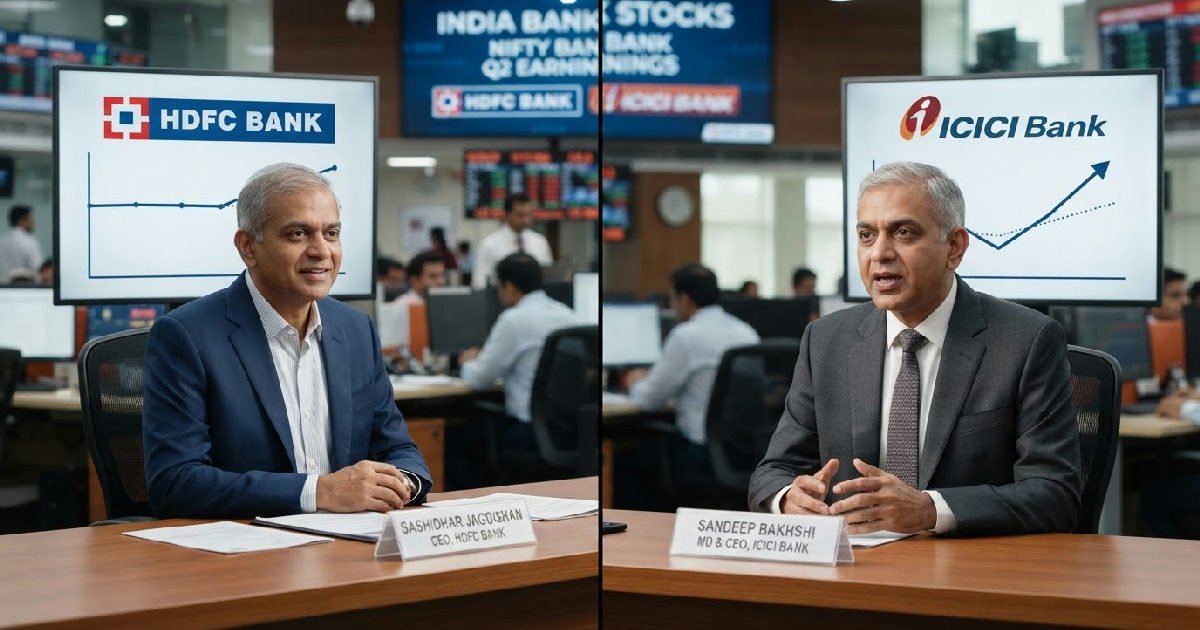
HDFC Bank earnings meet forecasts ICICI Bank beats
India’s two largest private lenders, HDFC Bank Limited and ICICI Bank Limited, have presented a divergent picture of the nation’s banking sector with their latest quarterly results. Released over the weekend, the earnings for the second quarter ending September 30, 2026, show HDFC Bank meeting profit estimates while its primary rival, ICICI Bank, surpassed expectations, setting a complex tone for the market open on Monday.
The mixed results from these financial heavyweights, which together account for over half of the Nifty Bank index’s weight, provide a crucial barometer for India’s economic health. Their performance is under intense scrutiny from investors looking for signs of sustained growth amid a shifting monetary policy landscape and increasing competition for capital.
HDFC Bank earnings and leadership change
Globally, observers continue to track diverse financial developments, from Ethereum ETF outflows to shifts in traditional investment. The results come as the broader Nifty 50 index posted its best week in six months, creating a high-stakes environment for the banking sector.
HDFC Bank, India’s largest private lender by assets, reported a net profit that was largely in line with analyst expectations. The bank is currently navigating a significant leadership transition, adding another layer of complexity to its performance narrative. The results offer the first clear glimpse into its financial health following the massive 2023 merger with its parent mortgage lender, HDFC Ltd.
The bank is also preparing for a change at the top. Chief Executive Officer Sashidhar Jagdishan announced he will not seek reappointment for a third term, with his retirement effective October 26, 2026. Anup Bagchi is slated to take over, and investors are closely watching for any shifts in strategy under the new leadership.
Profit and income analysis
For the second quarter of the 2027 fiscal year, HDFC Bank posted a standalone net profit of ₹17,378.7 crore. This marks a solid 20.6% increase year-on-year, though it landed just shy of the average analyst forecast of ₹17,500 crore.
The bank’s net interest income (NII), a core measure of profitability, grew by 13.9% year-on-year to reach ₹31,478.6 crore. This performance highlights steady, if not spectacular, growth in a competitive environment.
Despite the solid profit growth, the market reaction was muted. Shares of HDFC Bank registered an initial dip of 1.5% on the National Stock Exchange (NSE) following the announcement. This suggests investors may have been hoping for a stronger performance, particularly in its net interest income growth, when compared to its peers.
Asset quality and provisions remain a key focus
HDFC Bank demonstrated stable asset quality, a critical indicator of a bank’s health. Its Gross Non-Performing Assets (GNPA) ratio stood at 1.23% of gross advances, a marginal improvement from 1.24% in the previous quarter. The Net Non-Performing Assets (NNPA) ratio held steady at 0.30%. These figures indicate the bank is effectively managing its loan book and preventing a significant rise in bad loans.
However, the bank increased its total provisions for the quarter to ₹4,200 crore, up from ₹3,800 crore in the preceding quarter. This move signals a cautious outlook, suggesting that management is setting aside more capital to cover potential future loan losses. In his commentary, CEO Sashidhar Jagdishan emphasized a focus on strengthening the deposit franchise and maintaining asset quality, acknowledging the challenging competitive landscape.
ICICI Bank surpasses expectations with strong performance
In stark contrast to HDFC Bank’s steady report, ICICI Bank delivered a performance that comfortably beat market expectations. India’s second-largest private lender showed robust growth across key metrics, from profit to loan growth, alongside a notable improvement in its asset quality. The results were received warmly by the market, with the bank’s shares gaining 0.8% in early trading.
Under the leadership of CEO Sandeep Bakhshi, the bank has focused heavily on leveraging technology and digital initiatives to drive growth. This strategy appears to be paying dividends, allowing it to expand its loan book while simultaneously cleaning up its balance sheet.
The bank’s strong results could lead to a short-term divergence in stock performance compared to its main rival. Elsewhere, the dynamic market environment sees constant strategic adjustments, as exemplified by the Daimler Truck financial arm‘s shift in strategy.
Beating the street with robust profit
ICICI Bank reported a standalone net profit of ₹11,678 crore for the quarter, a significant 23.6% increase from the same period last year. This figure surpassed the average analyst expectation of ₹11,400 crore. The bank’s Net Interest Income (NII) also saw impressive growth, rising by 16.1% year-on-year to ₹28,872 crore, outpacing the growth rate reported by HDFC Bank.
This outperformance suggests that ICICI Bank is successfully capturing market share and managing its interest margins effectively. CEO Sandeep Bakhshi attributed the strong numbers to “robust growth across all segments,” underscoring the broad-based nature of the bank’s success during the quarter.
Improving health and lower provisions
A key highlight of ICICI Bank’s report was the marked improvement in its asset quality. The GNPA ratio fell to 2.80% from 2.90% in the prior quarter, while the NNPA ratio improved to 0.48% from 0.51%. This continued reduction in bad loans points to a strengthening balance sheet and effective risk management practices.
Crucially, this improvement allowed the bank to reduce its buffer for potential losses. Provisions for the quarter decreased by 10% year-on-year to ₹1,200 crore. This contrasts sharply with HDFC Bank’s decision to increase provisions, indicating a more confident outlook from ICICI Bank’s management regarding its loan portfolio and the broader economic environment.
Mixed signals for the Nifty Bank index
The divergent earnings from the Nifty Bank index’s two most influential members have created a mixed outlook for the sector. HDFC Bank and ICICI Bank collectively represent approximately 55% of the index’s weight, meaning their individual performances have an outsized impact on its direction. The contrasting results could lead to increased volatility as investors digest the different signals.
Analysts from Motilal Oswal Financial Services noted the potential for a short-term divergence in the stocks. They pointed out that while both banks demonstrated healthy overall growth, HDFC Bank’s higher provisions and comparatively slower NII growth could weigh on its performance relative to ICICI Bank.
This split performance complicates the picture for investors who use the banking index as a proxy for the entire Indian economy.
The results underscore the different paths the two giants are on. HDFC Bank is still integrating its massive merger with HDFC Ltd., a complex process that involves aligning different business cultures and product ecosystems. Meanwhile, ICICI Bank is reaping the benefits of a multi-year focus on digital transformation and balance sheet consolidation.
Broader economic backdrop and future outlook
These earnings reports do not exist in a vacuum. They arrive at a pivotal moment for the Indian economy, which is grappling with inflationary pressures and a tightening monetary policy. In its October meeting, the Reserve Bank of India’s (RBI) Monetary Policy Committee voted to increase the key repo rate by 25 basis points to 5.50%, shifting its stance to “calibrated tightening.”
This rate hike directly impacts banks by increasing their cost of funds, which can squeeze net interest margins if they are unable to pass the higher costs on to borrowers. It also threatens to slow loan growth by making credit more expensive for consumers and businesses.
Meanwhile, the wider global financial environment presents diverse challenges and opportunities, including how the World Bank plans to quintuple critical minerals financing. The banks’ ability to grow deposits and manage margins in this environment will be critical in the coming quarters.
Looking ahead, the Indian market is bracing for a busy earnings season and the launch of Jio Platforms’ $3.2 billion IPO, which could draw significant liquidity from the market. The performance of banking stocks will remain a central focus, as their health is intrinsically linked to the credit growth that fuels the nation’s economic expansion.
The tale of these two banks—one a steady giant navigating change, the other a resurgent competitor hitting its stride—will be a defining story for investors in the months to come.