

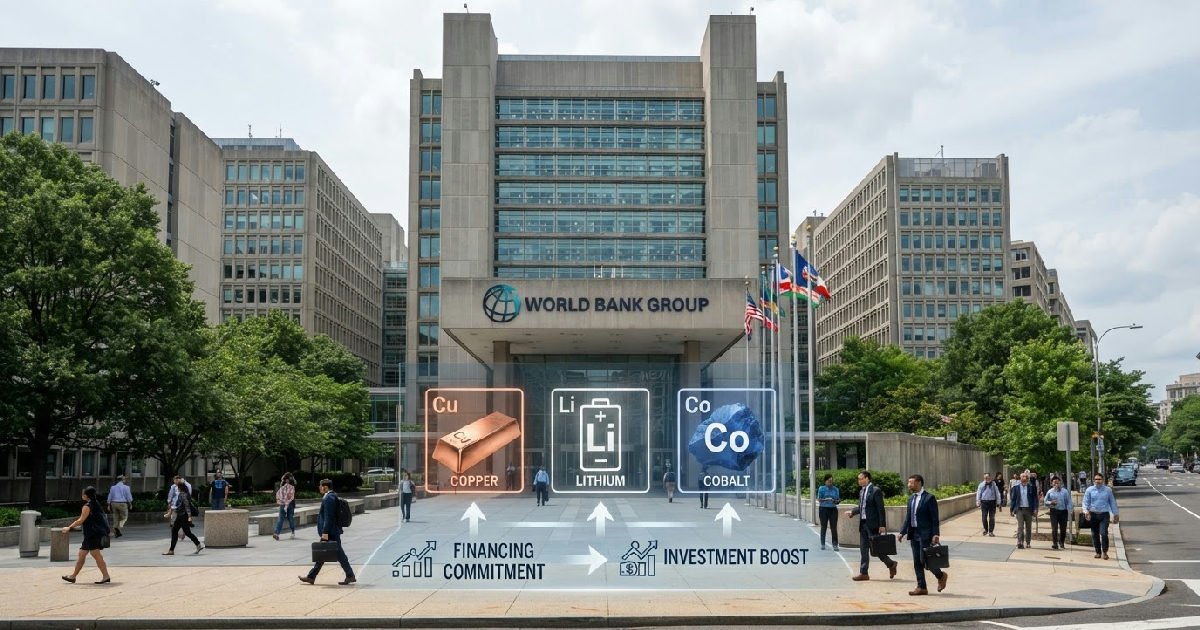
world bank plans to quintuple critical minerals financing
The World Bank launched its metals and minerals strategy implementation plan on 2024-04-17, aiming to bolster financing for World Bank critical minerals development in emerging markets. The institution specifically called for a fivefold increase in financing volumes to address persistent challenges like weak governance, inadequate infrastructure, and limited capital mobilization within these vital sectors.
This strategic move, unveiled during the annual meetings of the World Bank and the International Monetary Fund in Bangkok, underscores a growing global urgency. The plan responds directly to the escalating demand for minerals essential to the clean energy transition, including copper, lithium, and cobalt.
Boosting World Bank critical minerals financing for the energy transition
The World Bank’s latest plan dramatically ramps up its commitment to critical minerals, projecting a quintupling of its business in this sector. Over the fiscal years 2026-2030, the bank aims to allocate an impressive $19 billion in financing. This marks a substantial increase from the $3.6 billion provided during the preceding fiscal 2021-2025 period, reflecting the scale of the challenge and opportunity.
This financial push directly addresses the projected surge in demand for materials vital to electric vehicles and renewable energy infrastructure. Experts forecast that the demand for key minerals like lithium and cobalt could increase by nearly 500% by 2050. Without adequate investment, the transition to clean energy could face significant bottlenecks.
Riccardo Puliti, World Bank Vice President for Infrastructure, has highlighted the pressing need for this boosted financing. The current investment levels in developing countries are simply insufficient to meet the anticipated global demand. This new plan seeks to bridge that gap.
addressing governance and development challenges
Beyond pure financing, the implementation plan lays out eight solutions designed to create a more robust and equitable mining sector in EMDEs. These solutions are built around strengthening governance and ensuring sustainable development. The goal is to move beyond raw material extraction, fostering local industries and retaining economic value within these mineral-rich nations.
A core component involves integrating environmental, social, and governance (ESG) standards into mining operations. This emphasis aims to minimize the environmental footprint and ensure that local communities benefit from mining activities. The plan will also promote transparency and good governance, crucial for combating corruption and ensuring benefits are shared broadly.
Developing nations often grapple with unreliable energy grids, insufficient logistics, and a lack of skilled human capital. The World Bank intends to address these systemic issues through its lending instruments, including IBRD and IDA lending for policy reform and public infrastructure. IFC debt and equity will also catalyze private investment, while MIGA guarantees will help mitigate sovereign and non-commercial risks for investors.
global race for critical minerals escalates
The World Bank’s expanded focus on critical minerals unfolds against a backdrop of intensified geopolitical competition. Nations worldwide are striving to secure diversified supply chains for these essential materials. The push for cleaner energy has ignited a global scramble for resources.
The United States, as the World Bank’s largest shareholder, has actively advocated for the institution to play a more significant role in critical minerals development. US Treasury Secretary Scott Bessent has expressed a desire for the bank to enable mining and processing capacity through project de-risking and investment in infrastructure.
This aligns with broader US initiatives, such as Project Vault and Defense Department investments, aimed at bolstering domestic supply chains.
Such efforts highlight a collective drive to reduce reliance on single sources and ensure stability in the supply of materials. For instance, the US and Malaysia deepen critical minerals partnership, demonstrating how countries are forging alliances to secure their mineral futures. These partnerships are critical for geopolitical stability and economic resilience.
strategic partnerships and country compacts
World Bank President Ajay Banga announced that the bank has identified 20 countries for potential partnerships. These collaborations will focus on developing critical minerals projects tailored to specific national contexts. The aim is to maximize the economic and social benefits for the host countries.
The launch of the first “country compacts” with multilateral development bank partners is a key feature of this strategy. These compacts are designed to build local industries and ensure that more jobs and economic value are retained within EMDEs. It’s a direct response to concerns that developing nations might otherwise remain mere raw material exporters.
Policy reforms are central to these compacts, covering fiscal regimes, environmental and social monitoring, and geodata and digital permitting. The plan also emphasizes multi-user infrastructure development, integrating transport and ancillary facilities like roads and ports. Such developments serve multiple industries and local communities alike.
outlook: from strategy to implementation
The World Bank’s strategy, formally approved by its board on September 24, 2026, has been in the pipeline, building on previous initiatives like the “Minerals for Climate Action” report. The new implementation plan signifies a shift from conceptual frameworks to tangible actions. It focuses on transforming the critical minerals sector in developing countries.
Africa, holding approximately 30% of the world’s known mineral reserves, stands to be significantly impacted by this increased financing. The continent faces a pivotal moment, balancing the need for development with the demands of global supply chains. There’s an ongoing debate about whether these advanced economy demands might overshadow local development priorities, leaving Africa as primarily a source of raw materials.
The emphasis on value creation within EMDEs aims to counteract this. It seeks to ensure that countries can move beyond simple extraction into processing and manufacturing, creating more sophisticated economies. This long-term vision is crucial for sustainable economic growth, alongside supporting sectors such as Indian software sector growth, which also contribute to diversified national wealth.
The World Bank Group