

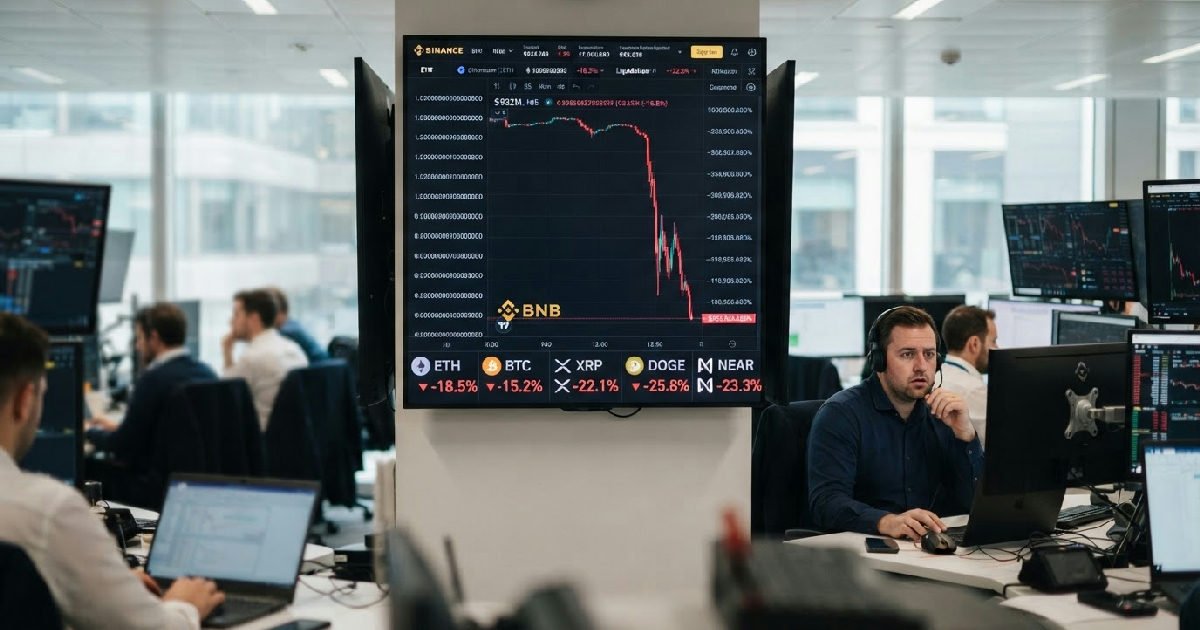
Crypto market liquidation hits $932 million overnight
The cryptocurrency market experienced a significant wave of forced liquidations overnight on October 15, 2026, totaling approximately $932 million. This drastic event primarily impacted traders holding long positions, wiping out $791.62 million, or 84.3% of all losses, from those betting on rising prices. Ethereum (ETH), Bitcoin (BTC), XRP, Dogecoin (DOGE), and NEAR Protocol (NEAR) all saw sharp corrections, marking the largest market purge since August.
This widespread sell-off served to clear the derivatives market of what analysts often term “speculative ballast,” a build-up of overleveraged positions. While the immediate aftermath was severe, market indicators soon pointed to a resilient rebound, suggesting a technical correction rather than a fundamental shift in the broader bullish trend for key assets.
Massive crypto market liquidation shakes derivatives market
The overnight liquidation event, detailed by CoinGlass, indicated a daily liquidation volume amounting to $939.30 million. A dominant 84.3% of these losses, totaling $791.62 million, were borne by long position holders. This indicated a sudden, sharp downturn that caught many optimistic traders off guard.
This substantial unwinding of leveraged positions represents a crucial, albeit painful, mechanism within the crypto ecosystem. It forcibly closes trades when collateral falls below maintenance margins, preventing further losses for both traders and exchanges. Such events are a stark reminder of the inherent volatility and risks associated with high-leverage trading in digital assets.
Ethereum and Bitcoin Bear the Brunt of Liquidations
While the market-wide impact was broad, Ethereum and Bitcoin absorbed the largest individual blows in terms of liquidation volume. Ethereum saw $286.11 million in liquidations, closely followed by Bitcoin with $215.49 million. These figures underscore their status as the market’s most heavily traded and leveraged assets.
The single largest incident recorded was a long position on the BTC-USDT pair on Binance, valued at $12.03 million, liquidated when Bitcoin traded at $80,208.96. Binance, one of the world’s leading cryptocurrency exchanges, accounted for 52.3% of the total volume of closed orders during the tumultuous period. This concentration highlights the exchange’s role as a major hub for crypto derivatives trading.
Altcoins XRP, Dogecoin, and NEAR Under Pressure
Beyond the market leaders, several prominent altcoins also experienced significant pressure as the wave of liquidations swept across the board. The volume of forcibly closed daily positions amounted to $12.82 million in XRP, $12.32 million in NEAR Protocol, and $12.18 million in Dogecoin.
For these highly liquid altcoins, often characterized by a strong retail capital presence, this correction marked a notable shake-up. Many had experienced prolonged periods of growth, making this a particularly deep and unexpected downturn in recent months. This liquidity shock demonstrated the interconnectedness of the broader crypto market, where sentiment shifts can quickly cascade from major assets to smaller ones.
Market Rebounds: Bitcoin’s Resilience Tested
Despite the initial shock and substantial losses, the crypto market demonstrated notable resilience, particularly for Bitcoin. During the steepest part of the decline, Bitcoin’s price tested the dynamic support in the form of its 50-day moving average (MA 50) around the $81,000 mark. This technical level met significant buying volume, preventing further slides.
Crucially, Bitcoin held above the psychological mark of $80,000. With its long-term 200-day moving average (MA 200) situated significantly lower, at $72,000, the ability to maintain these levels confirmed the underlying strength of the current bullish trend. Many analysts viewed this as a healthy “cleansing” rather than a signal of a trend reversal, suggesting the market was merely shedding excess leverage.
The swift rebound after the initial sell-off led to an aggressive short squeeze. As panic-driven retail traders began opening short positions at the local market bottom, Bitcoin and Ethereum prices surged upward, triggering a cascade of “bearish” order closures.
In just one hour, Bitcoin sellers lost $15.94 million (95.2% of all hourly liquidations for the asset), while Ethereum short sellers lost $19.41 million. Short positions on NEAR and DOGE also took a hit during the same hour, registering an instant wipeout of sellers.
Historical Context of Crypto Market Volatility
Large-scale liquidations are not new to the volatile cryptocurrency landscape. The October 15 event, while significant, echoes several past episodes of market turbulence. For instance, a similar event occurred on April 13, 2024, where approximately $970 million was liquidated from the crypto market, with Bitcoin briefly dropping from $67,000 to $60,600.
Other notable liquidations include nearly $1 billion in October 2026 due to inflation concerns and Federal Reserve interest rate decisions, and $929.14 million in September 2026 driven by a Bitcoin rally that triggered short liquidations.
These recurring events highlight the inherent risks of leveraged trading and the market’s sensitivity to macroeconomic news and sudden price movements. They serve as periodic stress tests, often clearing out overextended positions and recalibrating market expectations. This pattern of rapid correction followed by recovery is a defining characteristic of the crypto sector.
Implications for Market Health and Future Outlook
Despite the dramatic figures, many market observers view this particular crypto market liquidation as a necessary corrective action. The U.Today article suggested it was a “controlled cleansing” rather than a fundamental shift in trend. The rapid unwinding of long positions, followed by a short squeeze, indicates that underlying demand remains robust, particularly for Bitcoin and Ethereum.
Funding rates on key perpetual futures have remained in a stable positive zone (0.005%–0.009%) post-liquidation. This suggests that medium-term optimism among market participants has largely persisted after the technical purge of excess leverage. Such positive funding rates often imply that traders are still willing to pay a premium to hold long positions, a sign of continued bullish sentiment.
For investors navigating the cryptocurrency market, such events underscore the importance of risk management. While the allure of amplified gains through leverage is strong, the swift nature of liquidations can lead to substantial losses. This recent episode reinforces the idea that even during strong bull runs, periodic, sharp corrections remain a constant feature, offering both risks and potential entry points for those prepared for volatility.
The broader trend toward more integrated financial products in crypto also means that these market tremors can have wider implications. As platforms increasingly integrate swaps and yield, the interconnectedness of various market segments grows. This means that a large derivatives market event can ripple through decentralized finance (DeFi) protocols and other crypto-native services.
Looking ahead, the market will likely remain attentive to global economic signals and regulatory developments. While Bitcoin’s ability to hold above key support levels is encouraging, the potential for further volatility remains high.
Traders will continue to monitor metrics like open interest and funding rates for signs of renewed excessive leverage that could trigger future liquidation cascades. The future also holds potential for continued growth in the tokenized asset market, as digital assets become more widely adopted.
This market shake-up also puts a spotlight on the inherent risks associated with newer protocols and smaller cap assets. While XRP, DOGE, and NEAR showed resilience post-dip, their susceptibility to broad market movements means they often experience amplified price swings during periods of high volatility.
Maintaining a diversified portfolio and understanding individual asset characteristics becomes paramount during these turbulent times. Another key aspect for traders is understanding how major market events, such as a significant Bitcoin price test, can influence broader sentiment.
Ultimately, the $932 million liquidation served as a sharp reminder of the crypto market’s dynamic nature. It highlighted the ever-present tension between speculative trading and underlying fundamentals. While painful for those liquidated, the swift recovery suggests a healthy market still underpinned by significant demand, capable of absorbing shocks and continuing its long-term trajectory.