

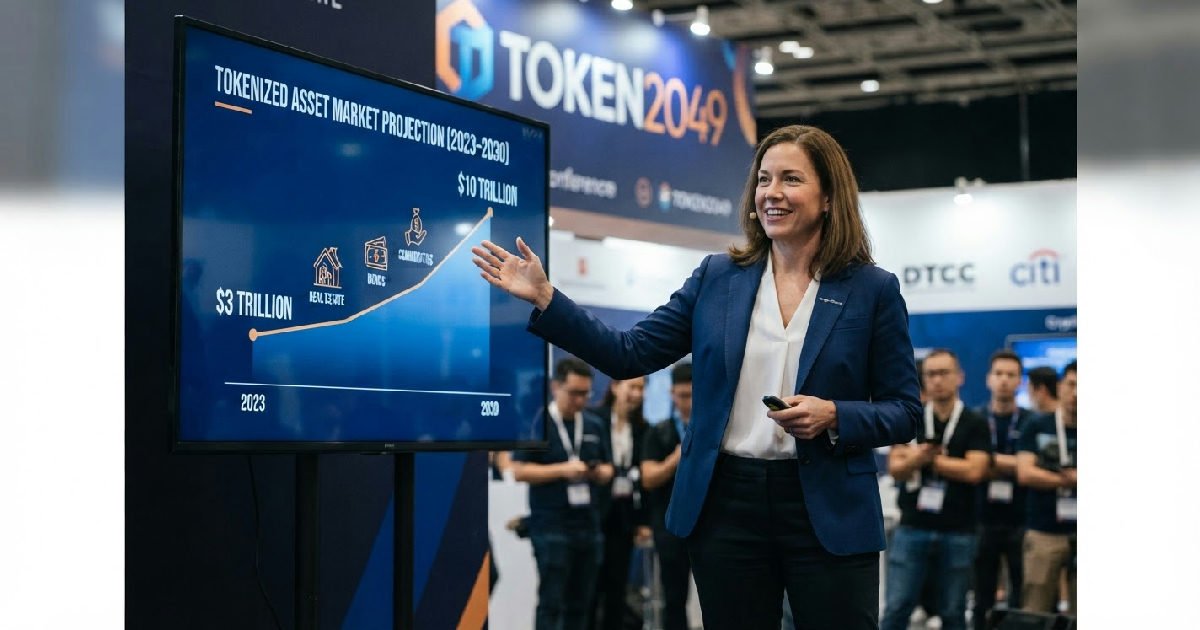
Amy Oldenburg forecasts $3 trillion to $10 trillion tokenized asset market
Morgan Stanley’s head of digital asset strategy, Amy Oldenburg, has reaffirmed a bold projection for the burgeoning tokenized asset market, anticipating its value to swell to between $3 trillion and $10 trillion by 2030. This outlook, revealed on October 12, 2026, during a TOKEN2049 interview, underscores growing confidence among major financial institutions.
The forecast comes as Morgan Stanley adjusts its timeline for supporting tokenized equity trading, pushing the expected launch to early 2027 from a previous 2026 target. This pivot happens amidst shifting global economic dynamics, impacting broader market trends. The delay highlights a common hurdle in this innovative space: the need for more available tokenized products before institutions can fully onboard client demand.
Massive Growth Expected in the Tokenized Asset Market
Amy Oldenburg expressed strong conviction in the projected growth, stating definitively that the market would “definitely be within that range without question.” This optimistic view extends beyond publicly traded stocks, encompassing a wider array of financial products and assets.
She identified private shares, structured notes, and various investment funds as prime candidates for tokenization. Blockchain integration in these areas promises to significantly reduce cumbersome paperwork and streamline administrative processes, offering a leap in efficiency.
Strategic Opportunities in Private Assets and Funds
Morgan Stanley sees substantial opportunities in applying blockchain-based systems to parts of the administrative processes for private shares, custom financial products, and private funds. This move could unlock liquidity and simplify ownership transfers for assets typically mired in complex processing.
Furthermore, Oldenburg highlighted the potential for tokenized holdings to serve as collateral once more assets become available in this digital format. This could revolutionize capital efficiency across financial markets, a concept that institutional crypto derivatives platforms are already exploring.
The acceleration of institutional interest has become palpable, according to the executive. She noted a growing number of announcements over the past year, indicating a rising concern among financial institutions about missing out on opportunities within the digital asset sector.
Morgan Stanley’s Infrastructure Development and Timeline Shift
In response to this escalating interest, Morgan Stanley is actively developing its infrastructure to support tokenized equities through its alternative trading system (ATS). The bank now targets the first quarter of 2027 for this launch, revising its earlier expectation of the second half of 2026.
Oldenburg attributed this adjustment primarily to a constraint in product supply. For the bank to facilitate trading, a sufficient volume of suitable tokenized securities must first exist. Client demand, while present, is currently limited by this very lack of available products.
The bank’s team continues to build the necessary technological framework. Oldenburg described the planned service as a natural extension of Morgan Stanley’s existing operations across equities, derivatives, and swaps. Clients could potentially hold investments in both traditional and blockchain-based formats.
Broader Industry Push for Tokenized Collateral
Beyond Morgan Stanley’s internal initiatives, the wider financial industry is also embracing tokenization, particularly for collateral. A September 24, 2026 report from Citi, prepared with The ValueExchange, found that 77% of financial institutions anticipate utilizing some form of tokenized collateral during 2026. This signals a significant shift in how assets are managed for financing and margin operations.
Citi’s research revealed that large institutions manage approximately $74 billion in collateral daily across around 65 custody locations. The report estimated that a quarter of this collateral often remains unremunerated or serves as an additional buffer due to systemic inefficiencies, leading to substantial annual lost income for firms.
With roughly 60% of global margin currently held in non-yielding cash, Citi identified tokenized money-market funds as a promising solution. These could combine investment income with faster transfers. Blockchain-based collateral could minimize reliance on prefunding by enabling assets to move precisely when payment or margin obligations arise, enhancing overall market efficiency.
DTCC’s Pivotal Role in US Securities Tokenization
A significant development Morgan Stanley is monitoring for US securities markets is the planned tokenization service launch by the Depository Trust & Clearing Corporation (DTCC) at the end of October. DTCC, a crucial market infrastructure provider, announced on July 15, 2026, that over 30 firms had already participated in production transactions. They used tokenized representations of assets held within the Depository Trust Company.
These transactions covered a range of activities, including securities lending, collateral pledges, equity transfers, and US Treasury repurchase agreements. The conversions operated across DTCC’s private Besu network and the public Canton Network, demonstrating the versatility of the technology.
The DTCC service will empower participating institutions to convert eligible securities between conventional and tokenized forms, delivering these representations to supported digital wallets. Crucially, American investors using this service will retain the same ownership rights, entitlements, and investor protections as their traditional equivalents, a safeguard supported by a December 2025 SEC no-action letter.
Institutional involvement in DTCC’s initiatives has broadened through its advisory group. On September 2, HashKey became the first Asian digital asset service provider to join DTCC’s working group, alongside other prominent members like JPMorgan Chase, Goldman Sachs, Nasdaq, and the New York Stock Exchange. HashKey aims to contribute its Asia-Pacific regulatory and operational expertise to shape standards for issuance, settlement, and custody.
Morgan Stanley’s Internal Innovation and Regulatory Progress
Internally, Morgan Stanley is fostering blockchain research through its recently established Digital Asset Lab. Launched with extensive coverage on September 29, the lab is conducting tests involving tokenized deposits, digital currencies, money-market funds, and decentralized finance vaults. This dedicated environment allows employees to explore blockchain applications without directly impacting the bank’s core systems.
Megan Brewer, who heads market innovation and labs at Morgan Stanley, noted the research includes software capable of executing investment strategies around the clock. This internal development underscores the bank’s commitment to integrating advanced digital asset capabilities, particularly as the sector witnesses significant ETH wallet movements.
Furthermore, Morgan Stanley is developing proprietary wallet infrastructure specifically for clients holding tokenized assets and financial products. This will provide a seamless and secure experience for clients engaging with these new investment vehicles.
On the regulatory front, the Office of the Comptroller of the Currency (OCC) granted preliminary conditional approval on June 18 for Morgan Stanley Digital Trust. This proposed national trust bank, located in Purchase, New York, signifies a major regulatory step forward for the institution’s digital asset ambitions.
The OCC’s decision outlines planned activities including digital asset custody, purchases, sales, swaps, and transfers to support client investments. It also encompasses fiduciary staking services and collateral administration for an affiliate’s digital asset lending business.
Conditions for approval include maintaining at least $50 million in tier 1 capital, with half in eligible liquid assets, and a separate liquid-asset reserve covering 180 days of operating expenses for its first three years.