

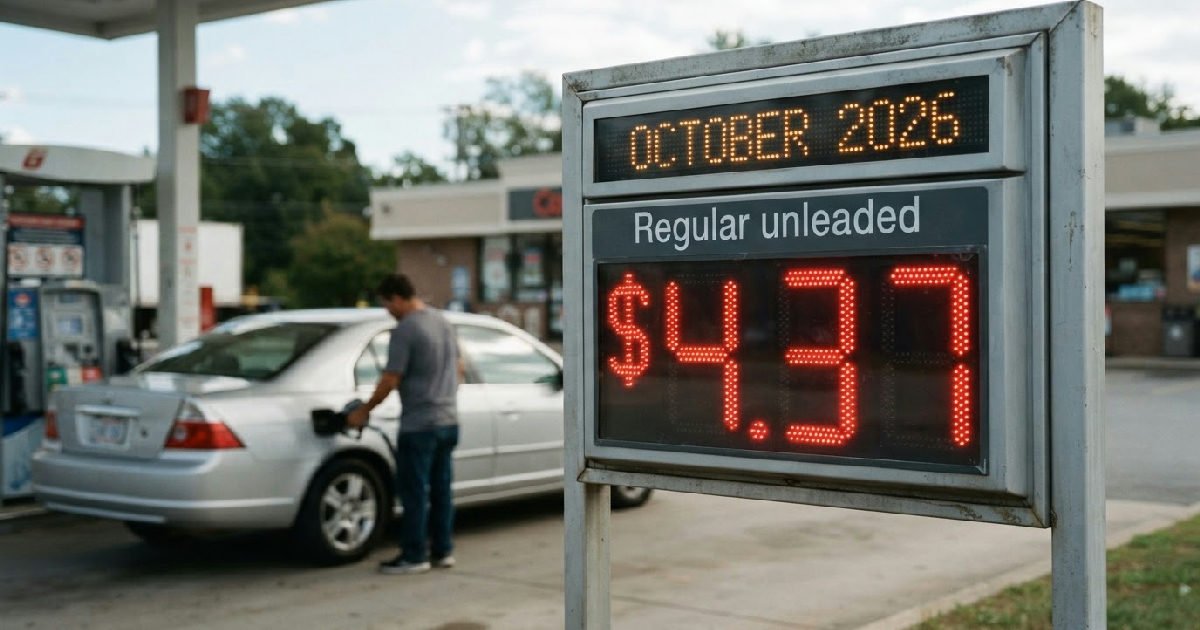
october 2026 gas prices hit record highs
October 2026 has ushered in unprecedented fuel costs for American consumers and businesses. The national average of October gas prices stands at $4.37 per gallon as of October 9, marking the first time prices have exceeded the $4 mark for this month.
This surge comes as crude oil prices climb back above $90 per barrel, presenting substantial challenges for small business owners grappling with escalating operational expenses.
While the national average saw a slight dip of five cents last week, settling at $4.36 per gallon by October 8, this figure remains significantly higher than the $3.11 per gallon seen in October 2025. This persistent rise directly impacts entrepreneurs, particularly those reliant on transportation for deliveries, services, and logistics.
How October Gas Prices Impact Businesses Nationwide
It forces them to reconsider their financial strategies and adapt quickly to a volatile market.
The record-high October gas prices are forcing small businesses across the United States to make difficult decisions. Many are finding their profit margins squeezed by the unexpected increase in fuel expenditures. This situation underscores a broader economic challenge where rising input costs can directly translate into higher prices for consumers or reduced business viability, marking an unprecedented peak for this time of year.
The Energy Information Administration (EIA) reported an uptick in gasoline demand last week, increasing from 8.68 million barrels per day to 8.76 million. Simultaneously, domestic production saw a decrease, falling from 9.46 million to 9.34 million barrels per day. This widening gap between supply and demand places additional pressure on an already strained market, contributing to the elevated prices experienced at the pump.
Regional Disparities in Pricing Intensify
The impact of these high prices varies significantly by state. Businesses in California and Hawaii face the steepest challenges, with average gas prices reaching $6.38 and $5.63 per gallon, respectively, as of October 6. Six states across the nation reported average prices above the $5 mark, highlighting concentrated areas of severe financial strain for local enterprises.
Conversely, states like Indiana and Ohio benefit from comparatively lower fuel costs, averaging $3.72 and $3.78 per gallon. These regional differences create an uneven playing field for businesses. Those in high-cost areas must quickly implement cost-saving measures to remain competitive against more adaptable rivals.
Geopolitical Tensions Fuel Crude Oil Rally
The primary driver behind the current escalation in fuel prices is the volatile global crude oil market, heavily influenced by geopolitical conflicts. Uncertainty surrounding oil movements through critical choke points, such as the Strait of Hormuz, has pushed crude prices higher. Damage to major refineries in the Middle East and persistently low fuel inventories further exacerbate the issue.
Recent events, including Houthi attacks in the Red Sea and the critical shutdown of Saudi Arabia’s East-West pipeline, which cut four million barrels per day from the global market, have been particularly impactful. These disruptions, coupled with Ukrainian drone strikes targeting Russian oil infrastructure, have significantly reduced refining capacity and tightened global supply.
Such widespread instability keeps crude oil prices elevated, even with minor weekly fluctuations.
Supply and Demand Imbalance Persists
The fundamental economics of supply and demand continue to exert pressure on global oil markets. While the U.S.
Strategic Petroleum Reserve (SPR) has released over 40 million barrels to help stabilize prices, and the G7 released an additional 100 million barrels through the International Energy Agency (IEA) on October 2, these measures offer only temporary relief. The SPR currently stands at approximately 40% capacity, holding around 283.0 million barrels.
Despite these releases, U.S. crude oil inventories decreased by 3.2 million barrels to 424.1 million barrels for the week ending October 2, 2026. This decline, contrary to market expectations for a rise, signals a tighter market than anticipated. It adds upward pressure on prices, especially as global demand continues its slow recovery.
Diesel Prices Escalate Further
While gasoline prices draw significant attention, diesel prices have seen an even more dramatic increase, climbing 71.7% year-over-year. As of October 6, 2026, the national average for diesel stood at $6.32 per gallon, a substantial jump from $3.68 per gallon a year prior. Diesel first crossed the $6 mark on September 11, 2026, hitting a record high of $6.53 per gallon on September 22.
This sharp rise in diesel costs poses an acute threat to the supply chain and freight industries. Most goods transported across the country rely on diesel-powered trucks. Higher diesel prices directly translate to increased shipping costs, which eventually filter down to consumers in the form of higher prices for everyday goods, fueling broader inflationary pressures across the economy.
Navigating the High-Price Environment: Strategies for Small Businesses
In this era of persistent high fuel costs, strategic planning is no longer optional for small business owners; it is essential for survival. Implementing energy-efficient practices can significantly mitigate the impact of rising operating costs. Businesses can achieve this through various measures, from optimizing delivery routes to investing in more fuel-efficient vehicles. Even subtle adjustments can yield substantial long-term savings.
Exploring electric vehicle (EV) options offers another potential escape route from fuel dependency for commercial fleets. While such integration often represents a significant upfront investment, the long-term benefits of reduced fuel and maintenance costs could outweigh the initial outlay for many businesses.
Moreover, remaining informed about market developments is crucial. Fluctuations in oil trading and crude inventories can signal upcoming price changes. For example, U.S. West Texas Intermediate (WTI) crude oil futures settled at $88.28 per barrel on October 7, indicating slight market shifts.
Businesses that proactively monitor these trends can adjust their purchasing and pricing models preemptively, allowing for greater agility in a dynamic market and preparing for evolving trends.
Outlook and Market Uncertainty Persist
The outlook for fuel prices remains uncertain, with several factors poised to influence market trajectory in the coming months. The EIA forecasts Brent crude oil spot prices to average $105 per barrel in the final quarter of 2026, a notable increase from previous predictions. However, they anticipate a decline to $84 per barrel in 2027, suggesting that the current highs may not be permanent.
Potential disruptions, such as the impact of Hurricane Isaias on oil infrastructure along the coast, could introduce further volatility. While U.S.
crude oil production forecasts have been revised upwards by the EIA for both 2026 and 2027, reaching 13.87 million barrels per day and 14.30 million barrels per day respectively, these increases may take time to materially affect retail prices. Businesses must remain vigilant and adaptable to navigate these evolving market conditions effectively.