

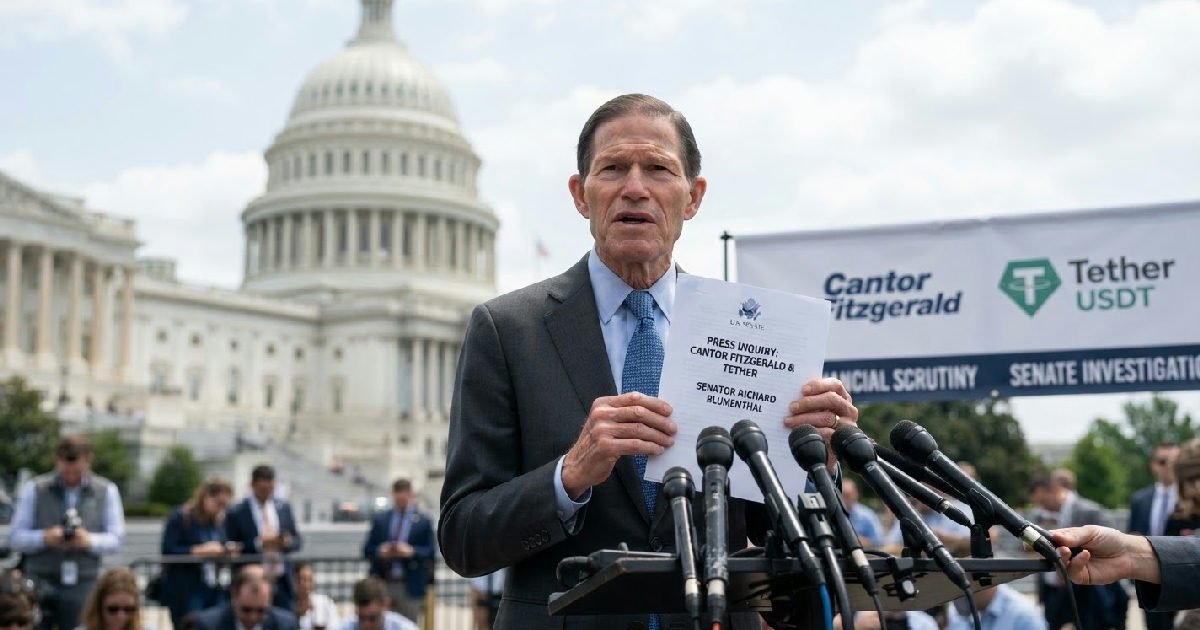
Senator Richard Blumenthal demands Cantor Fitzgerald records on $10B Tether
Senator Richard Blumenthal is investigating Cantor Fitzgerald’s $10 billion stake in Tether due to concerns about its ties with the stablecoin issuer. S. Senator Richard Blumenthal has launched a formal inquiry into Cantor Fitzgerald’s extensive financial ties with Tether, including a reported $10 billion stake in the stablecoin issuer.
The move comes amidst allegations that Tether’s USDT stablecoin is widely used by Iran to circumvent international sanctions, raising concerns about the nature of Cantor Fitzgerald Tether ties.
These claims also raise serious questions about America’s national security and the financial arrangements of Commerce Secretary Howard Lutnick.
Cantor Fitzgerald Tether ties: Senate probes $10B
On October 8, 2026, Senator Blumenthal, the ranking Democrat on the Senate Permanent Subcommittee on Investigations, dispatched a letter to Cantor Fitzgerald Chairman Brandon Lutnick. This communication demands comprehensive records related to the investment bank’s earnings, custody services, and monitoring of potential sanctions violations. Cantor Fitzgerald has until October 23, 2026, to provide the requested information.
The core of the senatorial inquiry focuses on Cantor Fitzgerald’s substantial relationship with Tether, which initially began in 2021. At that time, the investment bank started holding U.S. Treasury securities that back the USDT stablecoin, forming a key part of Tether’s reserve management strategy.
This partnership evolved significantly, with Cantor Fitzgerald acquiring rights to a reported 5% stake in Tether during 2024, a period when Howard Lutnick served as the firm’s chairman and CEO. The arrangement solidified a unique bond between a traditional Wall Street powerhouse and the world’s largest stablecoin issuer.
In his recent letter, Senator Richard Blumenthal estimated the value of Cantor Fitzgerald’s interest in Tether has soared from $600 million to approximately $10 billion since President Donald Trump re-entered office. This figure, derived from external reports, has not been independently confirmed through a public company valuation.
The senator also claims Cantor Fitzgerald reaps tens of millions annually from managing Tether’s assets, raising concerns about the financial benefits.
Tracing the Partnership’s Evolution
Senator Richard Blumenthal minced no words, stating that “Cantor Fitzgerald’s lucrative business arrangements with Tether come at the expense of America’s national security.” This declaration, while a serious allegation, represents the senator’s perspective and is not a finding by any court or enforcement body.
The letter specifically requests details on services provided to Tether, investment positions, custody arrangements, and any independent financial audits of the stablecoin issuer’s reserves.
Cantor Fitzgerald’s role in holding a significant portion of Tether’s U.S.-based assets, totaling over $100 billion, places it at the nexus of considerable financial influence. This pivotal role is now under intense scrutiny, particularly with allegations regarding USDT’s use in illicit finance. Regulators are keen to understand mechanisms ensuring compliance and preventing misuse.
Commerce Secretary Howard Lutnick’s Financial Dealings Questioned
Another significant aspect of Senator Richard Blumenthal’s inquiry centers on the financial arrangements involving Howard Lutnick, the current U.S. Secretary of Commerce and former chairman and CEO of Cantor Fitzgerald. The senator is particularly interested in the financial transactions and ownership transfers that occurred when Lutnick joined the Trump administration.
Howard Lutnick stepped down from his leadership roles at Cantor Fitzgerald in February 2025, following his confirmation as Commerce Secretary. His son, Brandon Lutnick, took over as chairman, while another son, Kyle Lutnick, assumed the role of Executive Vice Chairman. This transition has drawn congressional interest regarding potential conflicts of interest and asset management.
Senator Richard Blumenthal alleges that Commerce Secretary Howard Lutnick received over $250 million after President Trump’s return to office, including a $192 million distribution directly from Cantor Fitzgerald. While these figures pertain to Lutnick’s reported income, the inquiry seeks to clarify if any portion of these earnings is attributable to his Tether-related interests.
Earlier in January 2025, Senator Elizabeth Warren raised concerns about Lutnick’s business interests during his confirmation process, questioning potential conflicts.
The senator has asked Cantor Fitzgerald to explain the process through which Howard Lutnick transferred his ownership interests to his children. He also seeks to ascertain if Tether provided any loans or financing directly linked to that transaction. These questions aim to shed light on potential hidden financial relationships and ensure full transparency.
Allegations of Iran’s Sanctions Evasion Through USDT
The impetus for Senator Richard Blumenthal’s inquiry largely stems from a September 28 report compiled by Democratic investigators for the Senate Permanent Subcommittee on Investigations. This extensive report, titled “Tethered to Terrorism,” meticulously examined cryptocurrency transactions allegedly connected to Iran’s financial networks.
Investigators reviewed 846 digital asset wallets sanctioned or targeted due to suspected ties with Iran and its affiliated organizations. Their analysis revealed a staggering finding: 84% of these wallets had conducted transactions exclusively or almost exclusively using Tether’s USDT stablecoin.
This highlights USDT’s reported centrality in Iran’s illicit financial activities; the Senate report claims Iran moved more than $7.8 billion through USDT over the past year to evade U.S. sanctions.
Senator Richard Blumenthal has directly accused Tether of failing to freeze certain wallets, despite publicly available information linking them to illicit financing. He has since urged both the Treasury and Justice departments to investigate possible banking and sanctions violations. This increasing federal scrutiny on digital assets highlights broader regulatory concerns.
Tether, however, vehemently disputes these allegations and asserts its proactive cooperation with authorities. In a September 28 statement, the company announced it had helped freeze approximately $550 million in Iran-linked USDT during 2026.
This included over $344 million frozen across two addresses in April and more than $130 million across four wallets in July. All were identified by U.S. authorities as connected to Iran’s central bank and sanctions networks. Tether CEO Paolo Ardoino firmly stated that “USD₮ is not a haven for sanctioned actors, terrorist organizations or criminal networks.”
The Regulatory Landscape for Stablecoins
The intensifying scrutiny of Tether and its partners occurs within a rapidly evolving regulatory environment for digital assets. The U.S. Treasury’s Office of Foreign Assets Control (OFAC) has significantly ramped up its focus on cryptocurrencies throughout 2026, aiming to combat sanctions evasion and illicit finance.
This broader push underscores a concerted effort to bring digital assets under stricter oversight, affecting various sectors including banking and investment. Such government enforcement actions underscore this trend.
Furthermore, the “Guiding and Establishing National Innovation for U.S. Stablecoins Act” (GENIUS Act), enacted on July 18, 2025, has set a new federal framework for stablecoin regulation in the U.S. This legislation mandates that stablecoin issuers operate as financial institutions under the Bank Secrecy Act.
It also requires adherence to stringent anti-money laundering and sanctions compliance requirements, including regular disclosure of reserve composition. The operative restrictions of the GENIUS Act are set to take effect by January 18, 2027.
Looming Deadline and Broader Implications
Cantor Fitzgerald faces a critical deadline, with Senator Richard Blumenthal demanding responses and records by October 23, 2026. The scope of these requests is broad, covering communications and financial documents from January 1, 2023, to the present.
The senator also seeks historical information regarding the inception of Cantor Fitzgerald’s relationship with Tether, looking for a complete timeline.
Beyond financial disclosures, Cantor Fitzgerald must also detail its procedures for monitoring sanctions compliance, the steps taken to investigate allegations concerning Iran and Russia, and its due diligence processes for business partners in foreign jurisdictions. This comprehensive demand signals a deep dive into the firm’s operational integrity and its commitment to international regulations.
The inquiry, while significant, is currently framed as a congressional investigation and not a formal determination that either Cantor Fitzgerald or Tether has violated U.S. banking or sanctions laws. As of October 9, 2026, Cantor Fitzgerald has not issued a public response to Senator Richard Blumenthal’s letter.
No public committee hearing or separate enforcement deadline has been announced, leaving the next steps unclear.
This ongoing investigation carries substantial implications for the future of stablecoins and the broader cryptocurrency market. It highlights the delicate balance between fostering innovation in digital finance and ensuring robust national security.
The outcome could shape future regulatory approaches and redefine the responsibilities of financial institutions engaging with digital assets. The recent federal cryptocurrency actions underscore the dynamic regulatory environment.