

US Labor Department suspends Microsoft Adobe and six other firms
The U.S. Labor Department suspended Microsoft, Adobe, and six other tech firms from a green card program on October 8, 2026. The U.S. Labor Department announced the decision on Thursday, October 8, 2026, immediately halting the companies’ ability to sponsor foreign employees for permanent residency.
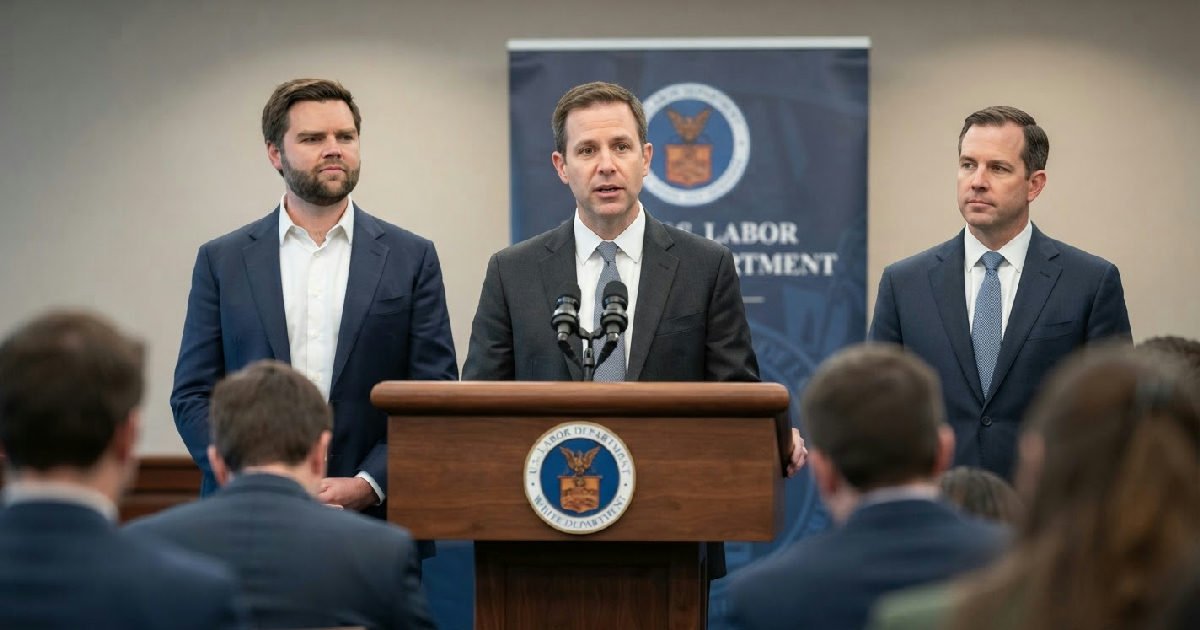
Labor Secretary Keith Sonderling, speaking at a White House press conference, confirmed the suspensions from the Permanent Labor Certification (PERM) program. He was joined by Vice President JD Vance and Attorney General Todd Blanche. The move targets what officials described as widespread fraud and abuse of visa programs that they claim disadvantages American workers.
Labor Department suspensions target tech and IT giants
The U.S. Department of Labor’s action effectively freezes the path to a green card for thousands of foreign workers employed by the affected companies. The suspension means the department will not accept or process any new applications for permanent labor certification from the firms, which is a mandatory first step for sponsoring most employment-based green cards.
Alongside tech behemoths Microsoft and Adobe, the suspension list includes major global IT and outsourcing firms Cognizant, Infosys, Tata Consultancy Services, Wipro, HCL, and Capgemini. While the move doesn’t revoke existing H-1B temporary work visas, it creates immense uncertainty for employees who saw the PERM process as their route to remaining in the U.S. permanently.
This move has been a point of contention within the tech industry, a sector that has faced various government warnings, including a recent one from the Consumer Technology Association on other policy matters.
According to Secretary Sonderling, the scale of foreign worker recruitment by these companies has been enormous. “Since 2009, just these companies alone have requested almost 3 million foreign workers,” Sonderling stated. “They’ve received over 230,000 H-1B visas approvals and over 100,000 permanent labor certifications.
That’s hundreds of thousands of jobs that were taken from American workers.” The action signals a significant shift in enforcement and a direct challenge to the hiring models of some of the world’s largest tech corporations.
Full list of suspended companies
The Department of Labor has suspended the following eight companies from the Permanent Labor Certification program:
- Microsoft
- Adobe
- Cognizant
- Infosys
- Tata
- Wipro
- HCL
- Capgemini
Administration alleges widespread fraud and abuse
Officials justified the unprecedented suspensions by citing “multiple active federal investigations” and alleging systemic abuse of the visa system. Vice President JD Vance singled out Microsoft, accusing it of being the company that has “most abused the system.” Vance pointed to Microsoft’s 6,000 layoffs in 2025, claiming the company simultaneously acquired 6,300 H-1B visas and nearly 3,000 green cards.
“So we’re going to continue to support Microsoft and have a great relationship with Microsoft, but we’re also going to deny them the ability to apply for these permanent residencies until they show that they are going to get serious about putting American workers first,” Vance declared. He calculated that for every American worker Microsoft laid off, they replaced them with 1.5 “foreign indentured servants.”
The alleged fraud involves a specific tactic where companies purportedly place job advertisements in obscure small-town newspapers. After receiving no responses, they then claim no qualified American workers were available, creating a justification to hire a foreign worker. This approach to talent acquisition stands in contrast to domestic strategies, such as how some firms like Citigroup shortens analyst programs to retain talent in competitive fields.
Microsoft defends hiring practices amid criticism
Microsoft quickly responded to the sharp accusations from the White House, defending its hiring record in a statement. The company asserted that “the vast majority of Microsoft employees in the United States are Americans” and sought to reframe the administration’s narrative about replacing domestic workers.
The Redmond-based software giant provided its own data to counter the government’s claims. “Of the approximately 6,000 H-1B visa applications we submitted in the last fiscal year, 80% percent were to extend or change the status of existing Microsoft employees,” the company stated.
This suggests that a large portion of its visa applications are for retaining current staff rather than hiring new foreign replacements for laid-off American workers. Adobe had not issued a public comment at the time of the announcement.
The crackdown comes at an awkward time, as it was announced at the same White House event where President Donald Trump was scheduled to award the National Medal of Science to several prominent immigrant tech leaders. This included Microsoft’s own CEO, Satya Nadella, who immigrated from India in 1988. This juxtaposition highlights the complex and often contradictory nature of the U.S. debate on high-skilled immigration.
Broader crackdown extends to universities and markets
The administration’s enforcement action is not limited to the eight named corporations. Officials also announced a wider probe into the J-1 visa program, which is used for work-and-study-based exchange programs. Subpoenas have been served to nine of America’s most prestigious universities, including Harvard, Yale, Stanford, MIT, Caltech, Brown, UC Davis, the University of Pittsburgh, and Arizona State University.
Attorney General Todd Blanche confirmed the Department of Justice is also pursuing investigations into companies that allegedly favor foreign workers over qualified Americans. The breadth of these actions, from corporate green card programs to academic visas, signals a coordinated, government-wide effort to reshape U.S. immigration and labor policies.
Such direct government interventions can have far-reaching consequences, similar to the market impact seen when the US government moves bitcoin in large quantities.
Wall Street’s reaction to the news was mixed. Shares of Microsoft and Adobe remained relatively stable, trading slightly higher. However, the IT outsourcing firms, which rely heavily on foreign workers, saw their stocks fall. Infosys shares dropped 2.2% and Wipro fell 3.5%, while Cognizant lost about 0.7%.
This divergence indicates that investors are, for now, betting the U.S.-based tech giants are better insulated from the policy’s impact than the global IT service firms.
A complex political landscape
The politics of the announcement were as complex as its policy implications. While castigating some companies for their use of visa programs, Vice President Vance drew a distinction for elite immigrant entrepreneurs. Other leaders being honored at the White House summit included Nvidia CEO Jensen Huang and AMD CEO Lisa Su, both born in Taiwan, and SpaceXAI CEO Elon Musk, a native of South Africa.
“It’s one thing if you want to bring in a person like Elon Musk,” Vance commented. “I think 99% of American citizens look at somebody like Elon Musk or Lisa Su…
and they say, obviously, if that person wants to come in and build something great in the United States of America, we support that.” The statement attempts to separate celebrated founders from the rank-and-file skilled workers who form the backbone of many tech operations.
What happens next remains uncertain, but the suspensions have undeniably thrown a wrench into the long-term plans of both the targeted companies and their thousands of foreign national employees.