

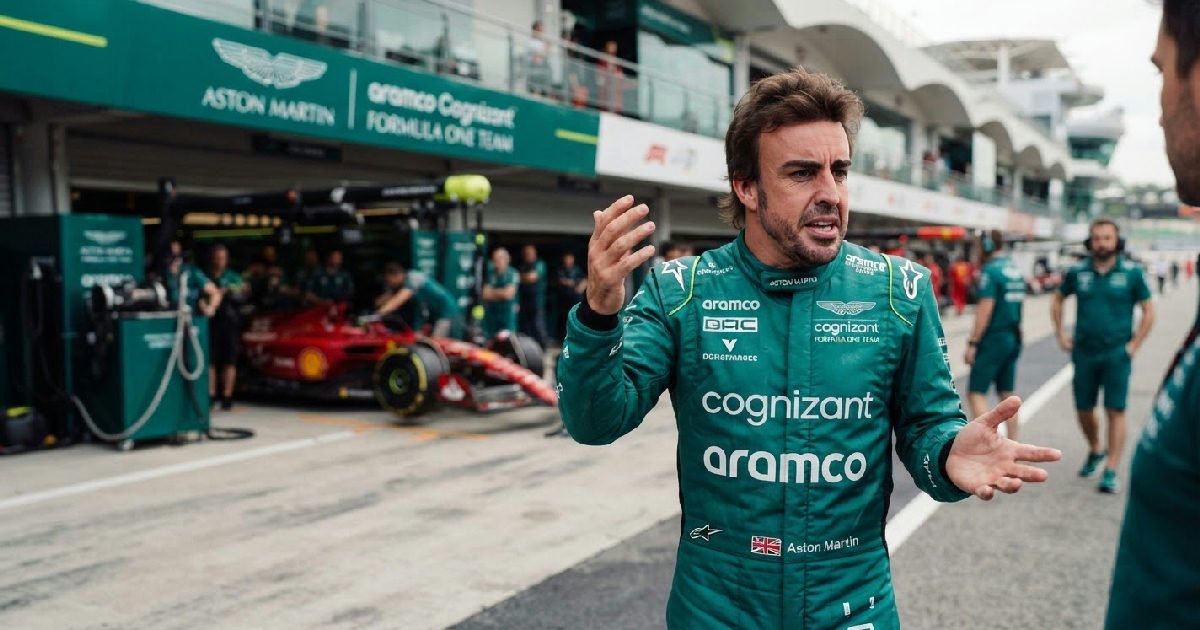
Fernando Alonso slams F1 grid reset as unfair
Fernando Alonso, the seasoned Aston Martin driver, didn’t mince words following the Bahrain Grand Prix in Malaysia on October 4, 2026, fiercely criticizing Formula 1 race control’s decision to reset the starting grid. Alonso labeled the move as “100% unfair,” and strongly implied it was made primarily to benefit Lewis Hamilton after the Ferrari driver encountered issues on the formation lap.
The controversial call came after a chaotic start to the 56-lap race at the Sepang International Circuit, which was already delayed by heavy rain. A widespread “software bug” impacted several cars, including Hamilton’s, prompting race officials to halt the procedure and reinstate the original qualifying order, reflecting the intense pressures inherent in competitive sport.
Fernando Alonso Reacts to Formation Lap Chaos
The pre-race drama unfolded during the formation lap when a critical software glitch, later attributed to the FIA’s managed system, caused multiple vehicles to suffer unexpected power losses. Lewis Hamilton, starting second on the grid, was among the most prominent victims, his Ferrari stalling on the back straight and plummeting him to 16th position.
Max Verstappen also experienced energy delivery issues early on, alongside Esteban Ocon and Valtteri Bottas. These widespread technical difficulties threw the intended starting order into disarray, prompting an immediate and extensive response from race control.
Grid Reset Stirs Controversy
After a 90-minute delay, the FIA identified and addressed the software problem. Race control then made the pivotal decision to reset the grid to the original qualifying positions.
This move allowed Lewis Hamilton to reclaim his second-place starting spot, effectively erasing the consequences of his formation lap mishap. But Fernando Alonso, who qualified 12th and would have started in that position had the grid not been reset, saw this as a clear violation of racing principles.
Alonso’s Vehement Objections
Alonso voiced his indignation to reporters after the race, asserting that such interventions were unprecedented unless directly related to significant safety concerns. His frustration stemmed from what he perceived as an inconsistent application of rules. “100 percent. I mean, this is motor racing, you know.
I mean, if it’s a safety concern, I get it,” he told media outlets, including Motorsport Week and RacingNews365. He clarified that genuine safety issues warrant a race stoppage, but mechanical failures should typically lead to retirement.
The two-time world champion pointed to his own challenging season. “I think I’ve had 50 percent DNFs this year. They never stopped the race for us,” he remarked, highlighting a perceived double standard. He also mused on the spectator experience, suggesting “too much technology” ultimately detracts from the sport’s raw appeal for fans.
FIA’s Explanation and Rule Interpretation
The Fédération Internationale de l’Automobile (FIA), the sport’s governing body, later confirmed a software bug supplied and managed by them was the root cause of the power unit failures. Nikolas Tombazis, the FIA’s single-seater director, explained that the issue arose from an “unprecedented combination” of low engine speed, wet conditions, and specific energy management settings on the Sepang circuit.
The FIA ultimately defended its decision to reset the grid, citing that regulations didn’t explicitly cover this precise scenario. They maintained the choice was based on “common sense and fairness” because the problem was a systemic failure, not the fault of individual teams or drivers.
Article B5.14.1 of the FIA’s sporting regulations outlines procedures for a suspended start, involving red flags and returning to the pitlane behind a safety car. However, it focuses on track conditions and doesn’t explicitly dictate a full grid reset after such widespread technical issues impacting multiple cars during a formation lap.
Broader Implications of F1’s Software Bug
The incident at the Bahrain Grand Prix in Malaysia casts a spotlight on the increasingly complex technology integrated into Formula 1. This is particularly relevant with the new 2026 power unit regulations now in effect.
These regulations introduced significant changes, including the removal of the MGU-H and a substantial increase in MGU-K output. They aim for a near 50/50 split between internal combustion and electrical power, a notable shift from previous seasons.
Technology Versus Sporting Integrity
The FIA’s admission of a software bug supplied and managed by the organization itself raises questions about the reliability of these advanced systems and the thoroughness of testing. Nikolas Tombazis noted that the specific conditions that triggered the bug – very low speeds in wet weather – had not been adequately replicated in testing.
Alonso’s comments about “too much technology” resonated with a broader concern among some fans and purists about the sport’s direction. While technological advancements are central to F1’s appeal, moments like these spark debate about where the line should be drawn to preserve fair competition and the fundamental challenge of motorsport.
The controversy highlights the delicate balance F1 must strike between pushing engineering boundaries and ensuring a clear, understandable competitive landscape.
Aston Martin’s Best Result and Future Outlook
Despite his vocal criticism, Fernando Alonso ultimately delivered a strong performance, finishing eighth in the Bahrain Grand Prix. This result marked Aston Martin’s best finish of the 2026 season so far, significantly boosting their points tally from three to seven and placing them 10th in the constructors’ standings.
Lewis Hamilton, despite the initial setback, recovered impressively to secure a third-place podium finish, while Max Verstappen claimed the race victory. Alonso’s recent contract extension with Aston Martin, taking him through to the end of 2027, underscores his continued commitment and competitive drive, even amidst these controversies.
The FIA has promised a full incident review in conjunction with teams and power unit manufacturers to prevent similar software-related issues from recurring. This commitment is crucial as Formula 1 continues to evolve its technical regulations, striving to balance innovation with unwavering competitive fairness.