

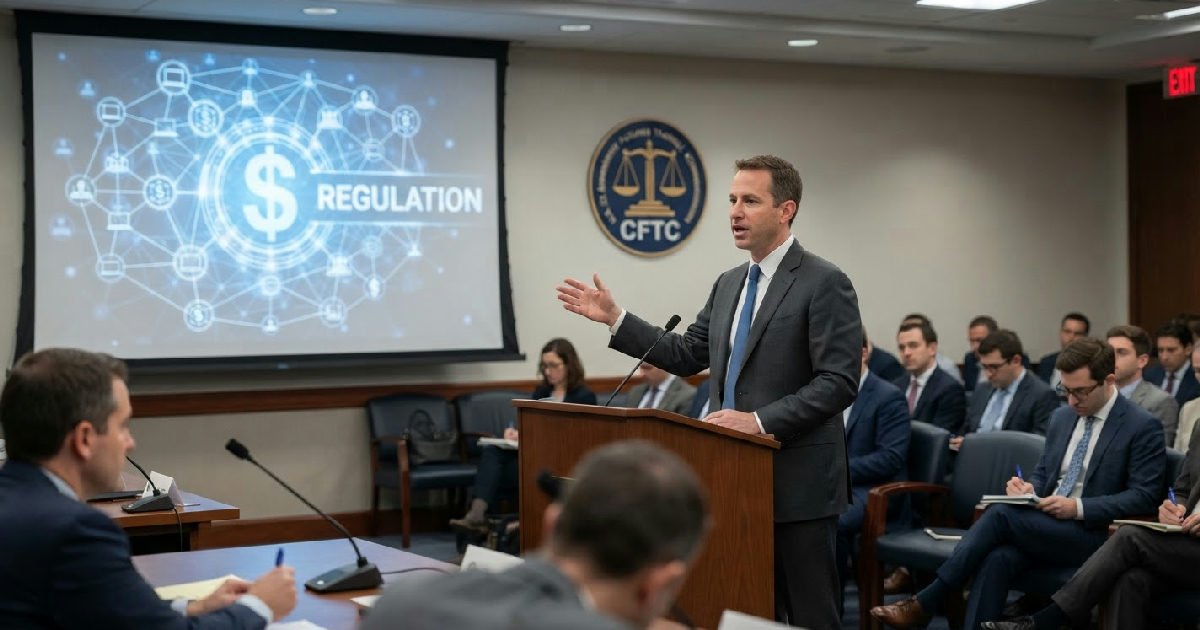
CFTC Proposes New Crypto Oversight Rules for US Exchanges
The CFTC proposes crypto oversight rules on Monday, October 5, 2026, to establish a federal regulatory framework for cryptocurrency exchanges. S. Commodity Futures Trading Commission (CFTC) proposed a new set of rules on Monday, October 5, 2026, aiming to establish a federal regulatory framework for cryptocurrency exchanges.
This pivotal move introduces comprehensive CFTC crypto oversight rules , offering U.S. digital asset exchanges a pathway to voluntarily opt into federal regulation.
The agency’s initiative arrives after the Digital Asset Market Clarity Act, known as the Clarity Act, stalled in Congress last month. CFTC Chairman Michael Selig underscored the urgency, stating that this action is “a critical step in the CFTC’s ongoing efforts to ensure America remains the crypto capital of the world.”
CFTC proposes federal framework for crypto trading
The newly proposed CFTC crypto oversight rules, officially referred to as “Regulation Crypto Asset Transactions” (CTX) and “Regulation Crypto Asset Markets” (CAM), are specifically designed to govern platforms offering leveraged, margined, or financed crypto trades to retail customers. This represents a significant effort to bring clarity and structure to complex market activities.
Under these proposals, a new registration category, termed “crypto asset market,” would be established for exchanges facilitating such advanced trading mechanisms. However, platforms dealing solely in basic spot crypto transactions would not be mandated to register with the CFTC, allowing them to remain under state-level oversight.
This framework is crucial given the CFTC’s existing jurisdiction under the Commodity Exchange Act (CEA), which classifies certain digital assets, notably Bitcoin, as commodities. The move aims to provide a clear regulatory environment for exchanges handling these commodity-based digital assets.
Navigating Legislative Impasse and SEC’s Parallel Efforts
The CFTC’s proactive stance is a direct response to the recent legislative gridlock that saw the Clarity Act falter in the Senate. This bill had sought to formally divide regulatory responsibilities between the SEC and CFTC by clearly distinguishing digital assets as either securities, commodities, or stablecoins.
The Clarity Act ultimately failed a cloture vote on September 15, 2026, receiving 49 votes in favor and 50 against, well short of the 60 required to advance. Its stalling was driven by several factors.
The banking lobby, for instance, raised significant concerns about crypto companies paying customers stablecoin rewards, fearing these could divert deposits from traditional banks. The American Bankers Association (ABA) even published a consumer survey in June 2026 to bolster its opposition to stablecoin rewards.
Such dynamics often illustrate the broader challenges digital assets face when interacting with established financial systems, recalling recent Bitcoin volatility and market shifts.
Additionally, lawmakers, primarily Democrats, raised ethical questions about provisions within the bill. They were particularly concerned about President Donald Trump’s reported crypto business earnings of over $1.2 billion in 2025 and how the legislation might grandfather in his existing interests.
SEC’s Independent Regulatory Push
While the Clarity Act stalled, the Securities and Exchange Commission (SEC) has also pressed ahead with its own regulatory initiatives. In August 2026, the SEC proposed “Regulation Crypto Assets,” a framework for certain investment contracts involving digital assets. It also approved tokenized stocks trading in September 2026.
This approval came via an “Innovation Exemption” issued on September 17, 2026. This temporary, conditional exemptive relief is designed to facilitate on-chain trading of tokenized National Market System (NMS) stocks through automated market makers and liquidity pools, further shaping the digital finance landscape.
Chairman Selig’s Pro-Crypto Stance Guides CFTC’s Approach
The direction of these new CFTC crypto oversight rules reflects the vision of Chairman Michael Selig. Confirmed as the 16th Chairman of the CFTC on December 18, 2025, Selig brings a notable pro-crypto background to his role, having previously served as chief counsel for the Crypto Task Force at the SEC.
Selig is a vocal proponent of a “minimum effective dose of regulation,” advocating for principles-based oversight that nurtures innovation while ensuring market integrity. He has publicly acknowledged Satoshi Nakamoto’s white paper as the foundational “big-bang” for decentralized networks, underscoring his deep understanding of the crypto space.
The Commission’s actions align with President Donald Trump’s broader directives regarding digital assets. Since taking office, President Trump has actively supported the digital asset industry, signing several pro-crypto legislation pieces and executive orders, including one in May 2026 titled “Integrating Financial Technology Innovation into Regulatory Frameworks.”
Safeguarding Investors: New Requirements and Protections
Central to these proposed CFTC crypto oversight rules are robust safeguards aimed at protecting consumers and maintaining market integrity. Key provisions include mandatory proof-of-reserves requirements for platforms, ensuring that exchanges hold sufficient assets to cover customer funds.
Additionally, the rules stipulate mandatory intermediation by futures commission merchants, adding another layer of oversight and financial stability. These measures are designed to instill greater confidence and transparency in the digital asset trading environment.
The crypto industry has consistently called for clearer regulatory guidelines, preferring defined rules over a fragmented, uncertain landscape. This move by the CFTC represents a significant step towards providing that much-needed certainty, especially as the SEC also pushes forward with its own frameworks.
The CFTC affirmed it would administer the Commodity Exchange Act (CEA) consistent with the SEC’s March 2026 interpretation on how federal securities laws apply to certain crypto assets.
These efforts highlight a growing trend among regulatory bodies to formally integrate innovative blockchain company Ripple into existing financial oversight structures, much like blockchain companies have expanded their presence in other sectors.
The Road Ahead: Public Comment and Future Regulation
The CFTC’s preliminary rulemaking notice is now open for public comment for a 60-day period, commencing after its publication in the Federal Register. This crucial phase allows industry stakeholders, legal experts, and the public to provide feedback and insights on the proposed CFTC crypto oversight rules.
Following this initial comment period, the agency will meticulously review all submissions. The CFTC will then decide whether to issue a formal proposed rule, which, if pursued, would undergo yet another public comment period before any final regulation is ultimately adopted, ensuring a thorough and inclusive process.
This agency-led approach signals a determined effort to build a robust regulatory environment for digital assets in the U.S., even in the absence of comprehensive legislative action. CFTC Chairman Michael Selig had previously stated the regulator was preparing for markets moving “24-7, on-chain.” This reflects a broader understanding within regulatory bodies that digital asset markets require specialized oversight, distinct from traditional financial structures.