

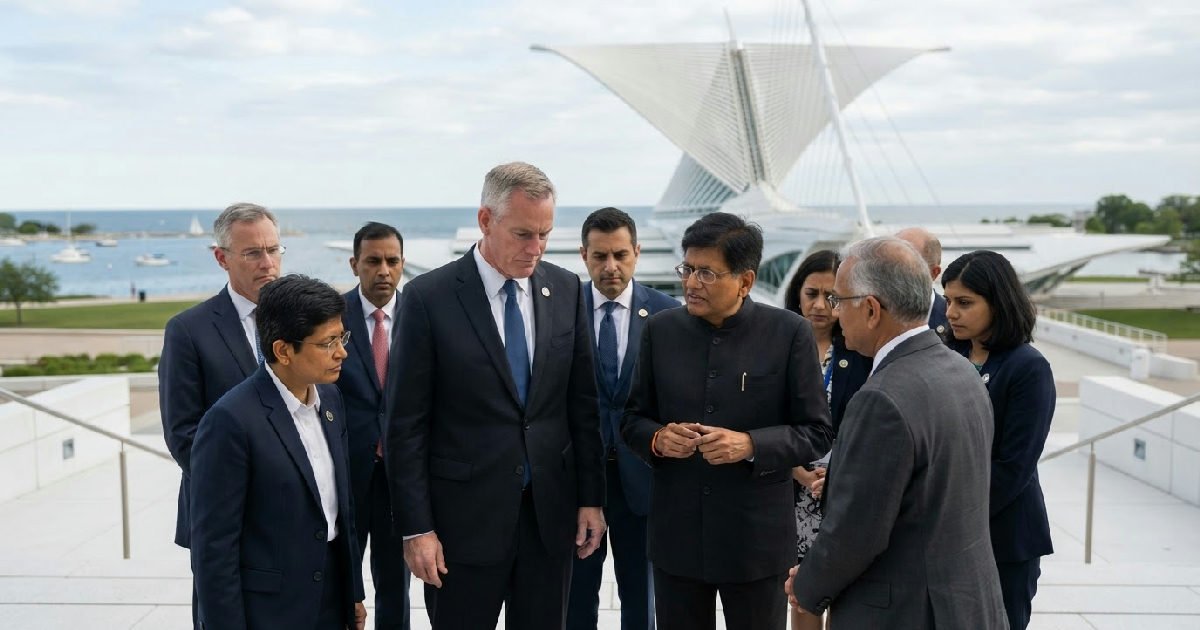
G20 trade ministers fail on forced labor
G20 Trade Ministers concluded their meeting in Milwaukee, Wisconsin, with significant disagreements emerging on critical trade issues. U.S.
Trade Representative Jamieson Greer confirmed on Friday, October 2, 2026, that ministers failed to reach a consensus on statements addressing forced labor in supply chains, structural excess industrial capacity, and a proposed reform of the Most Favored Nation (MFN) principle.
Forced Labor Divides G20 Trade Ministers
This lack of unity highlights deep divisions among the world’s leading economies on how to navigate pressing global trade challenges.
While consensus proved elusive on these contentious points, the G20 members did find common ground on one vital issue. They unanimously agreed to denounce the weaponization of food through coercive trade actions, a rare moment of alignment in a summit otherwise marked by discord.
The two-day ministerial, held from September 30 to October 1, saw intense discussions but ultimately underscored the growing complexity of international trade relations.
Efforts to forge a joint statement condemning forced labor in global supply chains faltered, despite strong advocacy from the United States. U.S. Trade Representative Jamieson Greer expressed disappointment that only Argentina and Mexico joined the U.S. in endorsing a separate statement calling for the elimination of forced labor.
He hoped that discussions on this topic would continue, and other economies would eventually join in taking increased action to combat forced labor in global supply chains.
This division comes against a backdrop of escalating concern over ethical supply chains. The U.S. has previously taken concrete actions, such as levying a 10% tariff on India for its perceived inaction on goods made with forced labor. India, for its part, maintains an “absolute and unconditional” commitment to eliminating forced labor, according to its Commerce and Industry Minister, Piyush Goyal.
Goyal emphasized that any border measures should be based on “specific and verifiable evidence” rather than broad assumptions, demanding respect for due process and World Trade Organization (WTO) rules. This reflects a broader tension between nations seeking to impose universal labor standards and those prioritizing national sovereignty in trade enforcement.
Industrial Overcapacity Strains Trade Ties
Another major point of contention revolved around addressing structural excess industrial capacity, particularly from China. Many countries voiced worries that China’s overproduction floods global markets with inexpensive goods, distorting fair competition.
USTR Jamieson Greer acknowledged that “nearly all countries agree that this is an issue that requires action,” but he expressed disappointment that “a handful of members rejected creating a pathway toward cooperative action,” signaling the deep divisions on a collective response.
China consistently rejects claims of excess capacity, instead asserting that its industrial growth is driven by innovation and global demand. Beijing often frames such accusations as protectionist tactics by Western nations. This fundamental disagreement makes finding a collaborative solution exceedingly difficult, pushing countries like the U.S. to consider unilateral measures.
The U.S. has already implemented unilateral tariff actions to safeguard its domestic industries, citing the inadequacy of existing trade remedies for overcapacity. Greer expressed skepticism about resolving these issues within the WTO, stating, “The WTO has no transparency whatsoever. The idea that this can be resolved on a multilateral basis is misguided.”
MFN Principle Faces Reform Proposal
A new and potentially disruptive topic on the G20 agenda was the U.S. proposal for a comprehensive reform of the Most Favored Nation (MFN) principle. This core tenet of the WTO prohibits discrimination among trading partners, ensuring equal benefits for all members. Typically, MFN discussions are confined to the WTO, making its inclusion in the G20 a notable shift.
USTR Greer argued that the current MFN system “fails to promote reciprocity and balance in the trading system” and “can actually create free riders.” He suggested that some nations benefit from favorable terms without offering equivalent concessions. This critique signals a potential re-evaluation of fundamental global trade mechanisms.
However, India’s Piyush Goyal countered this perspective, asserting that MFN treatment is crucial because it ensures “the same terms apply to the smallest trader and the largest trader.” He underscored its role in preventing discriminatory practices.
While no agreement was reached to alter the principle, the discussions recorded a range of differing views, indicating a long road ahead for any potential reform. The debate over global trade dynamics continues to evolve, with key principles under examination.
Food Weaponization Draws Rare Consensus
Amidst the disagreements, the G20 ministers achieved a rare moment of unity by reaching consensus on a statement condemning the weaponization of food through coercive trade actions. This agreement stands out as the sole point of broad approval from the USTR’s four priority issues for the meeting, a testament to the humanitarian and geopolitical sensitivity surrounding food security.
U.S. Trade Representative Jamieson Greer highlighted this achievement as a significant success for the ministerial. “It is especially significant that the entire G20 was able to reach consensus on the statement on the weaponization of food through coercive trade actions,” Greer noted. This reflects an understanding among member states that certain essential resources should remain outside the realm of coercive statecraft.
The collective condemnation signifies an important, albeit narrow, area where G20 nations can still align on principles of international conduct. It also implicitly acknowledges the growing fragility of global supply chains and the potential for food to be exploited as a political tool, urging caution in a volatile international landscape.
Implications for Future Trade Policy
The G20 meeting in Milwaukee starkly illuminated the growing fragmentation within the international trade community. The inability to reach broad consensus on critical issues like forced labor and industrial overcapacity suggests a retreat from multilateral cooperation on these fronts. It implies that individual nations, or groups of “like-minded” partners, may increasingly pursue their own agendas and remedies.
USTR Jamieson Greer hinted at this shift, indicating that discussions on these contentious topics would continue, potentially with smaller coalitions of countries. This approach could lead to a more fractured global trade system, where regulations and standards differ significantly across regions, creating new complexities for businesses and supply chains. The economic ripples of such fragmentation could be felt widely.
The U.S. proposal to reform the MFN principle further underscores a potential desire to reshape fundamental trade rules. If this gains traction, it could lead to significant changes in how tariffs and trade benefits are applied, potentially allowing for more targeted and reciprocal trade agreements. This would be a profound departure from the established WTO framework that has governed global commerce for decades.
Trade experts suggest that without a unified approach, the world could see a proliferation of unilateral actions, similar to the UFLPA in the United States, which targets goods made with forced labor from specific regions. These actions, while addressing national concerns, risk provoking retaliatory measures and escalating trade tensions globally. The current environment makes navigating economic uncertainty even more challenging for international businesses.
Ultimately, the Milwaukee meeting serves as a stark reminder that while the G20 remains a crucial forum for dialogue, achieving substantive consensus on deeply divisive trade issues is becoming increasingly difficult. The focus for many nations, particularly the United States, seems to be shifting towards pragmatic, albeit less universally agreed-upon, solutions to protect national interests and enforce specific trade values.