

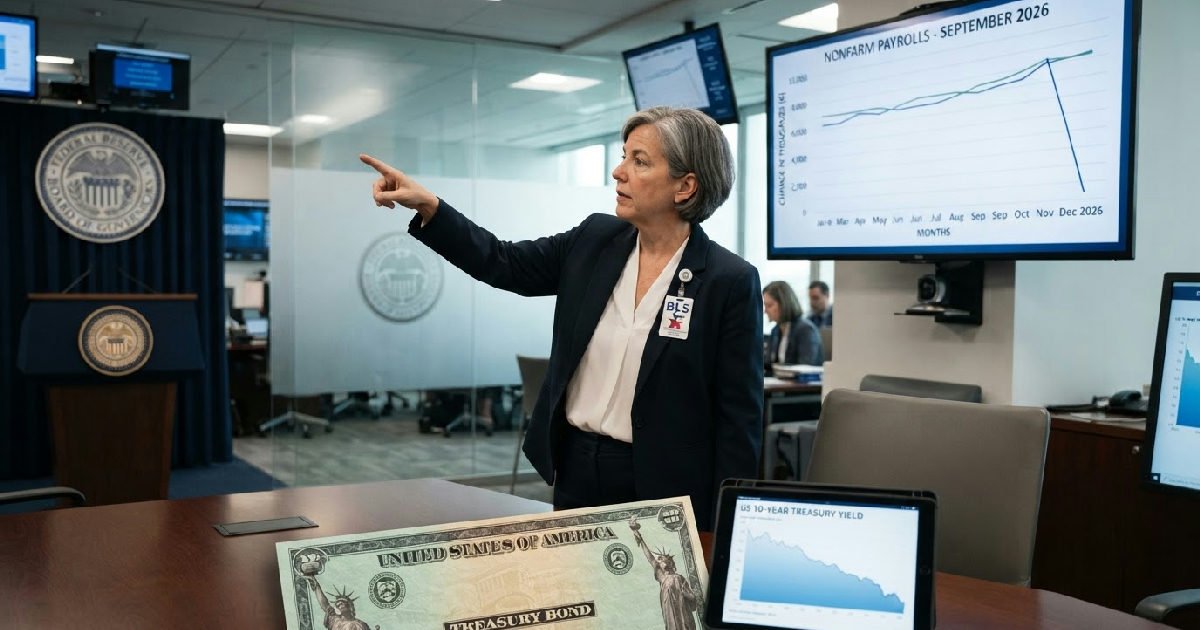
US jobs report shows hiring slowdown sends bond yields lower
US Treasury bonds saw a significant rally on Friday, October 2, 2026, as a weaker-than-expected jobs report for September indicated a sharp slowdown in hiring across the United States. The data, released by the US Bureau of Labor Statistics (BLS), quickly cooled expectations for an imminent interest rate hike by the Federal Reserve, prompting investors to pour into safer assets.
The sluggish performance of the labor market reverberated through financial markets, causing bond yields to fall from recent highs and sending US stock indices upward. This marked a notable shift in sentiment, with traders anticipating a less aggressive stance from the central bank.
Understanding the US Jobs Report for September
The US economy added just 29,000 nonfarm payrolls in September 2026, a figure that dramatically missed economists’ projections. Analysts had generally expected around 90,000 new jobs for the month, making the actual reported gain the lowest monthly increase since April 2021.
Further complicating the picture, the unemployment rate edged up to 4.2% in September, increasing from 4.1% in August. This rise defied predictions that the rate would hold steady, signaling a broader weakening trend in the nation’s employment landscape.
Revisions Paint Bleaker Picture
The BLS report also included significant downward revisions for previous months’ data, casting a bleaker shadow over the recent health of the labor market. August 2026 nonfarm payrolls were adjusted down to 133,000, a decrease of 29,000 from the initial estimate of 162,000.
July 2026 saw an even sharper revision, with job gains cut by 31,000, transforming an initial gain of 21,000 into a loss of 10,000 jobs. Combined, these revisions for July and August accounted for a total reduction of 60,000 jobs, indicating that economic momentum was waning faster than previously believed.
Bond Market Reacts Positively to Slowdown
The news of a cooling labor market provided immediate comfort to the bond markets. Prices for US Treasuries rose sharply, which in turn pushed down their yields—the return investors receive. This dynamic is a direct reflection of investor belief that the Federal Reserve will now be less inclined to raise interest rates.
A weakening jobs market reduces inflationary pressures, providing the Fed with more flexibility to pause its tightening cycle. This shift makes fixed-income assets, like bonds, more attractive, as their relative returns improve compared to other investments.
Yields Recede from Multi-Year Highs
The yield on the benchmark 10-year US Treasury note eased to approximately 5.174% on October 2, 2026, marking a drop of nearly 6 to 7 basis points from the previous day. This pullback was significant, moving the yield away from the 5.342% recorded on Thursday, October 1, 2026, which had been its highest level in over two decades.
Longer-term bonds also saw recovery, with the 30-year Treasury yield easing by 4.5 basis points to 5.568%. The 2-year Treasury yield, which is particularly sensitive to Fed policy expectations, slipped 6 basis points to 4.73%, further underlining the market’s interpretation of the jobs data.
This economic climate, characterized by shifts in monetary policy expectations, can significantly influence various investment avenues. For instance, such shifts can impact Spot Bitcoin ETF inflows and other digital asset trends.
Federal Reserve’s Policy Path Under Scrutiny
The soft September jobs report has placed the Federal Reserve’s monetary policy decisions under intense scrutiny. Markets are now significantly less certain about the likelihood of another interest rate hike at the upcoming October meeting, anticipating a more cautious approach from policymakers.
The CME Group’s FedWatch tool, which tracks investor expectations for Fed rate changes, showed an 84% likelihood of the Fed leaving rates unchanged in October. This marked a substantial increase from 64% just a week prior, reflecting a dramatic shift in market sentiment following the labor market data.
Analysts Weigh in on Fed’s Next Move
Economists and strategists quickly offered their assessments of the data’s implications. Seema Shah, Chief Global Strategist at Principal Asset Management, stated that “A softer-than-expected jobs report should put an October Fed hike firmly on the back foot.” Shah highlighted that weaker payrolls, softer wage growth, and a higher unemployment rate collectively point to a cooling labor market, lessening the urgency for the Fed to act.
Jeff Schulze, at Franklin Templeton Institute, echoed this sentiment, commenting that the “soft payroll report demonstrates that the labor market is simmering, not boiling.” This, he suggested, should bolster the argument for the Fed to remain on hold.
However, Nancy Vanden Houten, Lead US Economist at Oxford Economics, maintained that upside risks to inflation might still lead the Fed to raise rates by month-end, despite the softer report.
Bradley Saunders, North America economist at Capital Economics, noted that while the September gain was weaker than expected, it wasn’t “disastrous.” He attributed some of the drag to a 17,000 cut in government payrolls and a softer rise in healthcare and social assistance payrolls, potentially linked to recent policy changes regarding Temporary Protected Status (TPS) for migrants.
Navigating this economic landscape requires careful consideration of numerous indicators, from employment figures to broader consumer trends. Understanding these dynamics is crucial for analysts and investors, who also monitor evolving areas like stablecoin card spending.
Stock Markets Surge on Rate Hike Relief
The diminished likelihood of an immediate interest rate hike by the Federal Reserve ignited a rally in US stock markets. Major indices posted solid gains as investors expressed relief over the potential easing of monetary tightening. The S&P 500 index rallied by 0.9%, indicating broad market enthusiasm.
The tech-focused Nasdaq Composite climbed by 1.2% in early trading. The Dow Jones Industrial Average also rose 220 points, or 0.4%. This widespread positive reaction underscores how sensitive equity markets remain to signals about the future direction of interest rates and the broader economic outlook.
Sectoral Shifts in Employment
Delving into the specifics of where jobs were created or lost provides a granular view of the labor market’s shifts. Healthcare continued to be a notable job creator, adding 17,000 positions in September, albeit below its 12-month average. Construction also saw an increase of 11,000 jobs, consistent with its recent monthly trends.
Conversely, certain sectors experienced significant declines. Financial activities shed 7,000 jobs, while the information sector lost 10,000 positions. Professional and business services trimmed 9,000 jobs, and a reduction of 17,000 government payrolls also contributed to the overall weaker-than-expected nonfarm figures. These sectoral movements indicate uneven economic performance beneath the aggregate numbers.
Broader Economic Implications
Beyond the headline jobs figures, the report also highlighted a moderation in wage growth, with average hourly earnings rising by just 0.1% month-over-month. Annually, wage growth came in at 3.0%, down from 3.1% in August and marking the smallest year-over-year gain since May 2021. This slower wage inflation could further alleviate pressure on the Federal Reserve.
Nic Puckrin, a former Goldman Sachs analyst, noted that this “ice-cold report” forces the Fed into a difficult choice: hike again and risk increasing unemployment, or hold and potentially let inflation get out of control. Meanwhile, the labor force participation rate ticked up to 61.8% from 61.6%, suggesting more people are entering or re-entering the job market despite the overall slowdown in hiring.
The mixed signals from the September US jobs report underscore the complex economic environment currently facing policymakers. While the immediate market reaction was positive, particularly in bonds and equities, the underlying data points to a labor market losing steam.
This scenario will likely necessitate continued careful deliberation from the Federal Reserve as it balances its dual mandate of price stability and full employment. Policymakers must weigh these economic shifts carefully, especially as they consider future regulatory frameworks.
This includes ongoing discussions around how to manage and supervise emerging financial technologies, such as those related to DeFi regulations.