

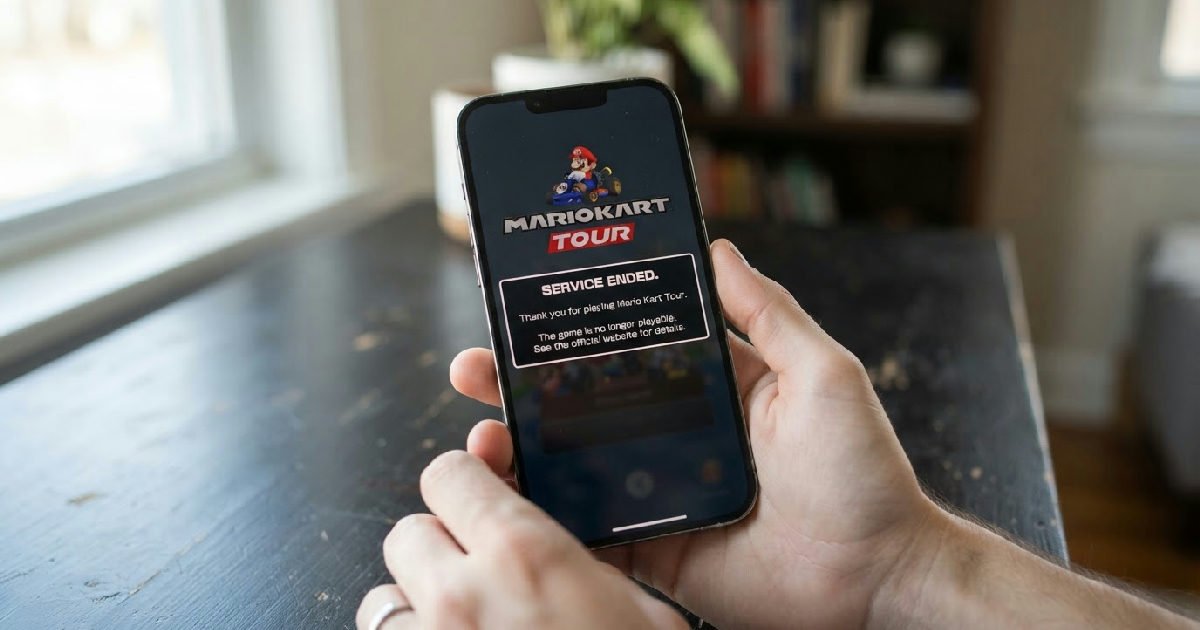
Nintendo ends Mario Kart Tour service today after nearly seven years
Nintendo’s mobile racing title, Mario Kart Tour, will permanently cease operations today, September 29, 2026, marking the end of its nearly seven-year run. The free-to-play game, which launched in 2019, will become completely unplayable for all users after 11 p.m. Pacific Time.
This shutdown means that even players who have the application installed on their devices will no longer be able to access the game’s features. Crucially, Nintendo has confirmed there will be no offline version available to preserve gameplay.
The Mario Kart Tour shutdown explained
The official service termination is set for 11 p.m. PT tonight, extending into the early hours of September 30, 2026, for many players globally. For instance, East Coast players can race until 2 a.m. EST, while those in the UK have until 7 a.m. tomorrow to say their goodbyes.
Nintendo initially announced the game’s impending closure on July 8, 2026, providing its player base with several months’ notice. Since that revelation, various in-game monetisation features have been gradually wound down.
The sale of rubies, Mario Kart Tour’s premium in-game currency, ceased on July 7, 2026. Players were strongly advised to spend any remaining rubies before the final shutdown to avoid losing their purchased value.
Automatic renewals for the Gold Pass subscription also stopped on July 7, 2026. In a gesture to its community during its final months, Nintendo made the Gold Pass effectively free, granting all users access to its benefits.
The game first arrived on Apple’s App Store and Google Play on September 25, 2019, after being announced in January 2018. Its initial reception was mixed among critics and fans alike.
While some praised the familiar gameplay and intuitive controls adapted for mobile, others criticised its monetisation model and gacha elements. Nintendo later addressed some concerns by replacing gacha mechanics with a standard item shop in 2022.
Evolving Mobile Strategy and Player Impact
The decision to shut down Mario Kart Tour aligns with Nintendo’s evolving strategy within the mobile gaming market. Industry observers often link such moves to a broader corporate focus, including anticipation for the direction of game development.
The game’s closure represents a significant impact on its dedicated player base. All progress, including unlocked drivers, karts, gliders, and accumulated rank data, will become permanently inaccessible.
Nintendo has also clarified that no refunds will be offered for unspent Rubies or past Gold Pass subscriptions. This policy often leads to frustration among players who have invested time and money into their accounts.
Mario Kart Tour, developed by Nintendo EPD and powered by the Unity Engine, never fully appealed to the hardcore Mario Kart fan base. It seemed designed more to introduce the franchise to mobile-first audiences.
The lack of an offline version also contrasts with some of Nintendo’s other mobile ventures, like Animal Crossing: Pocket Camp, which received an offline mode. This absence highlights ongoing challenges in game preservation.
Preservation Concerns for Delisted Mobile Games
The delisting of Mario Kart Tour brings into sharp focus the wider issue of game preservation, particularly within the mobile sector. Digital-only titles without offline components are especially vulnerable to being lost forever once service ends.
Many free-to-play mobile games are often played by casual audiences who may not even notice when a title disappears. They might download a game, play it briefly, then forget it exists.
However, this trend poses a significant challenge for gaming history and culture. Important titles, even those with mixed receptions, become unplayable and unarchivable when server support is withdrawn.
Unlike console or PC games, which can often be preserved through physical media or emulators, mobile titles frequently depend entirely on proprietary servers. This reliance makes them particularly susceptible to total loss.
The archiving of mobile game code, assets, and functionality becomes complex and often falls outside the scope of developers or publishers once a game’s commercial lifecycle concludes. Live service games, by their very nature of constant evolution, present unique challenges in capturing and preserving their historical state. This is a common challenge for evolving live service titles.
The “Lost” History of Mobile Gaming
Critics argue that more concerted efforts are needed from developers, platform holders, and preservation societies to address this problem. Without intervention, vast swathes of mobile gaming history could vanish without a trace.
Mario Kart Tour, despite its monetisation criticisms, was a mainline entry in the incredibly successful Mario Kart series. Its disappearance leaves a gap that will likely never be filled for historical purposes.
The sheer number of mobile games released annually exacerbates the issue. It makes the task of systematic preservation incredibly daunting for those who advocate for safeguarding digital heritage.
Looking Ahead: Nintendo’s Future in Racing and Mobile
Nintendo has not publicly provided a detailed reason for the shutdown beyond a standard end-of-service notice. However, industry insiders suggest a strategic pivot away from mobile, focusing resources on core hardware.
The company’s emphasis increasingly appears to be on its dedicated console ecosystem, particularly with the anticipated launch of the Switch 2. This shift signifies a re-evaluation of its mobile market approach.
Many elements and content from Mario Kart Tour have already been repurposed. A substantial amount of its course designs, characters, karts, and gliders were brought back as downloadable content for Mario Kart 8 Deluxe.
This integration ensures that some of the mobile game’s legacy lives on within Nintendo’s flagship console racing title. It also suggests a strategy of consolidating popular content onto its primary platforms.
The next anticipated entry in the venerable racing series is titled Mario Kart World. This future release signals Nintendo’s ongoing commitment to the franchise, albeit likely in a different format than its recently departed mobile sibling.
Legacy and Remaining Content
In its final moments, Nintendo released a “final MKT report” on the game’s official X account, sharing intriguing statistics. The report revealed a total of 202 drivers in the game’s roster.
Bowser emerged as the most popular character, leading a top-five that also included Princess Peach, Toad, Toadette, and Mario himself. These statistics offer a final glimpse into player preferences.
A “final Anniversary Tour” was launched prior to the shutdown, allowing players one last hurrah before the servers went dark.
Ultimately, Mario Kart Tour represents an interesting chapter in Nintendo’s mobile gaming experiment. It demonstrates the challenges of sustaining free-to-play titles in a competitive and rapidly evolving market.