

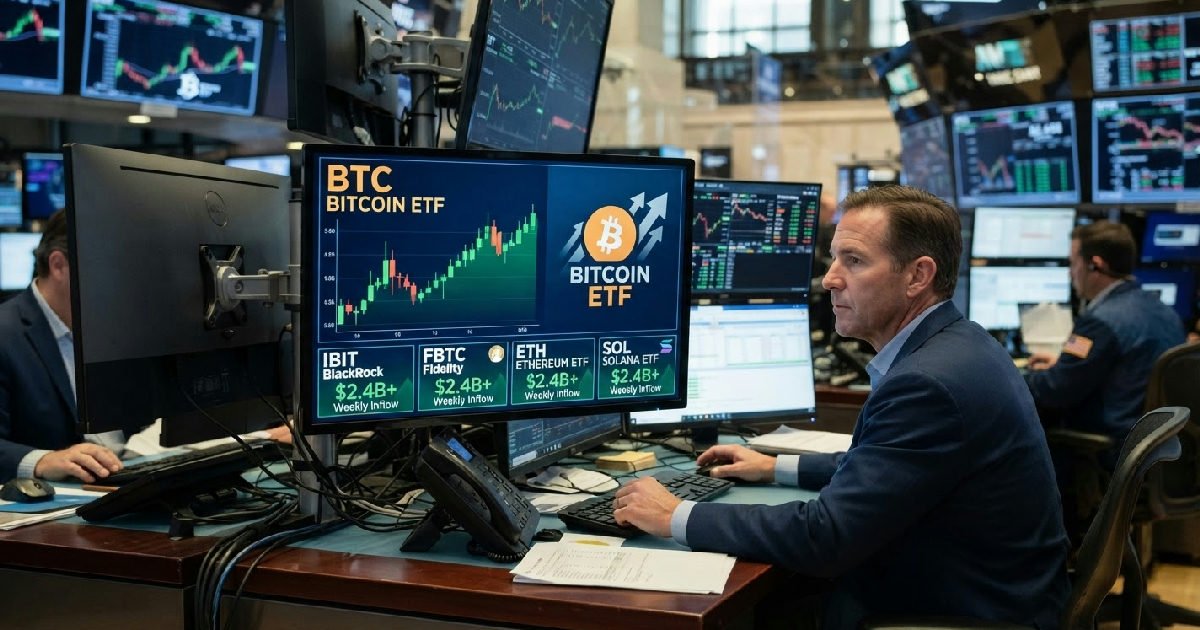
Bitcoin ETFs see $2.4B inflow largest since October 2025
U.S. spot Bitcoin ETFs attracted $2.4 billion in net inflows for the week ending September 25, marking their strongest weekly performance since October 2025. S. spot Bitcoin exchange-traded funds (ETFs) have staged a dramatic comeback, attracting a staggering $2.4 billion in net inflows for the week ending September 25.
This powerful wave of investment not only marks the strongest weekly performance since October 2025 but also completely erases the year’s earlier losses, pushing the Bitcoin ETFs into positive territory for 2026.
The reversal is stark. As recently as July, these same financial products were sitting on nearly $5.8 billion in net outflows for the year. Following the recent surge, they now hold approximately $934 million in net inflows for 2026, signaling a significant shift in investor sentiment and a return of institutional capital to the digital asset space.
A dramatic reversal for Bitcoin ETFs
The turnaround highlights a renewed confidence in regulated cryptocurrency products after a difficult first half of the year. The initial excitement following the launch of spot Bitcoin ETFs in January 2024 had given way to a sustained period of outflows. Markets grappled with macroeconomic uncertainty and price volatility, leading many analysts to wonder if the initial institutional rush was merely a fleeting moment.
This latest data suggests otherwise. The seven-consecutive trading days of net inflows, which brought a total of roughly $3 billion into the funds, points to a more resilient and broadening base of demand.
It shows that despite a challenging economic backdrop, major players are once again allocating significant capital to Bitcoin through these traditional investment vehicles. The trend confirms that broader crypto ETF inflows are becoming a defining market force.
This recovery did not happen in a vacuum. It follows a strong rally in Bitcoin’s price throughout September, which appears to have reignited interest. However, the sheer scale of the inflows, particularly from Wall Street’s largest asset managers, suggests a deeper, more strategic shift is underway among institutional investors looking for exposure to the cryptocurrency market.
BlackRock and Fidelity lead the charge
An examination of the data reveals that the bulk of the capital came from financial industry titans. BlackRock’s IBIT was the standout performer, single-handedly attracting more than $1.2 billion during the week. This represents half of the total net inflow and reasserts the firm’s dominant position in the crypto ETF market.
Fidelity’s FBTC was the second-largest contributor, pulling in a substantial $701.7 million in fresh capital. Together, these two giants accounted for nearly 80% of the week’s total inflow, demonstrating that established wealth managers are the primary drivers of this resurgence. Their participation lends significant credibility and stability to the burgeoning asset class.
Other funds also posted impressive numbers. The ARK Invest and 21Shares joint offering, ARKB, recorded about $294.7 million in inflows. More notably, Morgan Stanley’s MSBT fund attracted roughly $203.3 million, its strongest weekly performance since its launch in April. This suggests that the demand is beginning to spread beyond the initial frontrunners.
ETF demand defies bitcoin’s price pullback
Perhaps the most telling aspect of the recent data is the apparent disconnect between ETF flows and Bitcoin’s immediate price action. Bitcoin’s price climbed to a peak of $87,402.34 on September 21, but it subsequently retreated to the $83,000 region as traders took profits. Yet, the ETF inflows remained consistently positive throughout this consolidation.
This divergence indicates that ETF investors, who are often institutional and have a longer-term horizon, were not deterred by the short-term price dip. Many may have viewed the pullback as a buying opportunity. This contrasts with the more speculative behaviour often seen on spot exchanges, where market sentiment can shift rapidly.
The resilience of ETF demand during price consolidation signals a maturing market, although a potential moderation in daily inflows warrants close observation.
A potential sign of moderation?
While the weekly total is impressive, a closer look at the daily figures suggests a potential tapering of momentum. Nearly half of the week’s $2.4 billion inflow, approximately $999 million, arrived on Monday, September 21. Daily inflows then declined steadily, falling to $134.5 million by Friday, September 25.
This doesn’t negate the positive trend, but it does suggest the initial, powerful burst of buying may be settling into a more sustainable rhythm.
Investment appetite spreads to ethereum and solana
The renewed institutional interest is not confined to Bitcoin. Other major digital assets also saw significant inflows into their respective ETF products, suggesting a broadening of demand across the crypto ecosystem. U.S. Ethereum ETFs attracted approximately $689.9 million for the week, a sharp reversal from the $140 million outflow seen the prior week.
Once again, BlackRock led the way with its ETHA fund securing $326.2 million. Fidelity’s FETH and Grayscale’s Ethereum Mini Trust also posted strong results with $174 million and $100.3 million in inflows, respectively. This has brought year-to-date net inflows for Ethereum ETFs to roughly $1.6 billion, with total assets under management reaching $17.8 billion.
Solana ETFs also hit a new milestone, attracting $86.7 million on September 25 alone—their best single-day performance since launching in October 2025. Weekly inflows for Solana products reached about $188.2 million, pushing their total assets under management to a record $1.5 billion. The synchronized recovery across these top assets indicates a more holistic and confident approach from institutional capital.
Macroeconomic storm clouds fail to deter investors
This surge in crypto ETF demand is particularly noteworthy given the hostile macroeconomic environment. The U.S. 10-year Treasury yield climbed to 5.23% on September 24, its highest level since 2007. Typically, higher yields on safe-haven government bonds make riskier assets like cryptocurrencies less attractive by comparison.
Furthermore, the Federal Reserve’s recent interest rate increase has tightened financial conditions, while persistent inflation and rising oil prices add to market uncertainty. A stronger U.S. dollar also tends to act as a headwind for dollar-denominated assets like Bitcoin. That investors are pouring billions into crypto ETFs against this backdrop underscores a strong conviction in the long-term thesis for digital assets.
The ability of the crypto market to attract such significant capital in the face of these challenges suggests a growing number of investors view Bitcoin and other digital assets as a necessary component of a diversified portfolio, capable of performing independently of traditional market forces. This structural demand could provide a strong support level for prices moving forward.
Is the institutional comeback sustainable?
After a banner week, the critical question for the market is whether this momentum can be sustained. A single week of massive inflows is a powerful signal, but establishing a consistent trend is what will ultimately drive the next phase of the market cycle. Last year’s record annual inflow of over $21 billion would require a steady pace of buying through the end of 2026.
Market observers will now be keenly watching the daily flow data. If inflows remain positive and robust, even if below the recent peak, it would confirm that a new floor of institutional demand has been established.
This could give Bitcoin the support it needs to overcome macroeconomic pressures and target new highs, driven perhaps by continued innovation such as transaction cost reductions. A swift return to outflows, however, would suggest this was merely a short-lived surge of repositioning.
For now, the data points to a clear and decisive shift. After months of bleeding capital, Bitcoin ETFs are back in the green for the year. More importantly, the simultaneous demand for Ethereum and Solana products shows that institutional adoption of crypto as a legitimate asset class is not just surviving—it’s accelerating.