

Tether clarifies minimal EQIBank exposure
Tether, the issuer of the world’s largest stablecoin USDT, has moved to quell market concerns following a US asset seizure. The seizure targeted a payment processor used by one of Tether’s banking partners, and Tether has clarified its minimal EQIBank exposure.
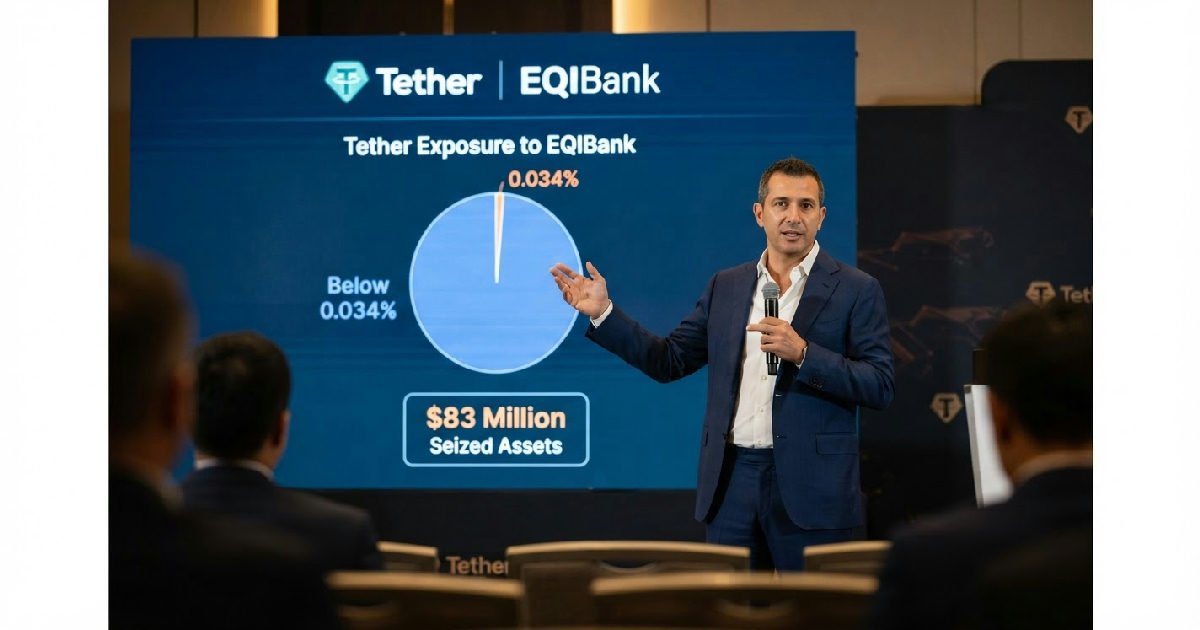
In a statement on September 26, 2026, the company announced its financial exposure to the offshore institution, EQIBank, represents less than 0.034% of Tether’s total group assets.
Sizing the seizure and Tether’s EQIBank exposure
The core of the issue lies with Capstone Limited, an intermediary firm that enabled EQIBank to process transactions through the US banking system. Court filings revealed that authorities are targeting approximately $83 million held in bank accounts and an additional 1.18 million USDT from cryptocurrency addresses associated with Capstone. EQIBank itself has reported the total affected sum to be around $89 million.
Tether has not disclosed the exact dollar value of its holdings with EQIBank. However, based on its most recent attestation report showing a total asset base of roughly $187.75 billion, the stated exposure of less than 0.034% would cap the potential loss at a maximum of approximately $64 million. This figure, while substantial, is a fraction of the company’s overall financial might.
The company confirmed its use of EQIBank for services related to USDT purchases and redemptions. This is a standard operational practice for managing fiat currency flows that underpin the stablecoin.
The incident serves as a reminder of the operational complexities and third-party risks inherent in the digital asset space.
For its part, EQIBank has warned that the seizure of the $89 million, which it uses to process customer transactions, could place significant pressure on its ability to continue operating. The bank’s viability is now in question, highlighting the cascading effects that enforcement actions against a single processor can have on connected financial entities.
A clear line between Tether and the investigation
In its communication, Tether was unequivocal in stating it had no knowledge of the alleged misconduct by Capstone that prompted the US government’s action. The stablecoin issuer has not been named in the legal proceedings, and there has been no finding by any court or authority that Tether participated in or was aware of the activities under investigation.
This careful positioning is critical for Tether, a company that has operated under intense scrutiny for years regarding the composition and transparency of its reserves. By immediately clarifying its limited exposure and lack of involvement, Tether aims to prevent the issue from spiraling into a wider crisis of confidence in USDT, which acts as a cornerstone of liquidity in the crypto market.
The firm’s swift response underscores a hard-learned lesson in the crypto industry: perception and trust are paramount. Any hint of instability or association with illicit activities can trigger market panic. Tether’s statement is a proactive attempt to control the narrative and separate its operations from the troubles of its third-party service providers.
The web of traditional finance dependencies
The EQIBank situation casts a bright light on a fundamental reality of the stablecoin ecosystem. While tokens like USDT can be transferred peer-to-peer across global blockchains in seconds, the reserves backing them remain deeply enmeshed in the traditional financial system. This creates a persistent layer of counterparty risk that blockchain technology alone cannot eliminate.
This reliance creates an unavoidable friction point between the decentralized world of crypto and the centralized, heavily regulated world of banking.
Even as institutional interest grows, the plumbing that connects the two systems remains vulnerable. The seizure related to EQIBank’s processor is a textbook example of this legacy financial risk impacting a digital asset’s operational framework.
USDT moves across public blockchains, but the reserves and fiat flows behind the token still interact with banks, custodians, payment processors and other conventional financial institutions. The broader financial sector is also seeing new forms of crypto integration, for example, with asset tokenization funds emerging to bridge these worlds.
That creates counterparty risk even when the token itself operates normally.
Tether has spent years diversifying its reserve portfolio and banking relationships, with much of its asset base now concentrated in highly liquid instruments including U.S. Treasury bills.
The company’s stated EQIBank exposure is small relative to its overall balance sheet.
But the situation shows why the quality and legal position of banking partners still matter to stablecoin issuers.
A token can settle globally in seconds. The dollars behind it still have to move through a financial system where accounts can be frozen, intermediaries can fail and courts can seize assets.
For Tether, the immediate message is that the exposure is limited.
For the wider stablecoin market, it is another reminder that blockchain settlement does not eliminate traditional financial counterparty risk.
Tether’s ongoing mission to de-risk its reserves
This incident finds Tether in a much stronger position than it was just a few years ago. In response to long-standing criticism about its reserve composition, the company has made a concerted effort to shift its holdings towards safer, more liquid assets. The bulk of its portfolio now consists of U.S. Treasury bills, widely considered one of the safest assets globally.
This strategic pivot was designed to mitigate risks exactly like the one presented by the EQIBank situation. By diversifying its banking partners and concentrating its reserves in highly liquid government debt, Tether has reduced its dependency on any single, smaller financial institution. The company can now credibly argue that the potential failure of one offshore bank would not threaten the stability of USDT.
The move towards greater transparency and higher-quality reserves has been a central theme for Tether’s management.
The company provides details on its reserves, including its latest reported asset base, aiming to build confidence and answer critics. This ongoing effort to professionalize its operations provides crucial context for its current statement, lending weight to its claim that the EQIBank exposure is not a systemic threat.
The broader implications for stablecoin issuers
The fallout from the Capstone seizure will be closely watched by other stablecoin issuers and regulators. It highlights the critical importance of due diligence on all third-party financial partners, particularly those involved in payment processing and correspondent banking. Regulators are increasingly focused on the on-ramps and off-ramps where crypto intersects with the traditional financial system.
For the wider market, it’s another lesson that the stability of a stablecoin depends not only on its on-chain performance. It also relies on the legal and financial soundness of its banking and processing network.
As the industry evolves, there’s a growing focus on future-proofing blockchain transactions and the infrastructure that supports them against all forms of risk, both digital and traditional.
Ultimately, while Tether appears to have successfully ring-fenced its risk in this instance, the event is a sober reminder for all crypto participants. The bridge to the fiat world is essential for growth, but it is guarded by traditional gatekeepers and subject to conventional rules and risks. Navigating this hybrid financial landscape remains one of the industry’s greatest challenges.