

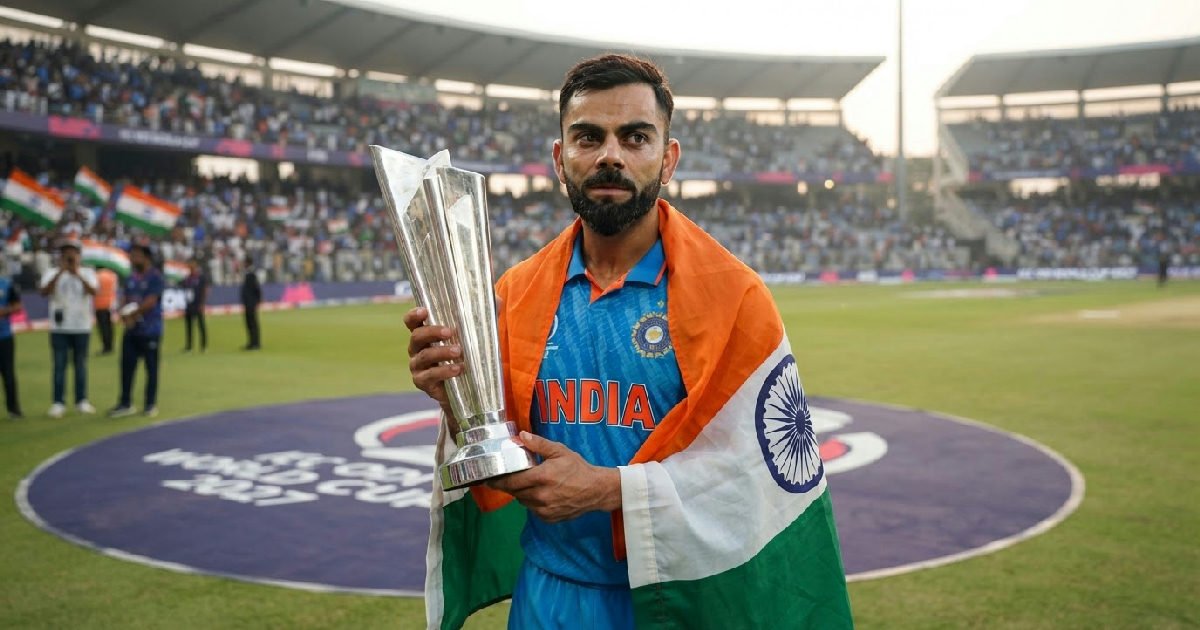
virat kohli confirms 2027 world cup is his last
Virat Kohli 2027 World Cup: final white ball chapter
Virat Kohli confirmed on Saturday, September 26, 2026, that the 2027 ODI World Cup will be his last for India. The 37-year-old star shared his motivation during an interview with JioStar, confirming his full focus is now on securing the title in what will be challenging foreign conditions.
His declaration provides a clear timeline for the end of his One Day International (ODI) career, following previous high-profile retirements from the other two formats. Kohli has already retired from T20 International cricket, a decision he made after India’s T20 World Cup triumph in 2024.
He subsequently stepped away from Test cricket in May 2025, narrowing his focus entirely to the 50-over format and the quest for a second 50-over World Cup trophy. The 2027 tournament, set to be co-hosted by South Africa, Zimbabwe, and Namibia, runs from October 4 through November 21, 2027, highlighting key developments in global sport.
Kohli’s reasoning behind continuing was starkly framed by the location and demanding nature of the upcoming tournament. He acknowledged that playing in southern Africa “takes a lot out of you.”
He confirmed this final attempt is now his singular drive, stating, “For me, it’s the last World Cup I’m going to play for India. And that is my motivation.”
The intensity of the 50-over World Cup format
The veteran batsman elaborated on the unique demands of the ODI World Cup, distinguishing it sharply from the pace of T20 cricket. He stressed that the intensity of a 50-over World Cup “is greater than anything” else he has experienced.
Kohli quantified this challenge by comparing the formats, suggesting the tournament requires maintaining a T20-level intensity across 10 games. Crucially, he noted, “you are playing 2.5 T20 games in one day,” referring to the physical and mental stamina required.
Maintaining that level of focus and energy throughout a major tournament is a “big deal,” especially considering the expanded format and competitive landscape of the 2027 edition. This final appearance provides Kohli with a clear target as his career enters its twilight phase.
His uncompromising attitude is clear: “And of course, the goal is absolutely to win the World Cup. And whatever it takes, I’m absolutely ready.” The challenge is compounded by the fact that the tournament will be played away from familiar home conditions.
This quest for a major global title represents a significant ambition in the latter stages of his playing days. For Kohli, streamlining his commitment to a singular goal is a clear strategy for maximum impact in his final global tournament.
Analysis of Virat Kohli’s exceptional tournament record
Kohli carries an exceptional individual record into his final Virat Kohli 2027 World Cup campaign, making him one of the most decorated ODI players globally. Across 37 ODI World Cup matches, he has amassed 1,795 runs, showcasing remarkable consistency.
His tournament batting average stands at an outstanding 59.83, significantly higher than most contemporary players in World Cup history. This record includes five centuries and 12 half-centuries, with a highest score of 117.
In his overall ODI career, the 37-year-old has compiled 14,941 runs across 302 innings, averaging 58.59. He holds a staggering 54 centuries and 79 fifties in the 50-over format, highlighting his dominance over the past decade.
Kohli has appeared in two ODI World Cup finals during his career, experiencing both the pinnacle of success and the sting of defeat. The first was the triumphant 2011 final, where India defeated Sri Lanka on home soil.
Revisiting past World Cup final outcomes
More recently, Kohli was part of the Indian side that reached the 2023 final, only to be defeated by Australia in a heartbreaking loss. Both of those pivotal matches were held in India, offering home advantage.
The shift to the conditions of southern Africa in 2027 will test the team’s adaptability in a way recent tournaments have not. This change underscores Kohli’s recognition that this effort will demand increased physical output and strategic execution.
Given the 2023 loss, there is an added layer of determination for the senior members of the squad. Kohli’s commitment reflects a hunger to rectify that result and finish his ODI World Cup legacy with a title.
His stated goal of winning the tournament aligns with the mindset of other seasoned competitors who target specific events. Kohli is clearly making this final effort his defining motivation for the World Cup.
The challenge of the 2027 conditions and format
The ICC Men’s Cricket World Cup 2027 presents a significant logistical and cricketing challenge due to its expanded format and complex hosting arrangement. South Africa, Zimbabwe, and Namibia will jointly host the 54 matches.
South Africa will handle the bulk of the schedule, hosting 44 matches across eight established venues, including major grounds like Wanderers Stadium in Johannesburg and Newlands Cricket Ground in Cape Town. Zimbabwe and Namibia will share the remaining 10 matches.
The tournament is expanding to 14 teams, up from 10, utilizing a three-stage format similar to the 2003 edition. This expansion reflects broader trends in sports events, much like other major announcements in the gaming industry.
The top three teams from each group will advance to a Super Six stage, which determines the four semi-finalists. This change ensures a longer, more rigorous tournament structure compared to the straightforward round-robin of the 2023 event.
For India and other non-African teams, adapting quickly to the pitches and climate across three different nations will be key to success. Kohli’s emphasis on “foreign conditions” shows that he is anticipating this specific environmental hurdle.
Logistic scale of the southern Africa tournament
The distribution of matches across three countries adds layers of complexity for team travel, logistics, and crowd management. South Africa’s host venues are well-known international grounds, but the conditions can vary drastically.
In Zimbabwe, cricket officials were pushing to complete the new Mosi-oa-Tunya International Cricket Stadium in Victoria Falls by August 2026 to accommodate matches. Namibia’s capital, Windhoek, is also set to host games, marking a milestone for the country.
The format’s intensity, combined with the extensive travel required, amplifies the demands Kohli highlighted. Teams must manage player workloads effectively through what will be a seven-week-long event.
This geographic spread ensures no single team will feel a dominant “home” advantage, increasing the importance of preparation tours and early success in the group stages. India’s preparation strategy must account for this varied environment.
India’s road map: preparation and current team dynamics
India’s campaign to win the 2027 World Cup has already begun, focusing on assembling a cohesive unit and giving match practice to key players. The team’s focus on the ODI format has been evident in its scheduling.
The current home season started with an ODI series against the West Indies, captained by Shubman Gill, marking a subtle shift in leadership dynamics. Kohli himself was included in the squad for this series.
Throughout the remainder of 2026, India is scheduled to play five ODIs in New Zealand and three against Sri Lanka. Additionally, three ODIs against Zimbabwe are slated for early 2027, providing crucial exposure to African conditions.
This heavy ODI calendar is designed to test depth and finalize the roles of players nearly a year out from the World Cup start date. The team must transition effectively from the dominant era led by Rohit Sharma and Kohli to the next generation.
The decision to split captaincy across formats, with Gill leading ODIs and Tests, and Shreyas Iyer leading T20Is, indicates a clear long-term strategy. This arrangement allows senior players like Kohli to focus purely on performance.
Shubman Gill’s emerging leadership role
Shubman Gill’s rise to captaincy signifies a strategic handover of leadership responsibility. The young opener now shoulders the burden of guiding the team through qualification and preparation for the flagship tournament.
Having a senior statesman like Kohli committed solely as a batsman will be invaluable for the new skipper. Kohli offers unparalleled experience in World Cup campaigns and a proven ability to perform under extreme pressure.
Gill and coach Gautam Gambhir will be tasked with blending Kohli’s veteran presence with a vibrant, younger core that has seen recent success. India secured the ICC Champions Trophy in 2025, maintaining its position as a global white-ball powerhouse.
For Kohli, playing under a different captain in a major tournament after years of leading the side requires a transition in perspective. His commitment to “leave everything out there” confirms his willingness to adapt to this support role.
A final push for a defining legacy
Virat Kohli’s career trajectory is now entirely defined by his performance leading up to and during the 2027 tournament. His intentional step back from Test and T20I cricket suggests a desire to conserve energy and peak for this final challenge.
At 37 years old, the physical toll of competitive cricket remains immense, particularly in multi-stage, intercontinental tournaments. His selective focus maximizes his chances of contributing significantly to India’s run.
Winning the 2027 World Cup in foreign conditions would solidify an already legendary status, providing a perfect bookend to his ODI career that began with the 2011 victory. It’s a pursuit of closure, driven by the memory of the 2023 final loss.
The sheer volume of his records—including 54 ODI centuries and a staggering average—means his legacy is secure regardless of the outcome. Yet, this final, vocal commitment to the team goal adds an element of drama and high expectation.
For India’s cricket fans, the announcement transforms the 2027 tournament into a deeply personal mission to support one of their greatest heroes in his final global tournament. The pressure on the entire squad to perform will be immense.
The team management and selectors must now carefully manage Kohli’s workload over the next just over 12 months, ensuring he arrives in South Africa, Zimbabwe, and Namibia fresh and at the top of his game. This final push requires strategic, rather than exhaustive, preparation.
The campaign promises to be one of the most watched narratives in world cricket, centered on whether one of the modern game’s titans can cap his career with the ultimate prize on the world stage. Significant career decisions, such as those that impact personal wealth management, also draw public interest.