

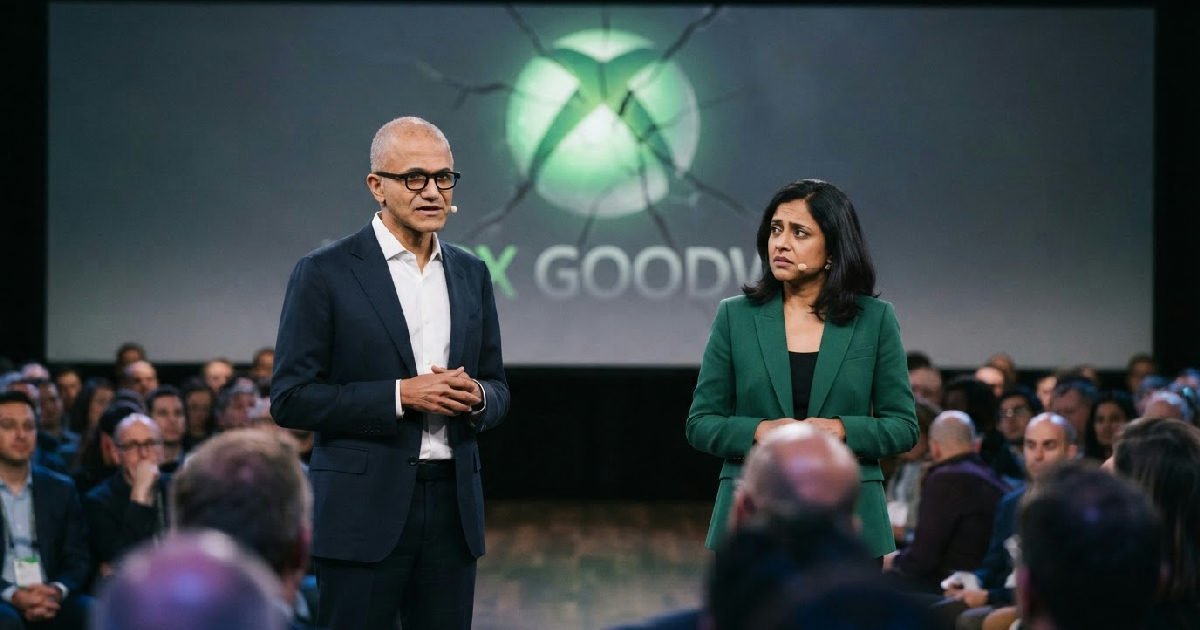
Microsoft’s Strategy Challenges Xbox Goodwill
Microsoft CEO Satya Nadella recently praised the “streamlining” efforts within Xbox, a sentiment that has ignited fresh debate over the company’s strategic direction and its impact on long-standing Xbox goodwill. His remarks on September 25, 2026, followed yet another round of significant layoffs just days prior, underscoring a period of profound transformation for the gaming division.
This restructuring includes widespread job cuts, a controversial push into multiplatform game releases, and continuous adjustments to the Game Pass subscription service. For many players, these shifts represent a stark departure from the Xbox brand they once knew.
Microsoft’s Latest Moves Challenge Xbox Goodwill
Satya Nadella’s public endorsement of Xbox CEO Asha Sharma’s actions comes after Microsoft announced an additional 268 job cuts on September 22, 2026. These latest reductions impacted employees across Halo Studios, other first-party studios, and Xbox Game Studios management.
The company also unveiled a significant internal reorganisation. It involves Activision overseeing the development of the next Halo title and Bethesda absorbing Obsidian Entertainment. These decisions have prompted widespread discussion among the gaming community and industry analysts alike.
A Turbulent Timeline for Xbox Strategy
The current period of change is not an isolated incident but rather the culmination of a series of strategic decisions made over the past two years. This turbulent timeline began in early 2024, setting a new course for Microsoft’s gaming ambitions.
Xbox’s trajectory has been marked by a clear pivot towards what leadership describes as a “sustainable business model.” This has often come at the expense of established operational norms and, some argue, traditional gamer expectations.
Initial Layoffs and Multiplatform Pivot
The initial wave of significant changes began on January 25, 2024, when Microsoft laid off approximately 1,900 employees across its gaming division. This reduction impacted teams from Activision Blizzard, Xbox, and ZeniMax, representing about 8% of the total 22,000-person gaming workforce.
Just weeks later, on February 15, 2024, Microsoft made a pivotal announcement: select Xbox-exclusive games would be coming to rival consoles. This included titles such as Pentiment, Grounded (for PS4, PS5, and Nintendo Switch), Hi-Fi Rush, and Sea of Thieves (for PS5), a move driven by a stated “revenue opportunity.”
Future multiplatform titles are also in the pipeline. Games like Indiana Jones and the Great Circle, Doom: The Dark Ages, and The Outer Worlds 2 are slated for launch on PlayStation 5. Microsoft CEO Satya Nadella reinforced this multiplatform strategy in December 2024, emphasizing a vision where players could “enjoy Xbox on all their devices” and experience “that joy of gaming everywhere.”
Game Pass Evolution and Pricing Shifts
Xbox Game Pass, once a cornerstone of the console’s value proposition, has also seen considerable changes. On July 10, 2024, price increases and tier redefinitions were announced.
Game Pass Ultimate saw its price climb from $17 to $20 per month, while Game Pass Core’s yearly cost rose from $60 to $75. A new “Standard” tier was introduced at $15 monthly, but crucially, it excluded day-one releases, EA Play, PC Game Pass, and cloud gaming.
Further adjustments came on October 1, 2025, with a revamped three-tier structure: Essential (formerly Core), Premium (formerly Standard), and Ultimate. The Ultimate tier price was again raised to $30 per month, with day-one releases becoming exclusive to this top tier. Microsoft justified these increases by promising more games and new service offerings.
However, on April 21, 2026, a price reduction for Game Pass Ultimate and PC Game Pass was announced. This coincided with the controversial removal of day-one availability for future Call of Duty titles, which would now be added about a year later.
Adding to the changes, November 2026 will see access to Xbox Cloud Gaming become limited across all tiers, ranging from 5 to 15 hours per month, with additional hours requiring purchase.
Mobile Store Ambitions Falter
Another significant, albeit less successful, venture was the planned Xbox Mobile Store. Xbox President Sarah Bond announced in May 2024 that a mobile store would debut in July 2024, initially featuring first-party titles such as Candy Crush and Minecraft.
But by April 22, 2026, these ambitions appeared to have stalled. Test URLs for the Xbox Mobile Store were returning 404 errors, suggesting the project was defunct. This marked a notable setback in Microsoft’s strategy to expand its gaming ecosystem beyond traditional consoles and PCs.
Studio Shake-Ups and Creative Control
The recent September 22, 2026, layoffs were accompanied by a sweeping reorganization of Xbox’s studio landscape. This move has fundamentally altered the creative structures and future Halo title development pathways.
Activision, part of the wider Microsoft Gaming family, is now set to oversee the development of the next Halo title. The long-standing Halo Studios will instead concentrate on existing titles within the franchise. This is a significant shift for one of Xbox’s most iconic series.
Bethesda’s influence is also expanding, with Obsidian Entertainment now falling under its remit. Obsidian will continue its current projects, including Grounded, and develop a new Fallout title in collaboration with Bethesda Game Studios. This integration aims to streamline development and leverage shared expertise.
Further consolidating resources, Playground Games and Turn 10 Studios will merge into a single entity. Their combined focus will be on the highly successful Forza and Fable franchises. Meanwhile, video game developer King, best known for Candy Crush, will absorb Microsoft Casual Games, centralising casual gaming efforts.
The internal memo detailing these changes also reportedly indicated ongoing or failed attempts to sell Ninja Theory and Arkane Lyon. These reports highlight a broader effort to divest or restructure studios that may not align with Microsoft’s evolving strategic priorities.
Nadella’s Vision: “Sustainable Business” Over Subsidization
At the heart of Microsoft’s aggressive restructuring lies Satya Nadella’s unwavering focus on creating a “sustainable business” for Xbox. Speaking on June 12, 2026, Nadella articulated his belief that Microsoft had been “subsidizing” Xbox entertainment rather than monetizing it effectively, a situation he clearly intends to rectify.
Xbox CEO Asha Sharma echoed this sentiment in August 2026, pointing to a “hardware component crisis” as a contributing factor. Sharma noted that console storage component prices had increased over fivefold from two years prior by Holiday 2026. This adds pressure for greater financial efficiency across the board.
Nadella further questioned Western consumers’ skepticism towards artificial intelligence, contrasting it with optimism in other regions like Nigeria. He argued that the industry needs to “earn the trust” of consumers by demonstrating tangible benefits, rather than merely “celebrating technology for technology’s sake.” This perspective subtly links the company’s broader AI strategy with its gaming division’s financial recalibration.
Industry Reaction and the Path Forward
The reaction from industry experts and the gaming public has been mixed, with many expressing concern over the implications for brand loyalty and creativity. Prominent AI skeptic Ed Zitron, for instance, attributed Xbox’s precarious position to “catastrophic mismanagement” by Microsoft, suggesting that ambitious AI gambits had failed to pay off.
This critical assessment reflects a growing unease within segments of the gaming community. They question whether the drive for profitability and cross-platform ubiquity might dilute the unique identity and appeal of the Xbox ecosystem. The continuous layoffs, particularly, have cast a shadow over employee morale and future innovation.
As Xbox navigates these profound changes, the challenge will be to balance financial sustainability with maintaining a compelling value proposition for its dedicated fanbase. The push for multiplatform titles could expand reach, but it risks alienating those who invested in the Xbox ecosystem for its exclusivity.
The success of this new strategy will ultimately depend on whether Microsoft can rebuild consumer trust and deliver innovative gaming experiences in a reshaped landscape.