

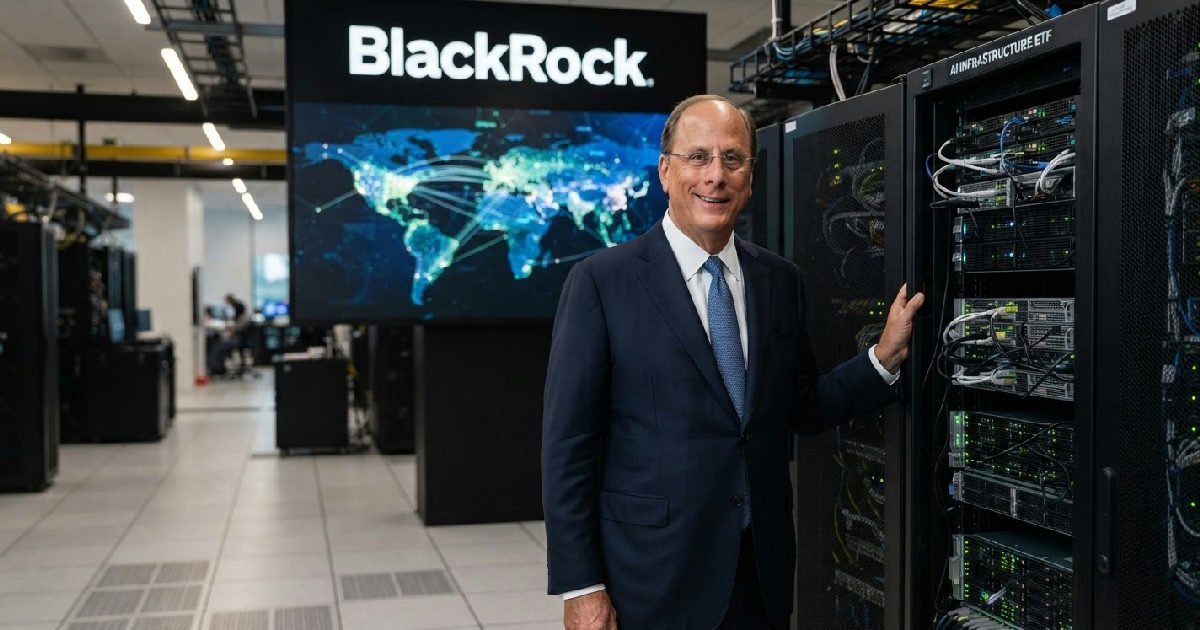
BlackRock’s AI infrastructure partnership launches new ETF
BlackRock, the world’s largest asset manager, is significantly pivoting its artificial intelligence (AI) investment strategy, moving beyond the traditional tech pioneers to focus on the foundational infrastructure and broader ecosystem driving AI’s explosive growth. This strategic shift is exemplified by their new Infrastructure Partnership.
This strategic shift is underscored by the launch of a new exchange-traded fund and a substantial partnership aimed at developing critical AI infrastructure globally. The move signals a maturing AI market where the underlying physical assets are becoming as crucial as the innovative software.
Investing in AI’s Physical Foundation
The firm’s evolving approach reflects a recognition that while the AI frenzy on Wall Street remains intense, the most compelling opportunities now lie in companies that both benefit from and enable the technology. Investors are increasingly looking past the “Magnificent 7” tech giants, instead seeking value in sectors like utilities, industrials, energy, and data centers.
This broader perspective on BlackRock AI investments highlights the massive capital outlays required to sustain AI’s expansion.
At the heart of BlackRock’s revised strategy is a profound commitment to the physical infrastructure essential for AI. The firm is increasingly directing its capital towards what it terms “AI-adjacent” opportunities. This encompasses vital sectors such as energy providers, robust industrial companies, and the real estate market for data centers, along with advanced semiconductor manufacturers beyond just the graphic processing unit (GPU) producers.
This approach isn’t merely theoretical; it’s backed by concrete actions. BlackRock is helping to spearhead initiatives that funnel billions into tangible assets. The sheer scale of computing power demanded by advanced AI models necessitates an unprecedented buildout of data centers and the energy grids to power them, creating a new frontier for investment.
The AI Infrastructure Partnership’s Genesis
A pivotal development in this infrastructure push was the formation of the Global AI Infrastructure Investment Partnership (GAIIP), later renamed the AI Infrastructure Partnership (AIP). Launched on September 17, 2024, the AIP brought together BlackRock, Global Infrastructure Partners (GIP), Microsoft, and MGX, an AI investment company established by Mubadala Investment Co.
The partnership’s explicit goal is to invest heavily in new and expanded data centers and the necessary energy infrastructure. This collaborative effort aims to meet the escalating demand for computing power, which is the lifeblood of artificial intelligence. It’s a recognition that the “AI buildout” is as much about concrete and cabling as it is about algorithms and software.
Strategic Acquisitions and Expansion
The AIP quickly moved to execute its vision, making its first significant investment in October 2025. The partnership, alongside GIP and MGX, agreed to acquire Aligned Data Centers in a monumental $40 billion deal. Aligned Data Centers currently boasts over 6.4 gigawatts of operational and planned data center capacity, making it a critical asset in the expanding AI landscape.
This acquisition is just the beginning. The AIP initially aimed to unlock $30 billion in private equity capital, with the potential to mobilize an astounding $100 billion in total investment when debt financing is included. Further solidifying its technological and financial prowess, NVIDIA and xAI joined the AIP on March 19, 2025.
Additionally, GE Vernova and NextEra Energy have agreed to collaborate with the AIP to accelerate critical energy solutions for these energy-intensive data centers, with further investment from entities like Kuwait Investment Authority and Singapore’s Temasek Holdings Pte.
Shifting Investor Sentiment and New Offerings
The evolution of BlackRock’s AI strategy mirrors a broader shift in investor sentiment across global markets. There’s a growing understanding that the most lucrative opportunities are no longer solely with the companies at the technological forefront of AI development.
Instead, the focus is broadening to include those businesses and industries that adeptly adopt and deploy AI, as well as the essential suppliers of components, power, and infrastructure. This nuanced perspective is reshaping how asset managers and their clients approach the artificial intelligence theme, emphasizing a more diversified and resilient investment thesis.
The iShares Future AI Beneficiaries ETF
Responding to this evolving market dynamic, BlackRock officially launched the iShares Future AI Beneficiaries ETF (AIBF) on September 23, 2026. This innovative exchange-traded fund specifically targets companies that *use* artificial intelligence rather than those primarily engaged in *building* it. The ETF aims to capture value from businesses that effectively integrate AI across diverse sectors, including healthcare, finance, logistics, and various industrial applications.
With a net expense ratio of 0.40%, the AIBF provides investors with a targeted way to gain exposure to the widespread economic impact of AI adoption. It represents a direct response to the market’s demand for investment vehicles that go beyond the initial wave of AI pioneers, focusing instead on the broader economic beneficiaries.
Beyond Traditional Tech
The latest “Investment Directions” report from BlackRock, compiled from interviews with over 700 EMEA clients, confirms this shift. Only a fifth of those polled considered large US technology firms a compelling investment for the coming year. In stark contrast, 54% identified energy providers as a stronger opportunity, while 37% pointed to energy infrastructure as offering more attractive returns.
BlackRock analysts emphasized this rotating market leadership in their Autumn Investment Directions report. “The volatility of, and dispersion within, AI-related exposures call for deliberate and intentional allocations in and around the AI stack,” they noted, suggesting that a more nuanced approach is required to navigate the complexities of the burgeoning AI economy.
Ibrahim Kanan, BlackRock’s U.S. Head of Core US Equity, reinforced this, stating, “It’s increasingly important to risk-manage megacap and AI exposure while also capturing differentiated upside opportunities.”
The Intersection of AI and Digital Assets
BlackRock’s forward-looking analysis also delves into the fascinating convergence of artificial intelligence and digital assets, proposing that blockchain technology will play an integral role in the future AI agent economy. The firm’s recent white paper on AI and digital assets outlines how the proliferation of autonomous AI agents will necessitate financial payment networks capable of supporting seamless machine-to-machine transactions.
This perspective suggests a profound transformation in financial infrastructure, where automated systems handle an increasing volume of payments. It’s a vision of an economy where AI agents not only perform tasks but also manage their own financial transactions, creating new demands on existing payment systems.
Blockchain as a Payments Network
The rise of AI-driven transactions is expected to significantly boost the adoption of stablecoins, particularly for machine-to-machine payments. Stablecoins, pegged to traditional currencies, offer the stability needed for these automated financial exchanges and leverage blockchain networks designed for continuous, high-volume transactions. BlackRock estimates that adjusted stablecoin transaction volume could reach $11.2 trillion in 2025, reflecting an 80% compound annual growth rate from 2020.
Larry Fink, Chairman and CEO of BlackRock, has spoken about the immense potential of AI to transform the global economy. “AI has the potential to transform the global economy if we can build the necessary infrastructure to support it,” Fink stated, underscoring the interconnectedness of technological advancement and its financial underpinnings.
The firm believes that blockchain, with its inherent programmability and security, is uniquely positioned to become the core payments network for this emerging economy.
Tokenized Computing Capacity
Beyond payments, BlackRock also identifies the long-term potential for tokenized financial assets, specifically tokenized claims on computing capacity. These digital tokens could be traded on secondary markets or utilized as collateral within various digital asset ecosystems, creating new financial instruments tied directly to the computational resources driving AI.
This innovative concept envisions a marketplace where access to processing power, a critical resource for AI development and deployment, can be bought, sold, and leveraged efficiently. It underscores the firm’s holistic view of the AI economy, encompassing not just the financial aspects but also the fundamental resources that fuel innovation. Jay Jacobs, BlackRock’s U.S.
Head of Equity ETFs, confirmed on September 20, 2026, that Bitcoin’s diversification case remains intact, even as AI opportunities broaden beyond traditional tech sectors.
Broader Economic Implications and Outlook
The sheer scale of investment required to support the AI revolution is staggering, with BlackRock forecasting expenditures that could rival industrial revolutions of the past. The firm’s strategic repositioning reflects a deep understanding of these economic seismic shifts. This isn’t just about technological advancement; it’s about fundamental changes to global economic structures and energy demands.
As AI permeates every industry, the demand for robust, scalable infrastructure will only intensify. This creates a fertile ground for investors willing to look beyond the immediate innovators and instead invest in the backbone of the AI-powered future. BlackRock’s moves provide a compelling blueprint for navigating this evolving landscape.
Unprecedented Investment Scale
BlackRock estimates that cumulative investment in AI infrastructure could exceed an astonishing $5 trillion between 2025 and 2030. This includes annual investments in data centers and AI chips alone, which could surpass $700 billion each year by 2030. Such figures represent more than 2% of the U.S. GDP annually, highlighting the transformative economic impact.
Larry Fink articulated this massive financial undertaking: “Mobilizing private capital to build AI infrastructure like data centers and power will unlock a multi-trillion-dollar long-term investment opportunity.”
Brad Smith, Vice Chair and President of Microsoft, echoed this sentiment, noting, “The capital spending needed for AI infrastructure and the new energy to power it goes beyond what any single company or government can finance. This financial partnership will not only help advance technology, but enhance national competitiveness, security, and economic prosperity.”
Strategic Risk Management in the AI Era
With such significant capital flowing into the AI sector, BlackRock is also emphasizing the importance of strategic risk management and intentional asset allocation. The “volatility of, and dispersion within, AI-related exposures” necessitates a thoughtful approach, moving beyond broad exposure to specific, well-researched opportunities.
The firm’s analysts pointed out that a summer sell-off wasn’t due to deteriorating fundamentals, but coincided with an improving earnings backdrop for AI and semiconductor stocks. This suggests that market corrections offer opportunities for discerning investors.
Ahmed Yahia Al Idrissi, CEO of MGX, summarized the broader impact: “Building the necessary infrastructure required to advance and accelerate the adoption of AI will reshape and revitalize almost every aspect of how we live.” This underscores BlackRock’s long-term vision, focusing on the foundational elements that will truly enable the AI revolution.