

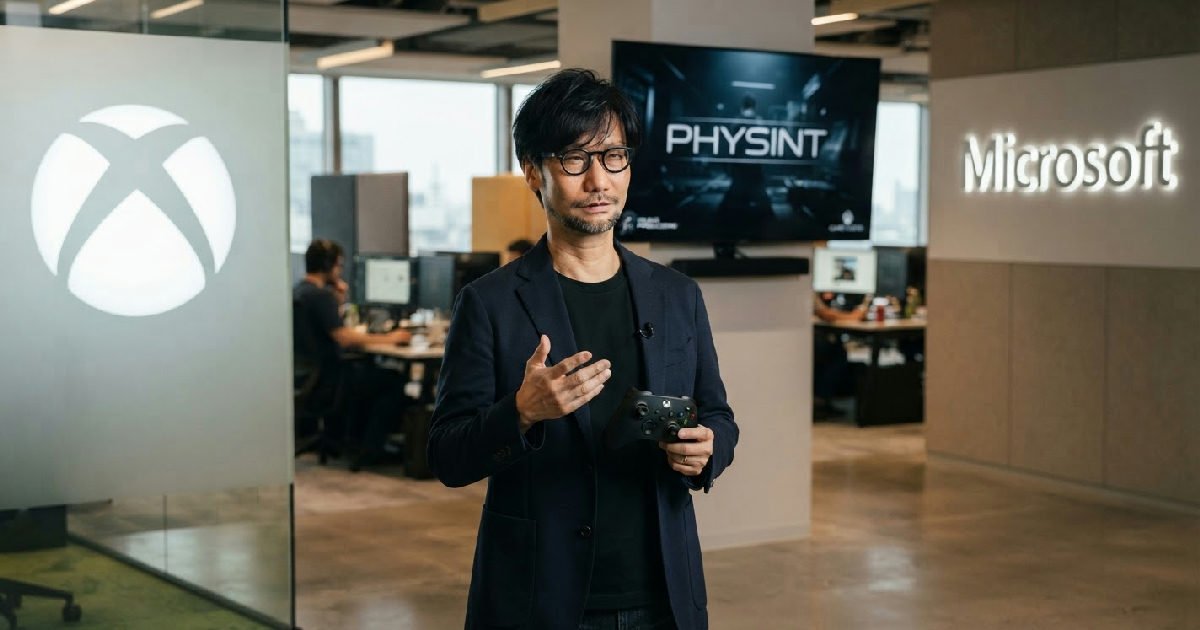
Hideo Kojima Physint Xbox deal followed Sony pullout
Legendary game developer Hideo Kojima has broken his silence on the sudden cancellation of his partnership with Sony for the upcoming title Physint. In an exclusive interview, Kojima revealed that Sony abruptly pulled its funding in a June 2026 Zoom call, a move that left him stunned and fearing for the very survival of his independent studio, Kojima Productions.
The decision forced one of the most significant shifts in modern gaming, with Kojima successfully pitching the beleaguered project to Microsoft. The former PlayStation exclusive is now an Xbox-backed title, with its ultimate fate on Sony’s console remaining uncertain. Kojima detailed the existential threat his company faced and the rapid scramble to find a new partner.
Hideo Kojima Physint Xbox: a stunning decision
The news came without warning. Kojima, accompanied by Kojima Productions president Shinji Hirano and head of talent development Aki Saito, was told bluntly that funding for Physint would end. He recalled his mind going blank, unable to process the finality of the decision from a partner of nearly three decades. Sony reportedly gave no specific reason for its withdrawal during the meeting.
For an independent studio like Kojima Productions, which operates on a project-by-project basis, losing one of its two major contracts was potentially catastrophic. “I thought I might have to cut all the people working on Physint,” Kojima explained, voicing his concern for his roughly 200 employees.
“Or our studio could end up collapsing because we’ll run out of cashflow.” The situation was a stark reminder of the volatility surrounding modern platform exclusives and publishing deals.
The immediate worry was the financial stability of the studio, which had taken out bank loans to expand its staff for the ambitious project. Kojima also expressed concern about a repeat of the infamous cancellation of P.T., and the impact on actors he had already begun scanning for Physint.
The project was deeply personal, timed to mark his studio’s 10th anniversary and his 40th year in game development.
The pivot to a new kind of pitch
Determined not to let the project die, Kojima kept the news from his wider staff for several days. He and his senior team immediately began exploring alternatives, deciding against a traditional game pitch. Instead, they formulated a more ambitious proposal: the creation of a massive new intellectual property (IP) that would span games, movies, anime, music, and more from the outset.
“I thought that the way to go was to say, ‘I’m making this new IP, and I want to consider everything,’” Kojima stated. He began approaching a wide range of companies, including movie studios and streaming giants, believing the lines between digital entertainment industries were blurring. The response was positive, but Kojima knew he needed more than just money; he required technical and marketing support.
The search ultimately led him to Xbox. Having already established a relationship with Microsoft for his other title, OD, Kojima found a receptive audience in new Xbox boss Asha Sharma. He said Xbox understood his grander vision. “They’re not thinking of just funding a game,” Kojima said. “It’s more about the IP.”
This aligned with Microsoft’s apparent strategy to build franchises with broad media reach, an approach that has long defined celebrated legacy IP like Nintendo’s Mario.
Inside the studio during the turmoil
After securing a path forward, Kojima informed the Physint team leaders. While some staff were temporarily moved to the OD project to manage resources, he was relieved and surprised by the team’s resilience. Rather than becoming demoralized, he found them “happily creating” materials for the new pitch to Xbox.
Kojima proudly noted that despite his fears, not a single employee left the company during the upheaval.
Crucially, development on the game never truly stopped. Kojima confirmed he continues to work on the core concepts, casting, and technological experiments daily. While having the full team would have been faster, a smaller group maintained momentum on key systems while others contributed to OD.
He remains undecided on the game engine, noting he is eager to explore the “cutting-edge technology” available at Microsoft’s research labs.
Unanswered questions and the future of Physint
While Kojima expressed no anger towards Sony, he conveyed disappointment with how the end of their long relationship was handled. The Physint project had begun with a handshake agreement with former SIE CEO Jim Ryan, making the abrupt termination even more jarring. “If this was the conclusion, I would’ve wanted to hear it a little earlier,” Kojima reflected.
Since the cancellation, reports have speculated on Sony’s reasoning, suggesting concerns over Death Stranding’s commercial performance and Physint’s budget and timeline. Kojima Productions issued a formal statement dismissing these claims as “unsubstantiated speculation,” reassuring fans the studio is in a “healthy, profitable state” and that its relationship with PlayStation “remains strong.”
Yet, the question of whether Physint will ever appear on a PlayStation console is now in Microsoft’s hands.
Kojima himself couldn’t give a definitive answer, leaving the decision to Xbox. The industry now watches to see how this will play out, with the developer focused on his transmedia vision for the IP. His goal is to shorten the pipeline between game and film, using digital assets across both mediums.
This type of long-term strategic planning is becoming more common as gaming IPs prove their immense value in mainstream entertainment.
A new espionage-action legacy
The idea for Physint, a spiritual successor to his iconic Metal Gear Solid series, came from overwhelming fan demand. Though initially reluctant to return to the espionage genre, Kojima felt a pull to create a new entry for the fans, especially as he contemplated his own legacy.
“I saw so many people requesting it,” he said. “Of course, I can’t make Metal Gear — that’s Konami’s IP. But I was thinking, ‘Okay, maybe I should create a new action espionage game.’”
Now backed by a new partner, Kojima’s determination appears stronger than ever. He sees the survival of Kojima Productions as a crucial test case for independent creators in an industry consolidating around major publishers. By saving Physint from cancellation, he hopes to prove that an independent studio can not only survive a major setback but also thrive by building the next great entertainment franchise.